Minister Lee Sang-min of the Ministry of the Interior and Safety Visits Gyeongbuk Regional Public Medical Institution
"Emergency Medical Measures to Prevent Healthcare Gaps Will Be Implemented Without Delay"
Government Raises Alert to 'Severe'... Public Medical Institution Operation at Maximum Level
Minister of the Interior and Safety Lee Sang-min visited local medical sites on the 23rd to inspect the emergency medical system and encourage on-site medical staff. On the same day, the government raised the health and medical disaster crisis alert level from 'Warning' to 'Severe' and discussed a whole-of-government response plan.
In the afternoon, Minister Lee visited Gimcheon Medical Center to check Gyeongsangbuk-do's emergency medical system related to the doctors' collective action and to listen to the difficulties faced by on-site medical staff. This visit was made to directly confirm the local government's medical preparation status following the medical community's collective actions, such as the submission of resignation letters by residents, after the government's announcement of plans to increase medical school quotas.
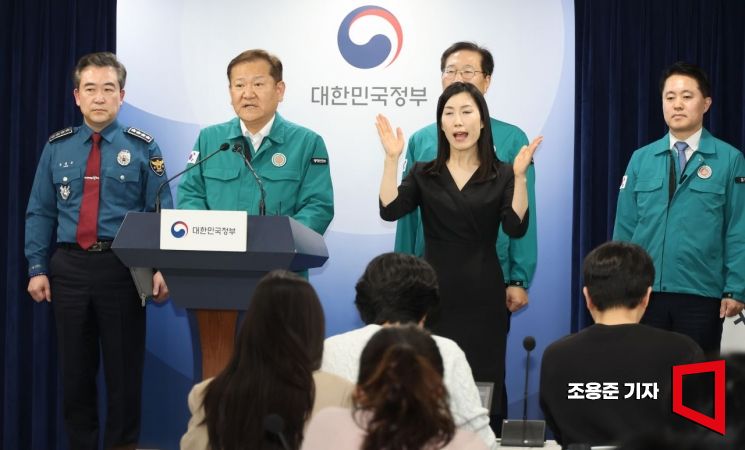 On the 21st, amid growing concerns over a medical crisis due to the collective departure of residents, Lee Sang-min, Minister of the Ministry of the Interior and Safety, made remarks regarding the medical community's collective action at the Government Seoul Office in Jongno-gu, Seoul. The joint briefing was attended by Park Seong-jae, Minister of Justice, Yoon Hee-geun, Commissioner of the National Police Agency, and Shin Ja-yong, Deputy Prosecutor General. Photo by Jo Yong-jun jun21@
Gimcheon Medical Center is a provincial hospital with a long history of over 100 years since its opening in 1921. It is a regional base public medical institution where about 400 medical staff work to treat diseases and promote health for the residents of the Gyeongbuk area.
Currently, Gyeongsangbuk-do operates nine emergency medical centers, 21 regional emergency medical institutions, and eight emergency medical facilities that provide 24-hour emergency room functions. Within Gyeongsangbuk-do, four provincial and county medical centers and two Red Cross hospitals operate an emergency medical system by organizing and managing specialist on-duty shifts, extending weekday working hours by two hours, normal Saturday work, and emergency duty teams for severe, emergency, and surgical cases to prepare for patient surges. At this occasion, Minister Lee stated, "The role of public medical institutions is more crucial than ever to prevent medical gaps caused by the doctors' collective action," and urged, "Please prioritize the lives and health of the people and ensure the regional emergency medical measures are carried out without fail."
Meanwhile, in response to the medical community's collective actions, including residents, the government raised the health and medical disaster crisis alert to the highest level, 'Severe,' from 8 a.m. on the same day. Accordingly, the operation level of public medical institutions was raised to the maximum. All public medical institutions extended weekday consultation hours to the fullest extent possible and expanded weekend and holiday consultations. The 24-hour emergency room operation system is also maintained. In particular, four new regional emergency situation rooms will be newly opened in early next month to control the transfer and referral of severe and critical patients. The purpose is to intensively manage emergency patients so that they can receive treatment within the golden time.
© The Asia Business Daily(www.asiae.co.kr). All rights reserved.
![Clutching a Stolen Dior Bag, Saying "I Hate Being Poor but Real"... The Grotesque Con of a "Human Knockoff" [Slate]](https://cwcontent.asiae.co.kr/asiaresize/183/2026021902243444107_1771435474.jpg)
















