The Bubble Peak of 1989... The Era of Disco Nightlife
"No Feeling of Prosperity Despite Stock Market Highs" Pessimism Also Present
As the Nikkei index surpassed the bubble economy period from 34 years ago and reached a new all-time high on the previous day (22nd), Japanese media also extensively covered this event. While they delved into the "good old days from 30 years ago" and expressed high expectations for economic recovery, pessimistic views also emerged, intertwined with fears of a bubble burst, suggesting it is still too early to celebrate.
On the 23rd, NHK reported an article reviewing the situation during the peak of the bubble in 1989 when stock prices hit an all-time high. NHK emphasized that it was "a period when both stock prices and land prices surged rapidly, and Japanese companies were buying prestigious American firms, with Japan money dominating the market."
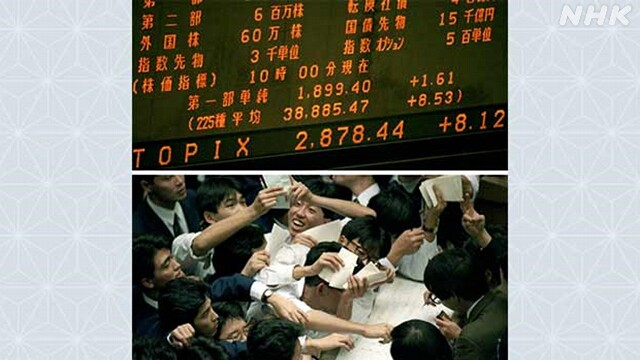
1989 marked the first year of the Heisei era, replacing the Showa era that lasted 60 years in Japan. On May 2, 1989, the market capitalization of some listed companies on the Tokyo Stock Exchange surpassed 500 trillion yen (4426.7143 trillion KRW) for the first time, reaching 501.3664 trillion yen. NHK explained, "As of the end of March, the market capitalization of the New York Stock Exchange was 343.0522 trillion yen (3028.4499 trillion KRW), making the Tokyo market the world's number one by a large margin." On December 29, the Nikkei average stock price reached a record high of 38,915 yen (343,600 KRW). Consequently, Sony acquired the American film company Columbia, and Mitsubishi Estate announced the acquisition of New York's Rockefeller Center, demonstrating the growing power of Japan money.
This led to the start of the Japanese bubble economy, where youth employment was guaranteed, companies paid bonuses four times a year, people went to discos at night, and taxis?now too expensive to even consider?were taken with extra tips.
Drinking and dancing all night... 'Disco Fever' swept across the archipelago
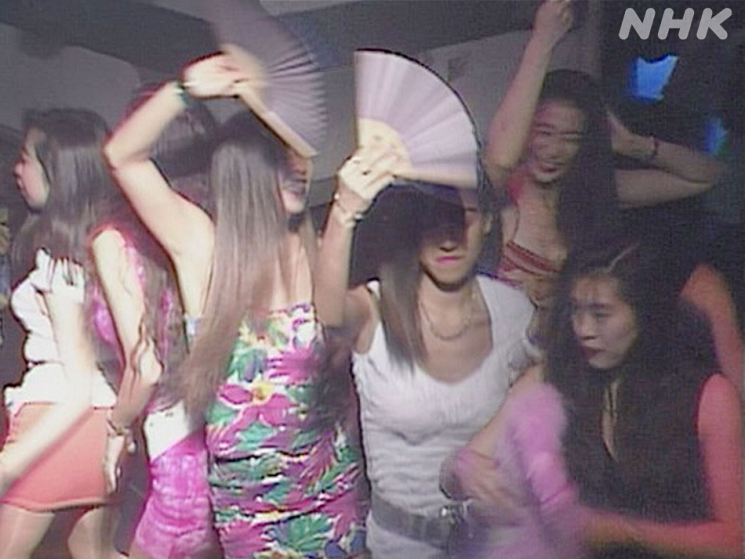
In 2017, Mynavi Newspaper released the results of a survey about memories of the bubble era. The shared memory among young people in their 20s and 30s was the large disco in Tokyo called "Juliana Tokyo." Opened in 1991 and operating until 1994, the venue was large enough to accommodate 2,000 people. On weekends, so many people crowded in that it was impossible to move without bumping into others.
At that time, the "one-length bodycon fashion," referring to tight-fitting dresses, was popular, and women dressed in this style holding fans and dancing excitedly at Juliana Tokyo became a symbolic scene of Tokyo's bubble economy. The dance performances by Japanese high school girls became famous, and the Korean group "Celeb Five" remade "I Want to Be a Celeb," which faithfully recreated the fashion and atmosphere of that era.
Waving 100,000 yen to hail taxis, unlimited company entertainment expenses
Even in Japan, where taxi fares are expensive and taking taxis was considered unaffordable, during the bubble economy, people paid extra to hail taxis. According to Mynavi's survey, a man in his 50s said, "The company gave us taxi vouchers in bundles of 100, allowing us to take taxis freely." Another man in his 50s said, "I waved a 10,000 yen (80,000 KRW) bill to hail a passing taxi." An interview on FNN featured a man in his 60s saying, "I took a taxi to eat ramen. Everyone did that."
There was even a person who commuted daily by taxi paying 10,000 yen, creating an atmosphere where most people used taxis without financial burden. Some respondents said they received 10,000 yen from their boss as a transportation allowance after company dinners. Company entertainment expenses were unlimited, and some said they visited restaurants featured in the media on weekends, spending company money lavishly without anyone raising objections.
Typically, bonuses for office workers were set at twice the monthly salary, and some received bonuses more than four times a year, including settlement bonuses and special bonuses. Some even went overseas for company training. People were enthusiastic about stock and real estate speculation. A 60-year-old man answered that his wife earned tens of thousands of yen daily from stocks, and he went to discos every night because he had plenty of money. Another person said that when a friend bought a house worth 100 million yen (882 million KRW), he received a call the next day offering to buy it for 300 million yen (2.648 billion KRW), and after some consideration, he sold it without moving in.
Youth employment was also easy. Companies distributed cash for interview expenses and entertainment to attract job seekers.
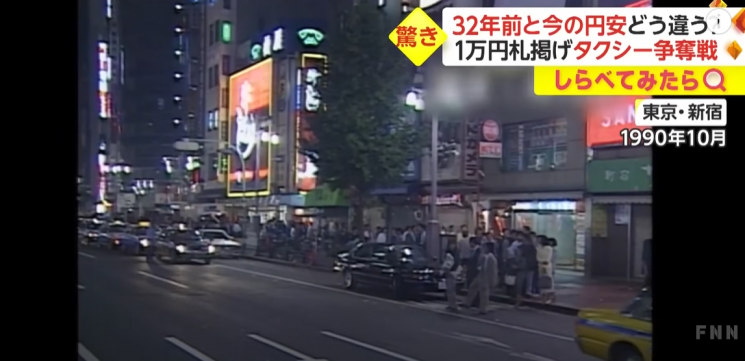 During the bubble economy period in October 1990, people lined up to take taxis in Shinjuku, Tokyo. (Photo by FNN)
The bubble burst abruptly... pessimism remains despite stock recovery
However, the overheated stock and real estate markets began to collapse after the 1990s, compounded by shocks from various incidents such as major earthquakes and the Aum Shinrikyo terrorist attacks. This marked the beginning of Japan's lost 30 years.
Due to the prolonged stagnation, despite the Nikkei reaching an all-time high, the media cannot simply celebrate. Sankei Shimbun pointed out, "Even though the Nikkei index hit an all-time high, it does not feel like the prosperous economy of 34 years ago. Financial inflows into Japan have shifted overseas due to low birthrates, aging population, and globalization of companies, making wage increases more difficult. An economic structure has been established where stock price strength does not directly translate to the economy." It added, "The benefits of the stock price surge are mostly seen by foreign investors. While some wealthy or high-income individuals holding stocks will benefit, it is difficult for ordinary salarymen to gain."
Hideo Kumano, chief economist at Dai-ichi Life Research Institute, also explained, "Currently, domestic company stock prices do not reflect Japan's economic fundamentals. Even if the domestic economy is poor, stock prices rise if overseas profitability improves. This differs from the bubble economy period when Japanese stock prices directly indicated the economy."
© The Asia Business Daily(www.asiae.co.kr). All rights reserved.
![Clutching a Stolen Dior Bag, Saying "I Hate Being Poor but Real"... The Grotesque Con of a "Human Knockoff" [Slate]](https://cwcontent.asiae.co.kr/asiaresize/183/2026021902243444107_1771435474.jpg)


















