Government Raises Health Care Crisis Level to 'Severe'
Emergency System Activated at Municipal Hospitals and Public Health Centers
Emergency Rooms at Medical Centers Operate 24-Hour System to the Maximum Extent
The Seoul Metropolitan Government has stepped up to fill the medical service gaps caused by the prolonged collective action of resident doctors. Following the government's escalation of the health and medical disaster crisis alert to the 'serious' level, emergency medical services have been immediately launched targeting public medical institutions and health centers within the city.
According to Seoul City on the 23rd, from this day forward, municipal hospitals will extend weekday consultation hours until 8 PM, and some hospital emergency rooms will operate on a 24-hour basis.
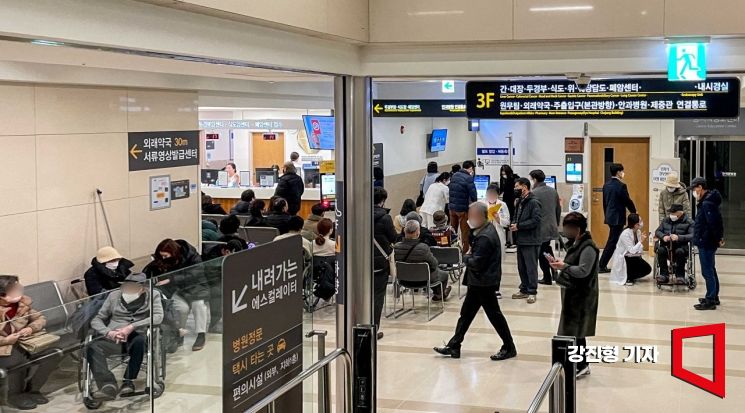 On the 21st, after the resignation letters were submitted and work stoppages continued among residents nationwide, including those at the Big 5 hospitals, visitors waiting for medical treatment were seen at a large hospital in Seoul. Photo by Jinhyung Kang aymsdream@
This measure follows the government's decision to raise the health and medical crisis alert level from 'caution' to 'serious' as of 8 AM on the same day. 'Serious' is the highest of the four alert levels, reflecting the need for stronger responses amid the increasing number of resident doctors leaving their posts and the nationwide doctors' general strike rally being announced. Already, over 8,000 resident doctors have stopped coming to hospitals, and more than 10,000 medical students have collectively applied for leave of absence.
Seoul City plans to minimize medical service gaps primarily through public medical institutions and health centers. First, eight municipal hospitals (Seoul Medical Center, Boramae, Dongbu, Seonam, Seobuk, Eunpyeong, Bukbu, and Children's Hospital) will extend weekday consultation hours. Weekday consultations, previously operating until 6 PM, will be extended until 8 PM, focusing on essential departments such as family medicine, internal medicine, and surgery at each hospital.
Emergency rooms at Seoul Medical Center, Boramae Hospital, Dongbu Hospital, and Seonam Hospital will maintain a 24-hour emergency medical service system, as they are used by citizens in urgent situations, even if some resident doctors resign. In particular, all 25 health centers across Seoul are preparing plans to extend consultation hours to accommodate additional general patients. If private practitioners also join the collective action, consultations will be extended through weekends.
Seoul Mayor Oh Se-hoon visited medical sites for two consecutive days to inspect the emergency medical system and encourage medical staff. Following his visit to Seoul Medical Center on the 21st, he visited Boramae Hospital the previous day to receive a report on emergency medical measures and emphasized, "As public hospitals, Seoul municipal hospitals will do their utmost to minimize medical service gaps by establishing a close transfer system with private hospitals to ensure that severe and emergency patients receive uninterrupted treatment under any circumstances."
The government is also preparing additional measures. At 8:30 AM on the same day, Prime Minister Han Duck-soo chaired a Central Disaster and Safety Countermeasures Headquarters meeting on the doctors' collective action to discuss a comprehensive government response plan. The meeting included related ministries such as the Ministry of Health and Welfare, Ministry of Education, Ministry of Justice, Ministry of the Interior and Safety, and local governments. When the health and medical disaster crisis alert level is raised to 'serious,' the Central Disaster and Safety Countermeasures Headquarters will shift from being chaired by the Minister of Health and Welfare to being chaired by the Prime Minister.
At the meeting, Prime Minister Han stated, "To enable hospitals to hire temporary medical personnel, we have significantly doubled the final treatment fees for severe and emergency patients and relaxed related regulations to allow flexible operation of hospital staff." He also said, "We are assessing the staffing needs of hospitals where essential treatments such as severe and emergency surgeries are delayed and will support public health doctors and military medical officers." Prime Minister Han expressed concern that as of the 22nd, over 8,900 resident doctors have submitted resignation letters, more than 7,800 have left their workplaces, and collective actions by the medical community, including medical students' alliance leave and class boycotts and the Korean Medical Association's large-scale urban rally, have intensified.
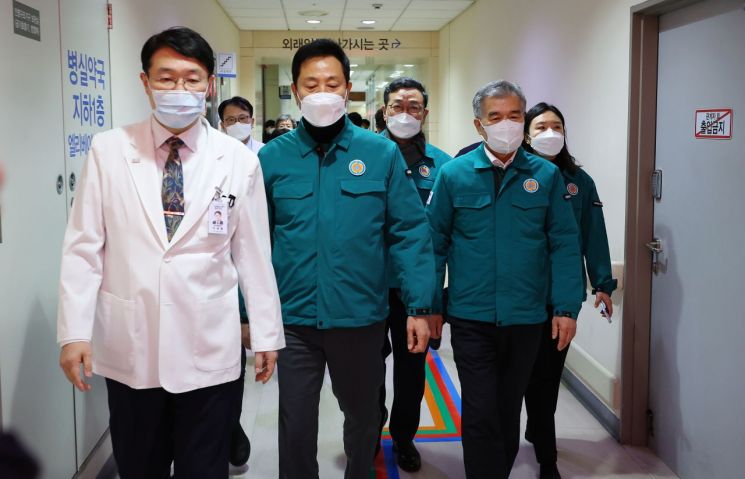 On the 22nd, the third day of the collective action by residents opposing the government's policy to increase medical school quotas, Seoul Mayor Oh Se-hoon visited Boramae Medical Center in Dongjak-gu, Seoul, heading to the emergency medical center to encourage the staff.
 [Photo by Yonhap News]
© The Asia Business Daily(www.asiae.co.kr). All rights reserved.


















