Amendment to Mercury Act Restricting Exports Nears Passage
Trickle-Down Effect Expected for SMEs and Ventures Collaborating with Large Corporations
Active VC Investment Centered on Defense Funds...Vibrant Returns Too
As the revision of the Korea Export-Import Bank Act (KEXIM Act), a long-standing wish of the defense industry, becomes visible, venture capital (VC) investment centered on defense funds is also expected to gain momentum. This is because the export path is opening up, and small and medium-sized enterprises, ventures, and startups that have cooperative relationships with large corporations leading 'K-Defense' are expected to benefit from a 'trickle-down effect.'
In 2022, domestic defense companies such as Hyundai Rotem and Hanwha Aerospace hit the jackpot by signing a weapons export contract worth 20 trillion won with Poland. In the case of weapons transactions, it is industry practice for the exporting country's bank to lend to the importing country, which then pays the price with that money. However, the industry's alarm was raised as the Export-Import Bank of Korea's (KEXIM) 'credit extension limit,' which allows financial support within 40% of the statutory capital (15 trillion won) for the first contract only, was exhausted.
Therefore, the biggest risk and concern in the defense industry recently has been the revision of the KEXIM Act. The main point of the amendment is to increase KEXIM's capital from the current 15 trillion won to 25 trillion won. The amendment, which passed the Economic Subcommittee of the National Assembly's Planning and Finance Committee on the 21st, is now on the verge of being processed in the plenary session on the 29th. Since an agreement was reached in the subcommittee composed of representatives from both ruling and opposition parties, it is expected to pass smoothly.
Professor Kim Ho-sung of Changwon National University's Graduate School of Advanced Defense Engineering said, "The defense industry, like shipbuilding or heavy industry, is a place where large corporations and partner companies are closely connected," adding, "The revision of the KEXIM Act could serve as a primer that allows capital to flow into smaller defense companies as well."
Active Formation of Public-Private 'Defense Funds'
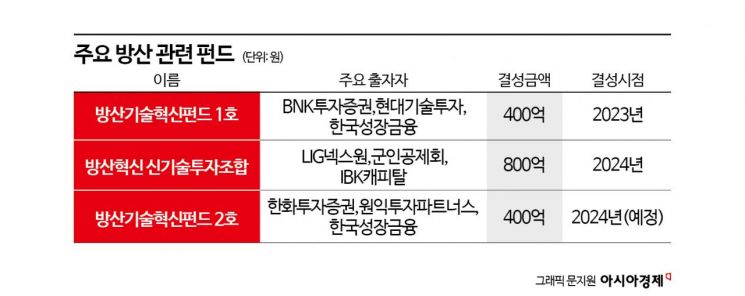
VC investment related to defense has hardly had any presence until now. Even looking at the industry classification by the venture investment information company 'The VC,' defense is not separately categorized. The VC classifies VC investments into 25 major industries such as semiconductors. It is difficult to find other organizations like the Korea VC Association that separately tally defense investments.
However, the situation is changing as K-Defense gains attention recently. The first policy-type fund in the defense sector, the 'Defense Technology Innovation Fund,' led by the Defense Acquisition Program Administration in 2022, acted as a catalyst. The core content is to establish a fund worth 40 billion won annually to invest in defense companies and defense-related venture companies. The first fund, with BNK Investment & Securities, Hyundai Technology Investment, and Korea Growth Finance as contributors, was formed in 2023, and a second fund of the same scale is planned to be created in the first half of this year.
Not only public but also private-led defense funds are emerging. LIG Nex1, the Military Mutual Aid Association, and IBK Capital recently decided to invest a total of 80 billion won in the 'Defense Innovation New Technology Investment Association.' It is a 'blind fund' (a fund that selects investment targets after raising capital) investing in promising defense-related companies.
Defense Stocks Rally... Some Companies Expected to Exit Within a Year
In November last year, the U.S. investment bank (IB) Goldman Sachs said, "Considering the strong position Korean defense stocks hold in the global military market, defense stocks are a good investment destination." In fact, a 'defense stock rally' has been unfolding this year. Hanwha Aerospace, which has broken its all-time high in seven months and continues a record-high rally, and Hyundai Rotem, which surpassed 30,000 won in five months, are representative examples. Both companies share the common benefit of export contracts to Poland for the K9 self-propelled howitzer and K2 tank, respectively.
Most other defense-related listed companies are also on the rise. Thanks to this, VCs that entered defense investments early and succeeded in exits have appeared. TS Investment, which invested 10.4 billion won in COTS Technology, a partner company of Hyundai Rotem, in 2019, is a representative case. COTS Technology succeeded in listing on KOSDAQ in 2023, and TS Investment has already recovered its investment, earning an evaluation profit of more than twice the principal. RF Systems, which was part of the first 'Defense Technology Innovation Fund' portfolio, is also expected to pursue an initial public offering (IPO) within this year, making it possible to exit within one year of investment.
© The Asia Business Daily(www.asiae.co.kr). All rights reserved.
![Clutching a Stolen Dior Bag, Saying "I Hate Being Poor but Real"... The Grotesque Con of a "Human Knockoff" [Slate]](https://cwcontent.asiae.co.kr/asiaresize/183/2026021902243444107_1771435474.jpg)
















