Increase to 55 High-Income Households out of 100 Births
"Middle Class Hesitates to Have Children, Low-Income Starts to Give Up"
South Korea's total fertility rate continues to set a world record low at 0.78, with the phenomenon of poorer households having fewer children intensifying. More than half of the children born come from high-income families, while only one out of ten children is from low-income families. In the research report "Analysis of Fertility Rates by Income Class and Policy Implications," cited in the new book "The Fear of 0.6, Disappearing Korea," Professor Jeong Jae-hoon of the Department of Social Welfare at Seoul Women's University announced on the 22nd that the phenomenon of poorer households having fewer children is worsening.
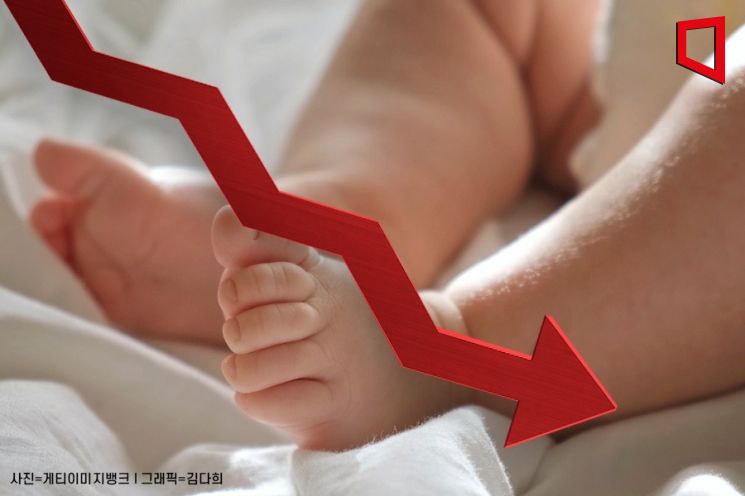 South Korea's total fertility rate continues to hold the world's lowest record at 0.78 children per woman, with the phenomenon of poorer households having fewer children intensifying. More than half of the children born come from high-income families, while only one out of ten children is from low-income families.
 [Photo by Kim Dahee, Asia Economy]
The research team assumed 100 households with children and examined changes in proportions by income brackets?low-income, middle-income, and high-income?from 2010 to 2019. As a result, the proportion of low-income households dropped from 11.2% in 2010 to 8.5% in 2019, a decrease of 2.7 percentage points. This means that out of 100 households with children, fewer than 9 are low-income households. The proportion of middle-income households also declined from 42.5% to 37.0% during the same period. In contrast, the proportion of high-income households increased by 8 percentage points, from 46.5% to 54.5%. This indicates that among 100 households with children, the number of high-income households rose from 47 to 55.
The income brackets were based on the Organization for Economic Cooperation and Development (OECD) standards. According to these, those earning 75% or less of the median income are classified as low-income, those earning 200% or more as high-income, and those in between as middle-income. Based on this classification and household financial welfare survey data, the median income per person in 2021 (after tax) was 31.74 million KRW annually. Those earning below 23.8 million KRW per year are considered low-income, while those earning 63.48 million KRW or more are classified as high-income.
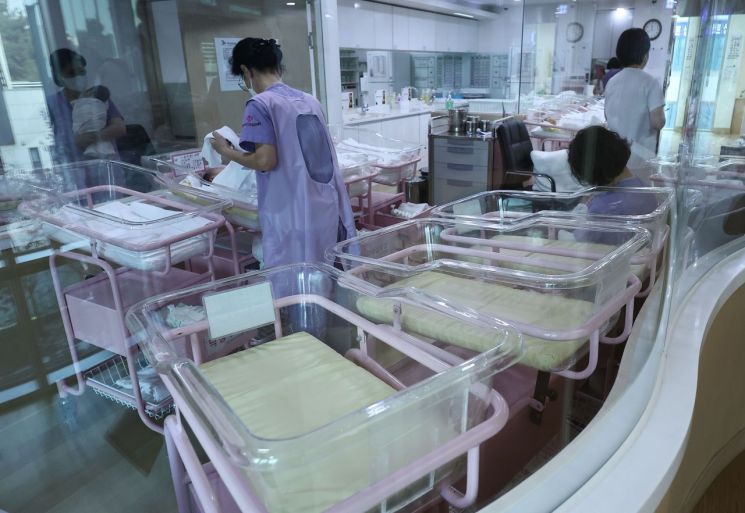 South Korea's total fertility rate dropped to 0.72 in 2023, following its first entry into the 0.7 range at 0.78 in 2022. The total fertility rate is expected to fall below 0.7 in 2024.
 [Photo by Yonhap News]
Professor Jeong analyzed this data and said, "Ultimately, we are living in an era where everyone is starting not to have children, but high-income groups are still having children, middle-income groups are hesitating, and low-income groups are beginning to give up on childbirth altogether." He added, "There is a saying, 'Justice for the rich, injustice for the poor,' but now there might be a saying, 'Children for the genetically privileged, no children for the financially disadvantaged.'"
He further pointed out, "The causes of low birth rates and low fertility do not converge into a single factor; rather, various stories and reasons gathered from here and there intertwine over a long period to create the low fertility phenomenon." He diagnosed that "only through a major reform that simultaneously addresses both social care systems and universal social security can the low fertility crisis be somewhat resolved."
Meanwhile, as the low fertility phenomenon continues to worsen, the government has presented four basic plans for low fertility and an aging society through the Low Fertility and Aging Society Committee since 2006. However, despite government measures, the fertility rate continues to decline steadily without a clear rebound.
© The Asia Business Daily(www.asiae.co.kr). All rights reserved.


















