Lee Jun-won Hanwha Aero Space Division Head
"Securing a Diverse Launch Vehicle Lineup"
"Striving to Launch Larger and Heavier Satellites"
"Ensuring Reliability and Economic Efficiency"
"Need to Secure Marine and Overseas Launch Sites"
"Will Collaborate with Space Aviation Agency on R&D"
Hanwha Aerospace expressed a strong commitment to securing demand in the private launch vehicle market, currently monopolized by SpaceX, and to promoting related industries.
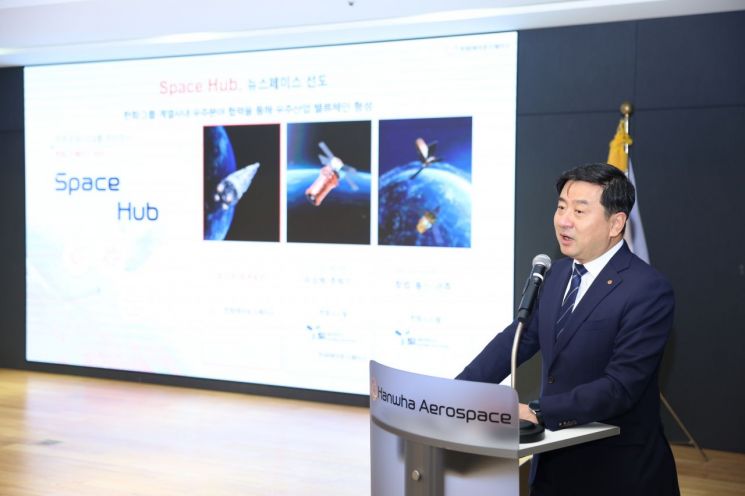 On the 20th, Lee Jun-won, Head of the Space Business Division at Hanwha Aerospace, introduced the space business value chain at Hanwha Aerospace Changwon Plant 1.
On the 20th, Lee Jun-won, head of Hanwha Aerospace’s Space Business Division, met with reporters from the Ministry of Science and ICT at Hanwha Aerospace’s first business site in Changwon and stated, "Based on liquid rocket engine manufacturing technology and comprehensive experience with the Nuriho system, we will secure capabilities for private launch services."
This reflects a determination to prevent the ongoing situation where satellites developed domestically are still launched by SpaceX. Lee believes that if the pursuit is not accelerated, it will become difficult to regain leadership in the private-led 'New Space' market, making technological advancement urgent.
Lee emphasized, "By 2026-2027, the reliability of launch vehicles will be almost secured. The issue is economic feasibility, which is difficult to achieve through old space development methods." He assessed, "Global competitiveness can only be attained through efforts to secure economic feasibility led by the private sector, as demonstrated by SpaceX." Currently, he considers Korea’s level to be at an intermediate stage, or 'Mid Space.'
Hanwha Aerospace has already been selected as the lead company for three additional Nuriho launch enhancement projects and has declared participation in the bidding for the next-generation launch vehicle development project, which involves an investment of 2.0132 trillion KRW.
Lee stated that performance improvements of Korea’s launch vehicles are essential to catch up with SpaceX. He said, "Compared to SpaceX and others, our scale is different, and competitiveness is lacking." He explained that SpaceX is like a bus, while we are at the level of a taxi. If a bus and a taxi compete, the taxi inevitably loses in price competitiveness.
Lee also said that efforts will focus on large fairings (satellite protective covers) for carrying bigger satellites, increasing engine pressure, and reducing launch vehicle weight. All are essential conditions for sending larger and heavier payloads into space.
Regarding next-generation launch vehicle development, Lee said it must be an internationally economical launch vehicle, adding, "After the next-generation launch, we will establish a diverse lineup including heavy-class launch vehicles with expandable solid boosters."
He mentioned, "We are considering a direction where the government and private sector jointly invest through national research and development (R&D)," and that he will actively persuade the Aerospace Administration once it is launched. Besides government R&D, he said they will also focus on roles they can perform independently, such as cost reduction.
Hanwha Aerospace plans to contribute to securing economic feasibility by developing engine reignition and thrust control technologies for the reuse of next-generation launch vehicles.
Lee emphasized that the launch site issue is urgent to enhance domestic launch vehicle competitiveness. Hanwha Aerospace is also considering establishing sea-based or overseas launch sites.
Satellite launches become easier the closer they are to the equator. This is why the U.S. and France operate launch sites in Florida and French Guiana, which are near the equator. In contrast, the Naro Space Center in Goheung must avoid Japan and China, limiting launch directions and angles. After launch, more fuel is required to reach orbit.
Lee said, "Even going down below Jeju Island, we can carry payloads 3 to 4 times heavier," adding, "A project with Hanwha Ocean seems possible, but it would cost over trillions of won and require government cooperation for operation." He also said that Australia, where Hanwha Group exported Redback armored vehicles, is being considered as a priority overseas launch site.
© The Asia Business Daily(www.asiae.co.kr). All rights reserved.

















