Private-Led Development... Total Project Cost 1.4 Trillion Won
"Easy Land Acquisition, Excellent Transportation Infrastructure"
Geoje City in Gyeongnam has been designated as a pilot site for the 'Corporate Innovation Park' project. A cultural industry city will be developed on a 1.71 million㎡ site in the areas of Guyoung-ri and Songjinpo-ri, Jangmok-myeon. The government will initiate additional pilot projects starting with Geoje.
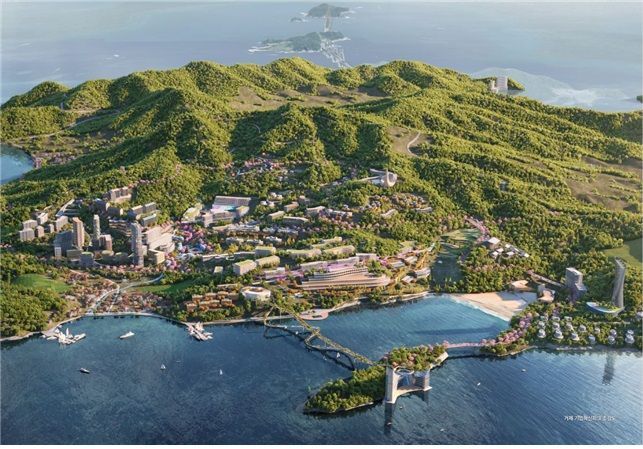 Perspective view of Geoje Corporate Innovation Park proposal / Image provided by Ministry of Land, Infrastructure and Transport
On the 22nd, the Ministry of Land, Infrastructure and Transport explained the 'Geoje Corporate Innovation Park Pilot Project Promotion' plan at the 14th public discussion on livelihood chaired by the President held in Changwon. The goal is to invest a total of 1.4 trillion KRW to develop Geoje City into a cultural industry city focusing on three core industries: bio-medical, information and communication technology (ICT), and culture and arts.
Regarding this, President Yoon Suk-yeol stated, "We will mobilize all policy measures to support cooperation between companies and Geoje City to establish a hub for cultural arts, ICT, and bio-medical industries. In addition to Geoje, we will select additional pilot projects to expand Corporate Innovation Parks nationwide."
The government selected Geoje City as the pilot site after considering various factors. A Ministry of Land, Infrastructure and Transport official said, "The Geoje Corporate Innovation Park has strong commitment from companies and local governments and easy access to project sites. It was evaluated to have potential due to excellent transportation infrastructure such as Gadukdo New Airport, Geoga Bridge, and the Gimcheon-Geoje Southern Inland Railway." Since September last year, the ministry has been conducting a public contest for the Corporate Innovation Park pilot project, with evaluations including document review, on-site inspections, and presentations by a committee composed of public and private sector experts.
Starting next month, the government will begin consulting with Geoje City and eight participating companies including Susan INT, Dasan Networks, and Antaek Construction, and commence preparatory work for the main project. Subsequently, a feasibility analysis and urban development committee review will be conducted before designating the development zone. The target completion date is 2030.
The Corporate Innovation Park is a system that complements existing corporate cities. The core idea is that companies lead the entire investment process from site selection to capital procurement and occupancy to create a complex city. Previously, corporate cities were operated to encourage companies to relocate to local areas. Since 2005, the government has piloted projects and completed corporate cities in Chungju, Chungbuk, and Wonju, Gangwon, but due to difficulties in attracting corporate investment, development zone designations were revoked in Muju County, Jeonbuk, and Muan County, Jeonnam.
The government has also relaxed the standards for Corporate Innovation Parks. The amended 'Special Act on Corporate City Development,' effective from August, significantly reduces the minimum development area from 1 million㎡ to 500,000㎡. Especially, if development is adjacent to existing corporate cities or industrial complexes, or if companies from the metropolitan area relocate to non-metropolitan areas, the project site only needs to exceed 250,000㎡ to qualify for development.
Complex approval procedures have been simplified. Development and implementation plans are combined, and individual matters such as transportation, disaster, and education are reviewed in an integrated manner. Additionally, development zones can be designated as urban innovation zones under the National Land Planning Act. Designation as an urban innovation zone provides incentives such as building coverage ratio and floor area ratio benefits. The scope of support facilities for resident companies funded by development profits has been expanded to include startup incubation facilities, and the legal basis for designation support of demonstration projects such as regulatory free zones has been clarified. Currently, only infrastructure and cultural and sports facilities can be installed. Furthermore, benefits such as reduced land sale prices for resident companies are maintained, and foreign educational institutions allowed to be established within development zones have been expanded from universities to kindergartens and elementary schools.
Lee Sang-joo, Director of the Land and Urban Office at the Ministry of Land, Infrastructure and Transport, said, "Corporate Innovation Parks are projects where companies, as economic agents, lead and directly find the necessary spaces to create jobs. We plan to actively support sustainable growth engines to take root in regional hubs."
© The Asia Business Daily(www.asiae.co.kr). All rights reserved.
![Clutching a Stolen Dior Bag, Saying "I Hate Being Poor but Real"... The Grotesque Con of a "Human Knockoff" [Slate]](https://cwcontent.asiae.co.kr/asiaresize/183/2026021902243444107_1771435474.jpg)











