KCC Announces Amendment to Enforcement Decree of the Mobile Communication Sales Act
Subsidies Possible According to Subscription Type
'Number Portability' Makes It Easier to Attract Competitors' Customers
The competition among mobile telecommunications operators, which had frozen due to the enforcement of the Act on the Improvement of Distribution Structure for Mobile Communication Terminals (DanTong Act), is expected to heat up again after 10 years.
The Korea Communications Commission (KCC) announced a revision of the enforcement decree allowing partial differential subsidy payments by mobile carriers, which is expected to activate marketing competition to attract 'number portability' customers.
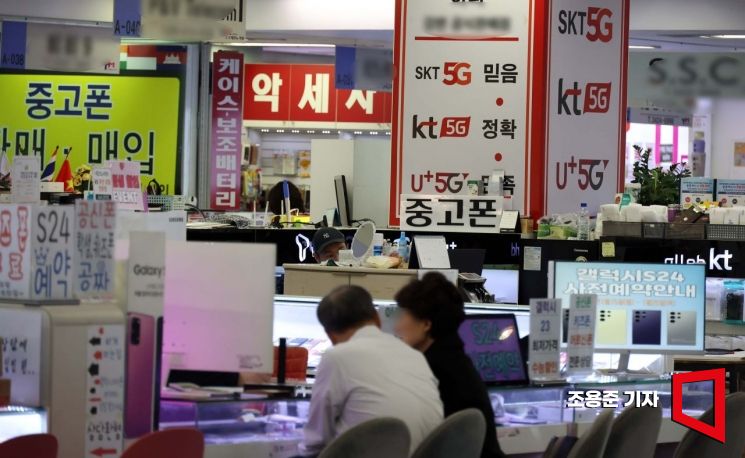 On the 21st, the Korea Communications Commission reported partial amendments to the Enforcement Decree of the Act on the Improvement of Distribution Structure of Mobile Communication Terminals (DanTongBeop).
 Photo by Jo Yongjun jun21@
On the 21st, the KCC reported a revision to Article 3 of the enforcement decree of the Terminal Distribution Act at a plenary meeting held at the Government Complex Gwacheon. The revision includes an exception clause stating that "subsidies may be provided according to payment standards based on subscription types determined and announced by the KCC, considering the expected profits of mobile carriers and the switching costs for users."
The KCC plans to apply the revised enforcement decree after public notice, consultation with related ministries, regulatory review, KCC resolution, review by the Ministry of Government Legislation, vice-ministerial meeting, and Cabinet approval.
With the establishment of the exception clause through the revision of the enforcement decree, subsidies can be provided differentially depending on whether number portability occurs and the price of the rate plan. Additionally, subsidies can now be provided for penalties incurred during number portability. For example, when a customer who used carrier A wants to switch to carrier B, the penalty the customer must pay to carrier A can be supported by carrier B in the form of a subsidy.
KCC Chairman Kim Hong-il said, "Since cooperation from the National Assembly is necessary to repeal the DanTong Act, we revised part of the enforcement decree to create conditions that can activate marketing competition among operators even before the law is repealed," adding, "Through this revision, we will activate autonomous subsidy competition among operators."
The DanTong Act was enacted in 2014 to curb excessive subsidy competition, but after 10 years of enforcement, there are criticisms that consumer welfare has decreased due to the high prices of terminals. In response, the KCC stated at a public discussion on livelihood last month, "We will improve the system to completely liberalize subsidy competition by fully repealing the DanTong Act and reduce the burden of terminal purchases for the public."
The telecommunications industry has no choice but to reluctantly comply with this revision. If subsidy competition is activated, companies will incur increased costs such as sales expenses and marketing commissions. However, if more subsidies are provided to number portability customers, it will be easier to attract competitors' customers.
An industry insider said, "Currently, the most intense subsidy competition is for number portability," adding, "If one of the three carriers provides more subsidies to number portability customers than to device change customers, other operators will inevitably follow."
The recent emergence of a fourth mobile carrier is also a variable. On the 31st of last month, StageX made a challenge in the mobile telecommunications business by winning the final bid for the 5G 28 GHz frequency auction. With a new competitor entering the long-standing oligopoly market centered on SK Telecom, KT, and LG Uplus, it is expected that the stagnant competition will become more active.
Professor Choi Kyung-jin of Gachon University’s Department of Law suggested, "For the fourth mobile carrier to gain competitiveness in the market, it will inevitably have to engage in aggressive marketing," adding, "If that happens, the three existing carriers will also actively respond to maintain their market shares."
© The Asia Business Daily(www.asiae.co.kr). All rights reserved.
![Clutching a Stolen Dior Bag, Saying "I Hate Being Poor but Real"... The Grotesque Con of a "Human Knockoff" [Slate]](https://cwcontent.asiae.co.kr/asiaresize/183/2026021902243444107_1771435474.jpg)
















