Held Cabinet Meeting Emphasizing the Necessity of Medical School Expansion
"Medical School Expansion is a Timely Task"
"Collective Refusal of Medical Treatment is Absolutely Unacceptable"
Refuting Claims of Excessive Expansion and Decline in Medical Education Quality
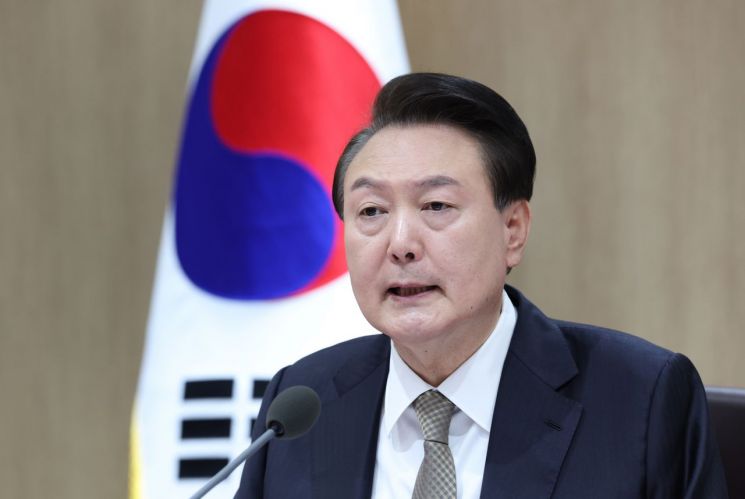 President Yoon Suk-yeol is speaking at the Cabinet meeting held on the 20th at the Presidential Office building in Yongsan, Seoul. [Image source=Yonhap News]
President Yoon Suk-yeol stated on the 20th regarding the collective leave of medical students and residents in protest of the increase in medical school admissions and their submission of resignation letters to hospitals, "They must not engage in collective actions that hold the lives and health of the people hostage."
At the Cabinet meeting held at the Yongsan Presidential Office that afternoon, President Yoon pointed out the inevitability of medical reform and the government's support policies for the medical community, yet the residents proceeded with collective action. He urged them to return to their posts, saying, "Doctors, even though they are not public officials like soldiers or police officers, must never engage in collective refusal of medical treatment."
President Yoon increased pressure by repeatedly emphasizing why doctors, who protect the people's right to health, must not abandon medical sites. He stressed, "Protecting the lives and safety of the people is, along with national security and public order, the fundamental constitutional duty given to the government and the reason for the nation's existence," adding, "From that perspective, the state must efficiently manage medical resources to safeguard the lives and health of the people."
He also enumerated problems occurring in the medical field, such as the collapse of essential regional medical services and nurse deaths due to the absence of surgeons in the Big 5 hospitals, emphasizing that "the increase in medical school admissions is a task of the times." The demand for medical services is rapidly increasing, but supply is not keeping pace. As a result, medical personnel in essential medical fields have decreased significantly, leading to the collapse of essential regional medical care.
In particular, President Yoon focused on explaining the necessity of expanding medical school quotas. He said, "The government has not increased medical school admissions by even one student in the past 27 years," and emphasized, "We all know well that increasing the number of doctors alone cannot solve the collapse of essential medical care. However, increasing the number of doctors is clearly a necessary condition to prevent the collapse of essential medical care."
He added, "The government has attempted to increase the number of doctors several times but has repeatedly failed and adjusted over the past 30 years," and stated, "Now, we have reached a point where failure itself can no longer be tolerated."
"Increasing medical school admissions by 2,000 is the minimum expansion scale"
He actively refuted concerns that increasing admissions by 2,000 would lead to a decline in the quality of medical education. President Yoon said, "Some claim that increasing admissions by 2,000 is excessive and even raise baseless conspiracy theories," emphasizing, "But even this number is far from sufficient. Increasing admissions by 2,000 is literally the minimum expansion scale." He explained that even if medical school admissions are increased starting next year, the first graduates will only emerge in 2031, and it will take at least 10 years to produce specialists to strengthen the essential medical system, with the increase of 2,000 essential medical doctors realized only by 2035.
He continued, "The claim that increasing medical school admissions will lower the quality of medical education is also incorrect," pointing out, "Seoul National University's medical school currently admits 135 students, but in 1983, it admitted 260. Over 40 years, medical demand has exploded, but admissions have been halved." President Yoon added, "The same applies to regional representative national medical schools such as Kyungpook National University, Chonnam National University, and Pusan National University," and "The capabilities of doctors trained when admissions were higher were not lacking in the slightest."
According to spokesperson Kim Soo-kyung, President Yoon reaffirmed his firm stance on medical reform in his closing remarks. President Yoon said, "The lives and health of the people must never be threatened during the medical reform process," and urged, "I ask the entire Cabinet to unite so that the people do not suffer any harm." He also added, "While clinical doctors are important, expanding medical personnel is also crucial to securing international competitiveness in advanced bio and healthcare fields."
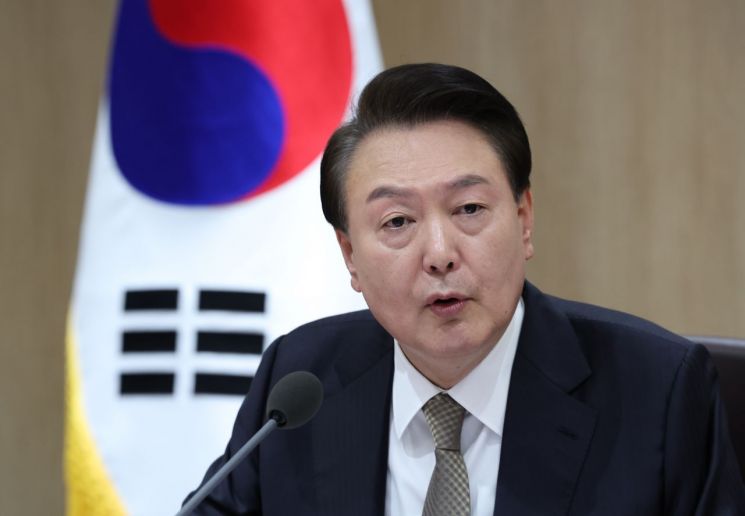 President Yoon Suk-yeol is speaking at the Cabinet meeting held on the 20th at the Yongsan Presidential Office Building in Seoul. [Image source=Yonhap News]
On the same day, President Yoon expressed concern about South Korea's severe low birthrate and mentioned plans to restructure low birthrate policies. He said, "The total fertility rate for 2023 will be announced in a few days," and predicted, "We will once again confirm with numbers how serious our low birthrate problem is."
According to the government, the total fertility rate is expected to drop to 0.68. Moreover, the population aged 70 and above is projected to surpass the number of people in their 20s for the first time, indicating that South Korea's chronic low birthrate and aging population issues will deepen further.
He continued, "It is true that there is no quick fix to the low birthrate problem," emphasizing, "We must thoroughly analyze the fundamental causes of childbirth and carefully review existing policies to restructure low birthrate policies." The government also promised to accelerate structural reforms in labor, education, and other areas to alleviate unnecessary excessive competition.
Tax Benefits for Companies Making Efforts to Overcome Low Birthrate
President Yoon expressed gratitude for corporate efforts to overcome the low birthrate, including recently unprecedented childbirth incentives. He said, "It is very encouraging that members of our society are coming together to solve social challenges," and added, "We will promptly prepare various support measures, including tax benefits, to further activate corporate efforts."
He ordered the Low Birthrate and Aging Society Committee, which recently appointed a new vice-chairman, to take on the role of a control tower for responding to the low birthrate with extraordinary determination.
President Yoon said, "The vice-chairman of the Low Birthrate and Aging Society Committee will be changed from a part-time to a full-time position, with rank and treatment upgraded, and a place will be created for you to discuss state affairs together at Cabinet meetings," and urged, "Each ministry should work closely with the Low Birthrate and Aging Society Committee to discuss low birthrate measures in depth and promptly implement the discussed policies."
During his recent visit to Daejeon, where he held the twelfth public livelihood discussion, President Yoon announced plans to continue these discussions throughout the year. He emphasized, "The more I visit the field, the more I realize there are many voices the government must listen to," and said, "Throughout this year, we will continue these public livelihood discussions to break down barriers between ministries and focus on tangible livelihood tasks through ministry reports and discussions."
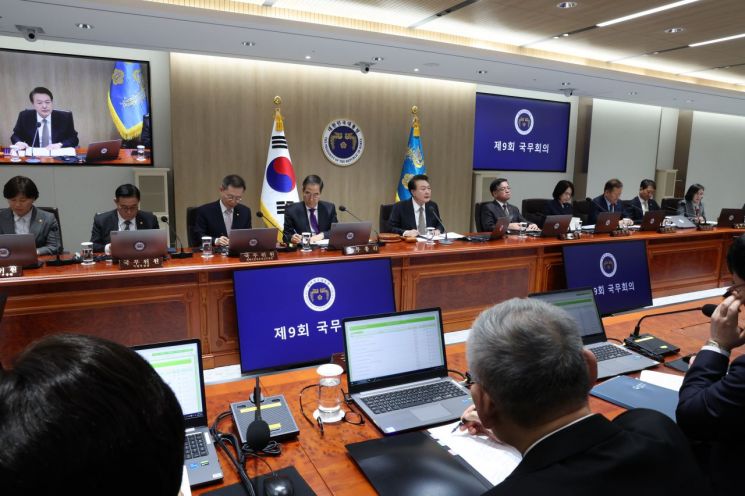 President Yoon Suk-yeol is speaking at the Cabinet meeting held on the 20th at the Yongsan Presidential Office Building in Seoul. [Image source=Yonhap News]
Regarding Neulbom School, President Yoon said, "It is a humanitarian and human rights issue that the state must resolve by any means to care for children," and added, "Our entire society must participate with the mindset of caring for our own children so that children are not left unattended after school." He also stated, "Politics must not intervene or influence the issue of raising children in our society," and urged, "I ask not only the Ministry of Education and local governments but the entire Cabinet to work hard to establish Neulbom School."
On the issue of school violence, President Yoon said, "Do not let teachers or schools bear the burden during the investigation and deliberation process of school violence cases," and added, "Deliberation and decision-making bodies should establish nationwide common standards so that similar offenses receive similar sanctions everywhere."
© The Asia Business Daily(www.asiae.co.kr). All rights reserved.
![User Who Sold Erroneously Deposited Bitcoins to Repay Debt and Fund Entertainment... What Did the Supreme Court Decide in 2021? [Legal Issue Check]](https://cwcontent.asiae.co.kr/asiaresize/183/2026020910431234020_1770601391.png)


















