Variables in Re-vote on Ssangteukgeom Act... Ruling Party Fears Nomination Defection
Jeonggae Special Committee Expected to Convene This Week... Negotiation 'Key' to Democratic Party
The general election is just 50 days away, but a protracted standoff over electoral district delineation continues. Amid concerns of a worst-case delay scenario, the Democratic Party of Korea is also expected to potentially use the 're-vote on the dual special prosecutor law' as a bargaining chip in negotiations.
According to the National Election Commission on the 20th, the Electoral District Delimitation Committee prepared a plan to reduce one constituency seat each in Seoul and Jeonbuk, and increase one seat each in Gyeonggi and Incheon. Unlike the People Power Party, the Democratic Party does not agree with this plan. The stated reason is that instead of Jeonbuk, Busan should be adjusted to better reflect population equity per constituency. This is interpreted as considering the pros and cons of reducing seats in the 'Honam stronghold' area.
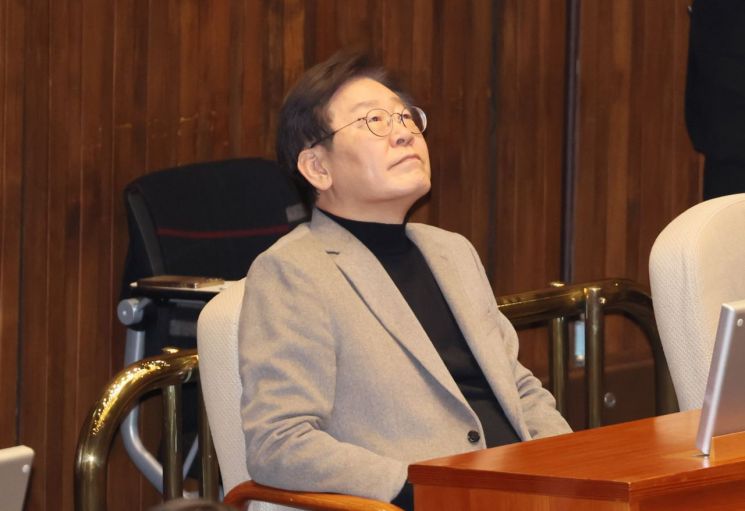 Democratic Party leader Lee Jae-myung is briefly lost in thought at the opening ceremony of the extraordinary session of the National Assembly held in the main chamber on the 19th. [Image source=Yonhap News]
The original 'agreement deadline' set by the Delimitation Committee was the 21st, when the overseas voter registry preparation begins. However, with only one day left physically and no resumption of negotiations between the ruling and opposition parties, the outcome remains uncertain.
There is also speculation that the opposition party might leverage the re-vote on the dual special prosecutor law during the February extraordinary session of the National Assembly to strengthen their negotiating power. The dual special prosecutor law centers on investigations into allegations such as stock manipulation involving First Lady Kim Keon-hee and the Daejang-dong 5 billion club scandal. President Yoon Suk-yeol labeled it a 'general election-purpose malicious law' and exercised his veto power on the 5th of last month. Although there is no deadline for the re-vote, the closer it gets to the general election, the more disadvantageous the situation becomes for the ruling party.
Previously, the People Power Party pushed for a re-vote immediately four days after exercising the veto on the 9th of last month, when the last plenary session of the December extraordinary session was scheduled. However, the plenary session was not convened due to opposition from the opposition party. From the ruling party’s perspective, as the general election approaches, concerns over vote defections based on candidate nominations inevitably increase. On the other hand, the Democratic Party, which holds the initiative, may expect to gain a reflexive benefit from the controversy.
A Democratic Party leadership official told Asia Economy in a phone interview on the same day, "The re-vote on the dual special prosecutor law depends on the stance the ruling party will take. If there is progress, there is a possibility of bundling it with the (delimitation) plan, but whether it will be tabled will be decided after a party caucus." He added, "If the ruling party continues to keep the door to dialogue closed, we are also considering the possibility of holding the general election as is."
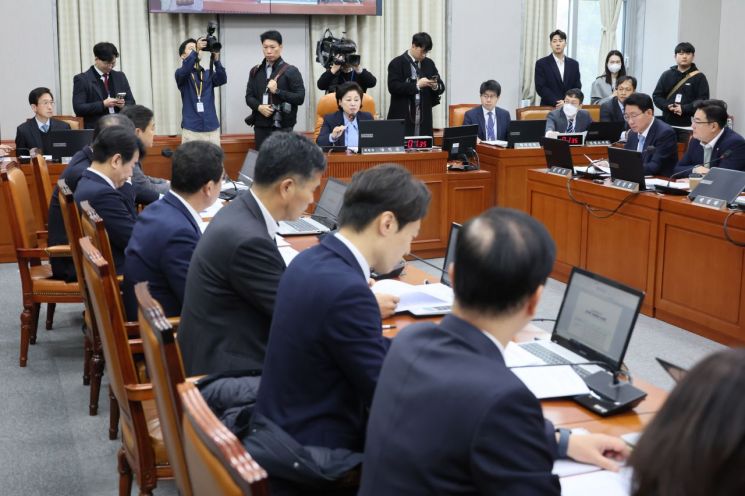
Even if the ruling and opposition parties ultimately fail to reach an agreement, the calculations remain complicated. In that case, the general election will be held using the electoral districts applied in the 21st general election, not the current delimitation plan, which causes problems in areas where population deviation standards are exceeded. Previously, the Constitutional Court ruled in 2014 to adjust the population deviation ratio for National Assembly electoral districts to '2 to 1.' Electoral districts must be adjusted each election according to population changes by region, but if the election is held under the delimitation plan from the last general election, unconstitutional lawsuits may continue even after the election results are announced.
The National Assembly’s Political Reform Special Committee is expected to convene a meeting within this week. Kim Young-bae, the opposition party secretary of the committee and a Democratic Party lawmaker, said, "Nothing has been finalized yet, but we plan to meet once during the week," adding, "We will do our best to ensure that the electoral district delineation issue is handled at the plenary session on the 29th."
If negotiations start this week, the likely scenario is to approve the delimitation plan by the 26th, deliver it to the Delimitation Committee, and handle it at the plenary session scheduled for the 29th. Since failing to process it by the 29th, with 41 days left until the general election, raises concerns of the worst delay scenario, both ruling and opposition parties are expected to speed up negotiations. In the 21st general election, electoral district delineation was completed 39 days prior. Since the establishment of the Electoral District Delimitation Committee in the 15th general election, the latest approval of a delimitation plan was for the 17th general election, which passed the plenary session with 37 days remaining before the election.
© The Asia Business Daily(www.asiae.co.kr). All rights reserved.


















