Saying "Divorce" Three Times Establishes Summary Divorce
Causes Various Issues Such as Bigamy, Custody, and Inheritance
Ruling Party's Election Strategy Criticized Ahead of April General Election
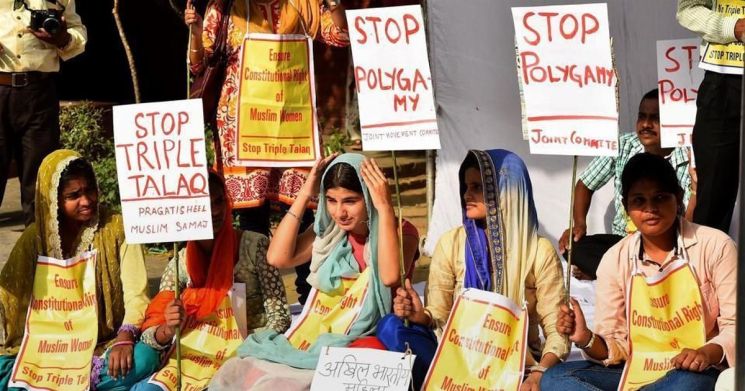 A polygamy opposition protest held in New Delhi, India, in 2017. Although polygamy has been legally prohibited in India since 1950, it has continued as a customary practice in regions where Islam is practiced.
 [Image source=India PTI News Agency]
In India, ahead of the April general elections, the issue of abolishing 'polygamy' has emerged as a significant political topic. The ruling Bharatiya Janata Party (BJP) has begun actively pushing to abolish Islamic-style polygamy, which has been cited as a major cause of various social problems such as bigamy, child custody, and inheritance, leading to clashes with over 200 million Muslims in India.
In fact, polygamy has been legally prohibited in India since 1950, but a policy of tolerance has been implemented according to the religious situation in each region, considering the backlash from the Islamic community. However, as this practice has been criticized as outdated and has generated various social problems, with increasing opposition from women, the BJP appears to be actively moving toward abolishing polygamy.
However, some voices express concerns that the ruling BJP's efforts may be more of a political strategy based on 'Hindu supremacy' rather than genuine goals of women's empowerment or modernization of Indian society. The controversy over polygamy is expected to continue around the time of the Indian general elections.
Uttarakhand State in India Declares "Abolition of Polygamy Regardless of Religion"
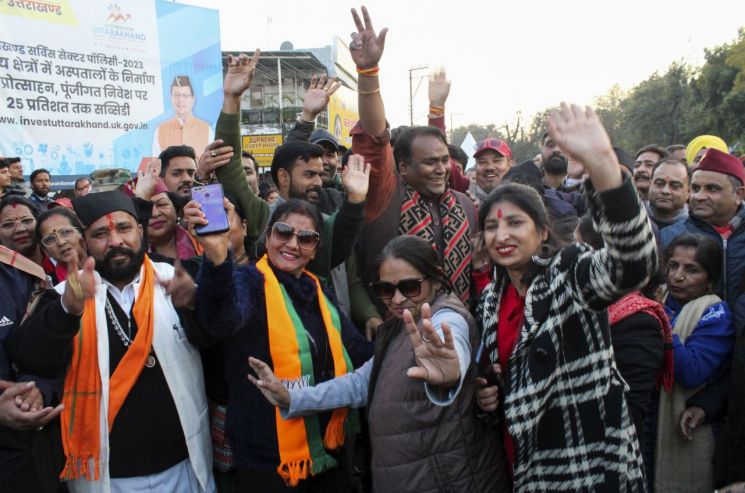 On the 7th, the Uttarakhand state assembly in northern India approved a Uniform Civil Code (UCC) that integrates personal laws regardless of religion, and supporters of the ruling Bharatiya Janata Party (BJP) in India are celebrating this.
 [Image source=AP·Yonhap News]
According to the Indian local media Hindustan Times on the 19th, in a court in Uttarakhand state in northern India, a woman named Shaila Bano won a divorce lawsuit against her husband, who married another woman without divorcing her. The reason she was able to win was thanks to the Uttarakhand state legislature passing a law banning polygamy on the 7th.
Previously, her husband, citing Islamic law, married another woman without his wife's consent, resulting in a bigamous situation. Although polygamy and bigamy have been legally prohibited in India since 1950, Islamic law-based polygamy has been effectively recognized due to tolerance policies toward Islam.
She stated, "Only now have I won the fight against Islamic law (Sharia), which regulates marriage and divorce," and added, "The Islamic marriage system that allows men to marry two or more women should have been abolished long ago."
Especially with the April Indian general elections approaching, the controversy over polygamy is intensifying in various states. The Uttarakhand state legislature, controlled by the ruling BJP, approved the 'Uniform Civil Code (UCC)' on the 7th, which integrates personal laws regardless of religion and completely abolishes polygamy, prompting other states to also show movements toward abolishing polygamy.
Social Problems Created by Polygamy... Bigamy, Child Custody, Inheritance Issues
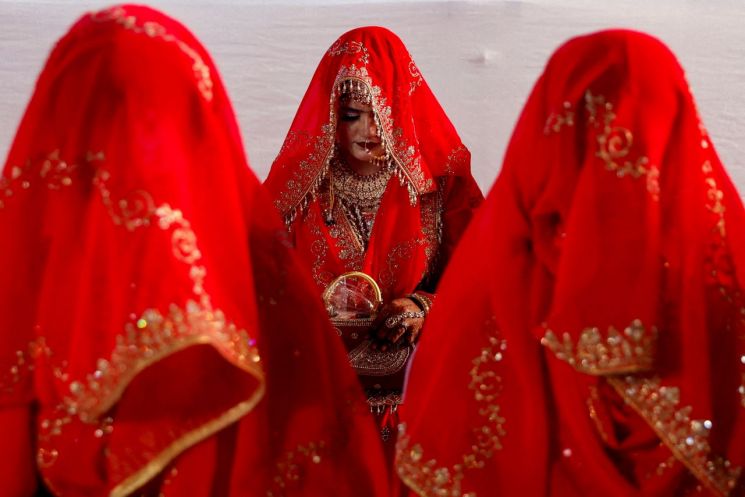 The joint wedding ceremony of 51 couples held on the 12th at an Islamic temple in Mumbai, India. [Image source=Reuters·Yonhap News]
In India, controversies and social problems have continued over polygamy among the Muslim population of over 200 million. Bigamy, which is legally prohibited, has become widespread in Islamic regions, leading to issues such as divorce from husbands, inheritance, and child custody after death.
Additionally, the so-called 'Triple Talaq,' a simplified Islamic divorce law, has caused severe domestic turmoil. Triple Talaq is an Islamic practice where a married man can divorce his wife by saying the word 'Talaq' (divorce) three times. Recently, men have even been using text messages or messengers to perform Triple Talaq, turning it into a social problem.
In regions where Islam is the majority, women who are subjected to simplified divorces through Triple Talaq often face very unfavorable situations regarding property division and inheritance. Even when appealing to local courts, many cases follow Islamic law, which has often led to social controversy.
In response, the Indian federal parliament enacted a law in 2018 allowing men who misuse Triple Talaq to be sentenced to up to three years in prison, but the law has not been effectively enforced in regions with a Muslim majority.
Concerns Over Ruling Party's Election Strategy Ahead of April Indian General Elections
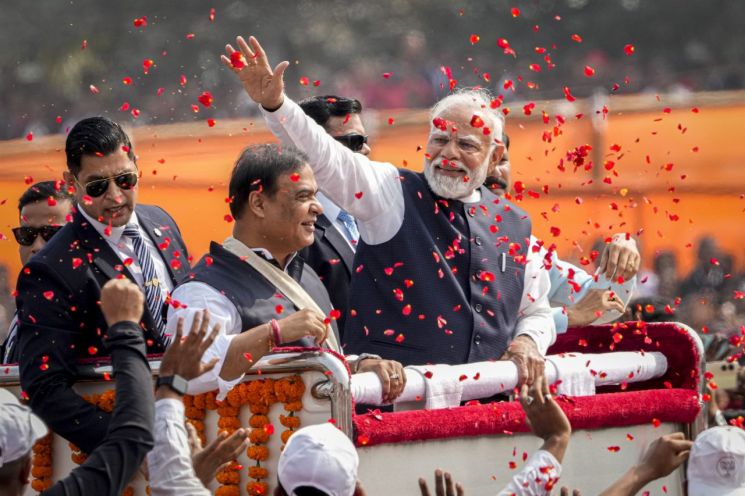 Indian Prime Minister Narendra Modi is receiving a warm welcome from supporters during his visit to Guwahati, Assam, India, ahead of the April general elections.
 [Image source=AP·Yonhap News]
The abolition of Islamic-style polygamy, which has caused various problems, has received overwhelming support from women. A 2013 survey showed that 91.7% of Muslim women in India supported the abolition of polygamy.
However, some express concerns that ahead of the Indian general elections, Prime Minister Narendra Modi and the ruling BJP, who have pushed Hindu supremacy, might use this issue as a political tool to pressure Islamic leaders. A member of the Indian opposition told major foreign media, "There are almost no Muslim men in India with more than one spouse, so the actual ban on polygamy will have little significance," and argued, "The government has no right to question Islamic law."
Meanwhile, India is scheduled to hold general elections over several weeks starting in April. Especially with the BJP led by Prime Minister Modi expected to win, it is widely anticipated that Modi will secure a third term in office. The BJP is strengthening Hindu nationalism centered on the Hindu population, which accounts for over 80% of the total population.
© The Asia Business Daily(www.asiae.co.kr). All rights reserved.
![Clutching a Stolen Dior Bag, Saying "I Hate Being Poor but Real"... The Grotesque Con of a "Human Knockoff" [Slate]](https://cwcontent.asiae.co.kr/asiaresize/183/2026021902243444107_1771435474.jpg)


















