Medical Students' Collective Action in 2000 and 2020
"No Past Cases of Mass Failing, but Concerns Over Intern Shortages if Students Fail"
In response to the government's plan to increase the number of medical school admissions and the essential medical package, medical students nationwide are entering a 'collective leave of absence.' If leave applications are not processed, and collective action takes the form of 'class refusal,' there is a possibility that participating medical students could be collectively failed. Previously, medical students took collective action in opposition to the 2000 separation of drug prescribing and dispensing and the 2020 increase in the number of doctors, but these actions ended before leading to mass failures.
According to the education and medical sectors, the Korean Medical School and Graduate Medical School Student Association (KMSA) held emergency committee meetings on the 15th and 16th and resolved to begin the collective leave of absence starting on the 20th. Students from Konyang University College of Medicine posted on SNS that day, stating, "We will unite as one and, together with KMSA, enter a collective leave of absence after the 20th. For now, we will pause our studies, raise our voices, and focus on reclaiming important values. Once the situation is resolved, we will return to school."
About 190 medical students from Chungbuk National University reportedly expressed their intention to refuse classes to the school administration the day before the semester started, ahead of the collective leave of absence. The 160 medical students from Wonkwang University, who were the first to submit collective leave applications, withdrew their leave the day before but may resubmit them to align with other medical schools.
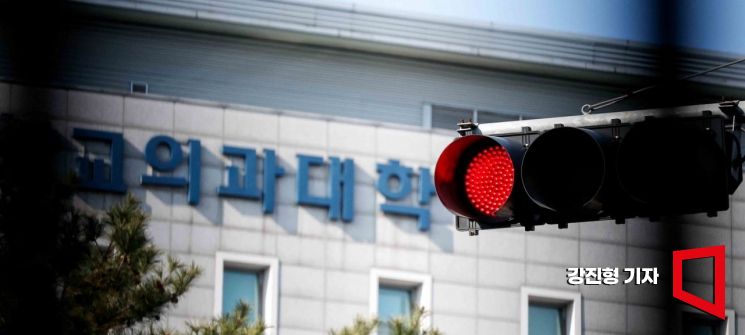 On the 16th, when student representatives decided that medical students nationwide would submit leave of absence applications together on the 20th in protest against the government's plan to increase medical school quotas by 2,000, a red light was on at a traffic signal near a medical school in Seoul. Photo by Jinhyung Kang aymsdream@
Medical students have previously taken collective action such as leave of absence in opposition to government medical policies. In 2020, medical students who conducted a collective leave of absence against the government's plan to increase medical school admissions returned to school after 38 days when the government launched a permanent health and medical policy monitoring body. However, a 'mass failure' situation did not occur. This was because, due to the impact of COVID-19, the processing and withdrawal periods for leave applications were longer than usual, and some universities adjusted academic schedules by extending semesters so that students could meet the required number of class days to advance.
Medical students who took collective action in opposition to the 2000 separation of drug prescribing and dispensing also avoided mass failure. At that time, medical students refused classes for about two months in a 'failure protest.' In some universities, the refusal to meet the legally required number of class days nearly led to failure, but students returned to classes just before that point. Professor Baek Soon-young, emeritus professor at the Catholic University College of Medicine, explained, "As far as I know, there has never been a case of mass failure due to collective action by medical students. If a mass failure occurs, it would lead to a shortage of interns and a subsequent manpower shortage, which is problematic."
This year’s collective action by medical students is also expected to proceed as a 'collective leave of absence,' but according to the Ministry of Education’s policy, 'collective leave of absence cannot be considered a valid reason for leave,' so it may proceed in the form of class refusal. Although academic regulations vary by university, in some medical schools, if the number of absences exceeds a certain level, such as 'one-fifth of class days,' grades are assigned an F, which affects failure.
The Ministry of Education is operating a situation response team in preparation for the medical students’ collective action. A Ministry of Education official stated, "Universities that do not properly enforce academic regulations may be subject to corrective orders and other measures according to relevant laws."
© The Asia Business Daily(www.asiae.co.kr). All rights reserved.

















