Memorandum of Understanding for Exchange and Cooperation with Apsara Cheong
Restoration and Maintenance of the Northeast Base of Bakan Ruins
The government will take the lead in the preservation and restoration of Angkor Wat, a cultural heritage site representing Cambodia.
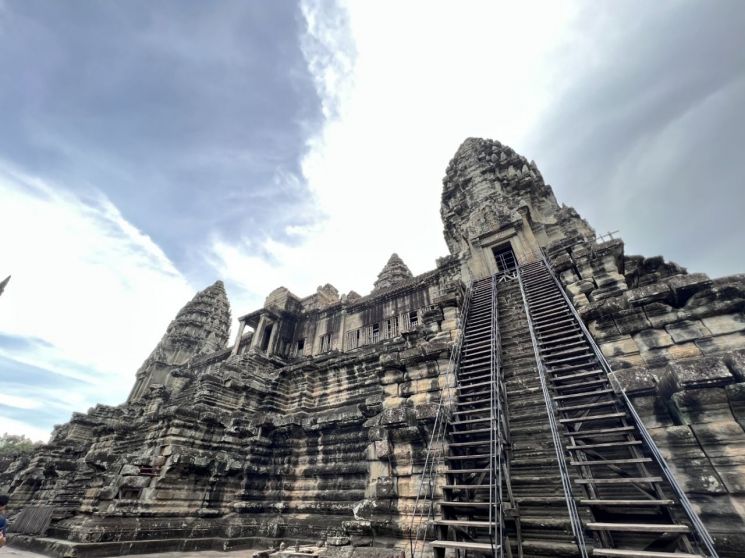
On the 19th, the Cultural Heritage Administration signed a memorandum of understanding for cultural heritage exchange and cooperation with the APSARA National Authority, a Cambodian government agency responsible for the preservation and management of the Angkor site, at the National Palace Museum in Jongno-gu, Seoul.
This is a follow-up measure to the joint press release issued last year by the two organizations, agreeing to join forces for international development cooperation projects including the Angkor site, archaeological surveys, and the preservation and restoration of excavated artifacts.
Accordingly, the Cultural Heritage Administration will begin the preservation and restoration project of Angkor Wat starting this year.
The Korea Cultural Heritage Foundation, in charge of the project, will repair and maintain the platform (基壇, a raised and leveled foundation for buildings) on the northeast side of the Bakan ruins of Angkor Wat for about three years until 2026. They will also promote the maintenance of viewing stairs for visitors to Angkor Wat and the construction of a promotional center.
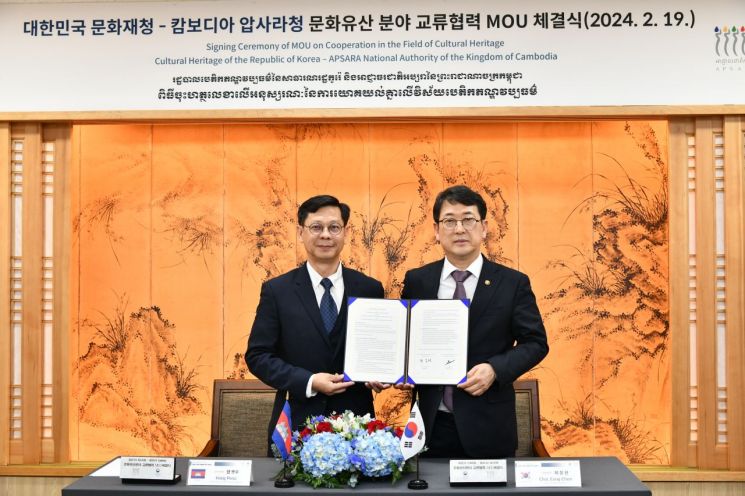 Hang Phoeuk, Director of Cambodia's APSARA Authority (left), and Choi Eung-cheon, Administrator of the Cultural Heritage Administration (right), signing a Memorandum of Understanding for exchange and cooperation in the field of cultural heritage.
The Cultural Heritage Administration stated, "Following the United States, Germany, Italy, and Japan, we are the fifth country to participate in the preservation and restoration of Angkor Wat," adding, "This will be a project that marks a milestone in the history of Korea's international development cooperation (ODA) in the field of cultural heritage." They emphasized, "We will strategically expand the target countries for projects to advanced nations such as Peru's Machu Picchu and Africa, leading ODA in the cultural heritage sector."
Angkor Wat is a temple built by Suryavarman II, who achieved the golden age of the Angkor dynasty, to unite with Vishnu, one of the main gods of Brahmanism. Although influenced by India, it possesses a unique style of the Angkor dynasty in all aspects, including building forms and stone decorations.
The temple, constructed by mobilizing tens of thousands of people, was discovered and widely publicized in the mid-19th century by Henri Mouhot, a French explorer and biologist. Many Buddha statues were damaged or taken abroad due to war and looting, but since being designated a UNESCO World Heritage Site in 1982, it has been preserved and restored.
© The Asia Business Daily(www.asiae.co.kr). All rights reserved.
![Clutching a Stolen Dior Bag, Saying "I Hate Being Poor but Real"... The Grotesque Con of a "Human Knockoff" [Slate]](https://cwcontent.asiae.co.kr/asiaresize/183/2026021902243444107_1771435474.jpg)

















