"Periods Create Intimidation"... New Slang Emerges
"Empathy" VS "Is It Generational Division?" Controversy
In Japan, a newly coined term "Maruhara," which refers to the discomfort caused by placing a period at the end of messages, has sparked controversy. It is said that when superiors or bosses add a period at the end of their messages, it makes recipients feel as if they have done something wrong and creates a sense of distance. This has led to debates between younger generations and older generations in Japan, attracting significant attention even from Japanese media outlets.
 A sentence introduced as an example of Maruhara. A period was added after the sentence "알겠습니다". (Photo by Nittere)
On the 19th, the Mainichi Shimbun reported that debates about Maruhara have been ongoing recently, especially on social networking services (SNS). Maruhara is a compound word combining the Japanese word for period "maru (丸)" and "harassment." Mainichi explained that adding a period at the end of a sentence in messenger apps is causing fear among young people, making it a hot topic.
For example, when a boss or superior sends a message with phrases like "Understood" or "Thank you" followed by a period, younger generations perceive it as authoritarian or feel a sense of coldness and distance. Some voices even suggest that if a company superior continues to send messages in this manner, it could be considered harassment.
This difference arises because middle-aged and older people and those in their teens to thirties have different ways of sending messages. Nippon Television Network Corporation (Nittere) stated, "Unlike middle-aged people who are accustomed to periods, younger generations often engage in short chat-style conversations without periods," adding, "Maruhara is just one phenomenon showing generational differences, and there are many such differences beyond Maruhara."
Linguistics experts analyzed that people in their teens to thirties tend to interpret periods in messages as a sense of disconnection.
Kei Horio, a lecturer in the Japanese Language Department at Utsunomiya University, said, "Young generations value speed in messenger communication. Communication is established with abbreviated words and emoticons alone," and analyzed, "In this context, the appearance of a period can give the impression that the fast-paced exchange has been cut off." However, he also pointed out, "There are students who use periods even in messenger apps. We need to consider whether all people in their twenties and thirties perceive this as harassment. It might rather be a generational gap stirred up by the media."
Kazuko Miyake, a sociolinguist and professor emeritus at Toyo University, introduced a 2006 experiment, saying, "Sentences without periods have been popular among young people for about 20 years."
In the experiment, which focused on how students respond via messenger when they are late for an appointment, students sent long, caring messages with emoticons such as "Don't worry, come slowly" to close friends after receiving a message saying "I think I will be late," but sent short replies like "Understood" with a period at the end to acquaintances they were not close to.
Professor Miyake added, "Young generations included anger in the act of sending messages without emoticons or with short answers ending in periods. They certainly perceive periods as creating a sense of distance or coldness."
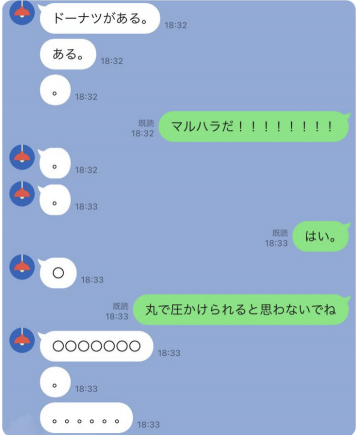 An example of 'Maruhara' that became a hot topic on X (formerly Twitter). When the mother sent a message with a period saying, "(There are) donuts at home as a snack," the child pointed out, "That's Maruhara," and the mother deliberately kept sending messages with periods. (Photo by X @Nidai__)
Experts also criticized Maruhara as a form of distinction based on generational differences. According to a survey by the Ministry of Internal Affairs and Communications, 100% of people in their twenties and thirties use the messenger app "LINE," and the usage rate across all age groups, including the elderly, reaches 94%. Despite almost the entire Japanese population using LINE, generational divides regarding its usage continue. Mainichi said, "Not only Maruhara but also long sentences with many emoticons are called 'Ajumma syntax,' and there are criticisms of 'Ajossi syntax,' which refers to deliberately familiar expressions used by young women to address middle-aged men."
Professor Miyake emphasized, "Whether young or middle-aged, instead of negatively perceiving or approaching differences, we should think about why they exist. This can lead to many realizations."
Meanwhile, on social networking services (SNS), opinions on the Maruhara controversy are divided between positive voices saying "Understood. I will be careful from now on," and opposing views like "Is everything harassment? How can you work in a company like that?" Recently, the famous poet Machi Tawara posted on X (formerly Twitter), "There is a saying that putting a period is like an ajumma tone, so I leave this phrase here," adding, "Japanese is kind because it always ends with an O, not an X," which became a hot topic with 120,000 likes.
© The Asia Business Daily(www.asiae.co.kr). All rights reserved.
![Clutching a Stolen Dior Bag, Saying "I Hate Being Poor but Real"... The Grotesque Con of a "Human Knockoff" [Slate]](https://cwcontent.asiae.co.kr/asiaresize/183/2026021902243444107_1771435474.jpg)


















