Expenditure Increased by 47.3% Compared to Last Year
Daily Spending Per Person Decreased by 5%
Recovery Speed of Consumption Amount Is Slow
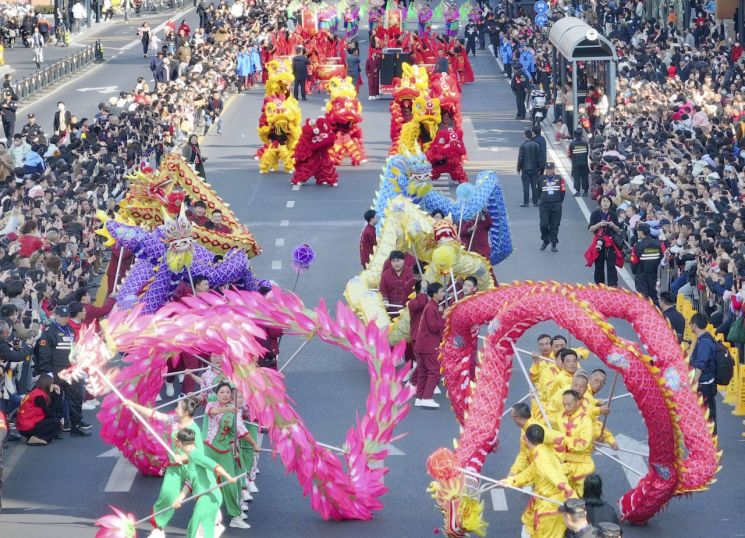
This year, local tourism demand during China's Spring Festival holiday period surged explosively, signaling an improvement in consumption. However, the daily expenditure per person slightly decreased compared to last year, showing a relatively slow recovery.
On the 18th, the Chinese Ministry of Culture and Tourism announced that the number of domestic tourists nationwide during the Spring Festival from the 10th to the 17th reached 474 million, a 34.3% increase compared to the same period last year. This is also a 19.0% increase compared to 2019, before the spread of COVID-19. During the same period, travelers' spending amounted to 632.687 billion yuan (approximately 116.9015 trillion KRW), up 47.3% from last year and 7.7% from 2019.
Bloomberg estimated, based on data from the Chinese Ministry of Transport and railways, that railway travel during this period reached 99.5 million trips, a 36% increase compared to 2019. Zhuishan, Chief China Economist at Goldman Sachs, explained, "Strong New Year tourism data is an encouraging sign that the actual household consumption growth rate this year could reach 6%."
However, Caixin, citing the Ministry of Culture and Tourism's announcement, pointed out that the average daily expenditure per person was 166 yuan, about 5% lower than last year's 174 yuan. Caixin diagnosed, "The downward trend in consumption in tourism after COVID-19 remains," adding, "The recovery speed of spending relative to the number of tourists is slow."
According to the Chinese State Taxation Administration, service-related consumption during the same period increased by an average of 52.3% compared to the same period last year. In particular, sales related to cultural and artistic services jumped 86.7%. The China National Film Administration reported that box office revenue during this period reached 8.016 billion yuan, an 18.47% increase compared to the same period last year, setting a record high. Total audience numbers reached 163 million, and the number of screenings was 3.942 million, also breaking historical records.
Additionally, private data also showed an overall recovery in demand. According to Meituan, a Chinese delivery platform, the average daily consumption scale during the first five days of the Spring Festival holiday increased by 36% compared to the same period last year and by 155% compared to 2019. In particular, purchases of restaurant set menus (taochan) surged by 186%.
The market is paying close attention to how the top leadership will set this year's economic growth target at the annual major political event in March, the Two Sessions (National People's Congress and Chinese People's Political Consultative Conference), considering this recovery trend. The consensus is that the target will likely remain at around 5%, as it was last year.
On the other hand, deflation (price decline amid economic recession) and the resulting weak demand remain challenges China must overcome. Especially, sales of high-priced durable goods such as automobiles and home appliances are recovering more slowly compared to the service sector. According to the China Association of Automobile Manufacturers (CAAM), passenger car sales in China in January this year decreased by 26% compared to the previous month.
© The Asia Business Daily(www.asiae.co.kr). All rights reserved.

















