"Korea Discount Resolution... This Is the Last Chance"
The Korea Corporate Governance Forum presented four principles for the government’s corporate value-up program to succeed, stating that "this is the last chance to resolve the Korea discount." The forum particularly emphasized that, like Japan, a separate independent 'Corporate Governance Improvement Report' should be submitted in both Korean and English versions.
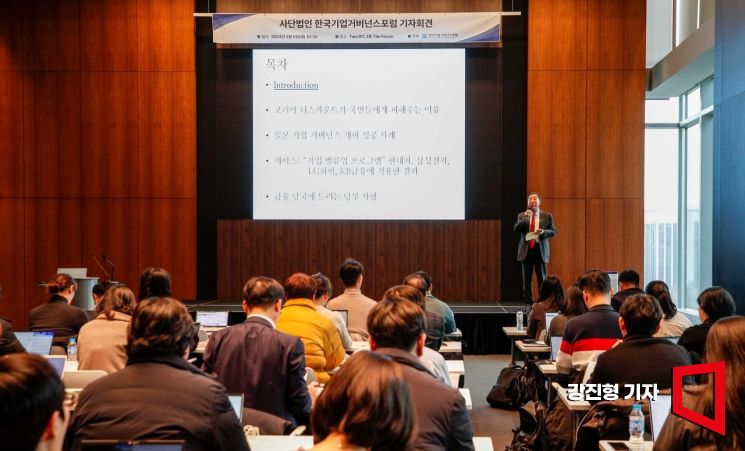 Namwoo Lee, Chairman of the Korea Corporate Governance Forum, is revealing a letter addressed to the Financial Services Commission Chairman and the new Chairman of the Korea Exchange at the 'Korea Corporate Governance Forum New Year Press Conference' held on the 5th at Two IFC, Yeouido, Seoul. Photo by Jinhyung Kang aymsdream@
The Korea Corporate Governance Forum issued a statement the day before, saying, "Foreign investors have recently purchased trillions of won worth of Korean stocks, but their trust in the Korean government is not high. To avoid being downgraded to a temporary policy-themed stock market, the government must present very sophisticated policy measures," and urged, "To enhance the program’s effectiveness and make it a refined policy tool, we hope the following four principles will be reflected."
First, the forum stressed that the corporate value-up program should include the submission of an independent corporate governance improvement report, as is done in Japan.
The forum stated, "As currently known, the improvement plans are included in the corporate governance report without a separate report, but as the saying goes, form dominates content, so a standalone report like Japan’s Corporate Governance Report is absolutely necessary."
Although the corporate governance report has good intentions, in reality, most CEOs or outside directors of the companies are often unaware of its existence. Furthermore, encouraging the upload of the report on the initial page of each listed company’s IR website would maximize the program’s effect by allowing more stakeholders to read and take interest in the report.
Additionally, it argued that it should be clearly stated that the value-up’s main agent is the board of directors, not the management, and that the report should list the names of all directors composing the board to emphasize responsibility and duty. The forum said, "The biggest reason for the success of Japan’s governance reform was that the board of directors, not the management, led the initial and core processes such as analyzing the current status of companies that felt the problem and establishing improvement plans," and suggested, "Since the main culprits causing the Korea discount are major shareholders and management, although independence is still insufficient, it is appropriate to entrust the project to the board."
Moreover, the forum pointed out that related ministries such as the Financial Services Commission and the Korea Exchange need to build partnerships with major long-term investors (domestic and foreign) and continuously receive feedback. According to the forum, the Tokyo Stock Exchange conducted interviews with more than 90 high-quality long-term investors between April 2023 and January 2024 to receive feedback. This process is a government-led process different from companies receiving feedback through dialogue with shareholders.
The forum urged, "We ask that executives and senior officials of the Financial Services Commission and the Korea Exchange regularly update the progress of the ‘program’ to the National Pension Service, large domestic institutional investors, and major foreign mutual funds and pension funds, and publicly disclose objective feedback received from them."
Finally, it emphasized that once the value-up program starts, it should be pursued continuously for at least 3 to 5 years. The forum said, "If the ‘program’ is initiated this time, soft norms and hard norms (especially the addition of the director’s duty of loyalty clause to shareholders related to the amendment of Article 382-3 of the Commercial Act) should be continuously upgraded until the Korea discount is resolved."
Meanwhile, the forum will hold a seminar on the same day under the theme "Learning from Japan’s Corporate Governance Reform," focusing on the essence and success factors of the Tokyo Stock Exchange’s price-to-book ratio (PBR) reform. In this regard, Ryushiro Kodaira, senior reporter of the Japanese Nikkei newspaper, will deliver the keynote presentation.
© The Asia Business Daily(www.asiae.co.kr). All rights reserved.
![User Who Sold Erroneously Deposited Bitcoins to Repay Debt and Fund Entertainment... What Did the Supreme Court Decide in 2021? [Legal Issue Check]](https://cwcontent.asiae.co.kr/asiaresize/183/2026020910431234020_1770601391.png)