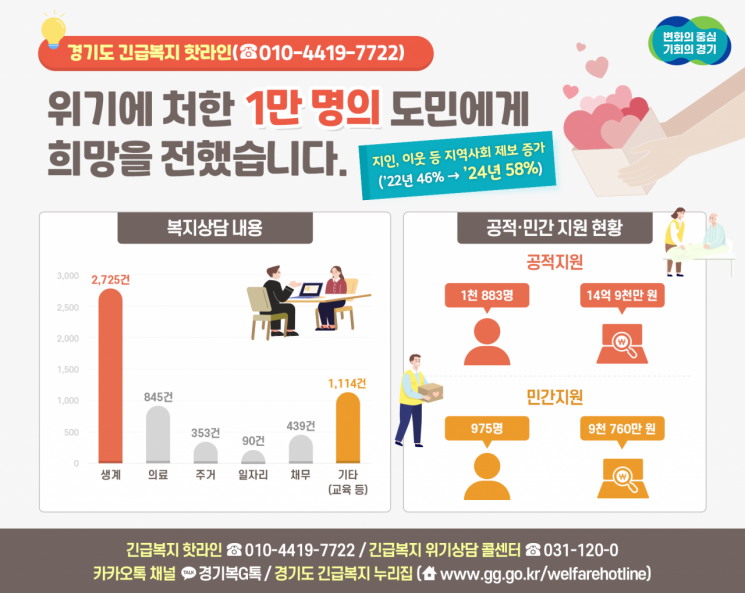
Gyeonggi Province's 'Emergency Welfare Hotline,' introduced in August 2022 to identify residents in crisis, has surpassed 10,000 counseling cases in just one year and six months.
Following the 'Suwon Three Mothers' incident, Gyeonggi Province established the Emergency Welfare Hotline (010-4419-7722) and the Emergency Welfare Crisis Counseling Call Center (031-120) on August 25, 2022, to eliminate welfare blind spots.
As of the 18th of this month, Gyeonggi Province announced on the 20th that analysis of calls received by the Emergency Welfare Hotline showed a total of 10,000 cases, including 4,286 welfare consultations and 5,714 cases related to unpaid health insurance premiums and in-province policy consultations.
Analysis of the 4,286 individuals who received welfare consultations revealed that those in their 50s were the largest group, accounting for 1,048 people or 24.5%. Regarding the types of assistance requested through welfare consultations (multiple responses allowed), 'livelihood support' accounted for 49%. This was followed by medical support (15%), housing (6.3%), and debt (8%). When categorized by household type, single-person households accounted for 42%, while two-person and three-person households accounted for 22% and 13%, respectively.
Among the 4,286 people who requested welfare assistance, Gyeonggi Province provided public support amounting to 1.49 billion KRW to 1,883 individuals, including those receiving emergency welfare, national basic livelihood security, and near-poverty support. Additionally, private support totaling 97.6 million KRW in cash, gift certificates, and donated goods was provided to 975 people.
Furthermore, to identify welfare blind spots, Gyeonggi Province has distributed Emergency Welfare Hotline promotional materials this year to 2,937 gosiwon (small lodging houses) with many housing-vulnerable residents, 36 jjokbangchon (tiny room villages), and 16 free meal centers.
Gyeonggi Province reports that while reports initially came mainly from family members or relatives when the hotline was first established, they have recently expanded to include acquaintances, neighbors, and other community members. In fact, community reports increased from 46% at the end of 2022, when the hotline was launched, to 58% by the end of January this year.
On the 19th of last month, a neighborhood resident called the Emergency Welfare Hotline and requested welfare assistance while simultaneously transporting an elderly woman who had fallen on the street and was bleeding from her face to the hospital.
Gyeonggi Province evaluated this case as evidence that residents have become more aware of the Emergency Welfare Hotline and do not hesitate to contact it for help in urgent situations.
Oh Byeong-kwon, the First Deputy Governor of Gyeonggi Province, stated, "Gyeonggi Province receives reports through four channels: the hotline, the Emergency Welfare Call Center, Gyeonggi Bok G Talk (KakaoTalk), and the Emergency Welfare website, whenever neighbors in need are found." He added, "We will do our best to ensure that residents in welfare blind spots can easily receive help through the Emergency Welfare Hotline."
© The Asia Business Daily(www.asiae.co.kr). All rights reserved.

















