Joint Research Achievements with Korea Institute of Energy Research Published in International Academic Journal
The research team led by Professor Jo Gye-yong (majoring in Industrial Chemistry) at Pukyong National University successfully developed a high-performance mixed matrix membrane by intentionally inducing defects in UiO-66 nanoparticles, one of the metal-organic frameworks (MOFs), and analyzing the effects of these defects on the fabrication and performance of the composite membrane.
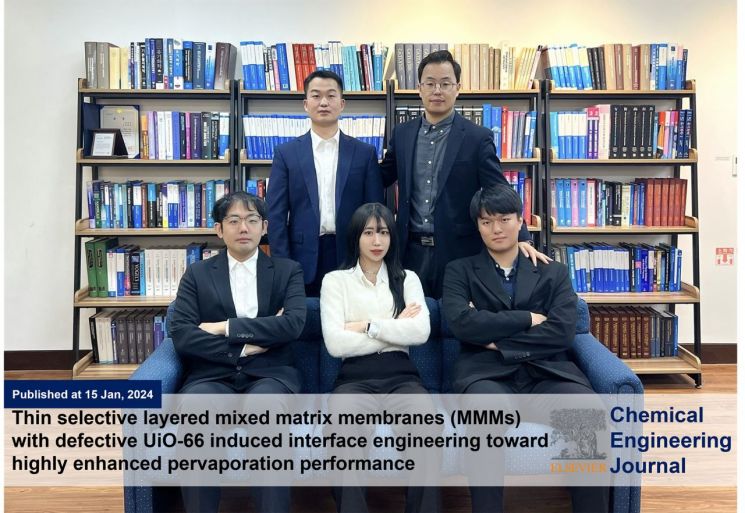
Professor Jo Gye-yong achieved this research outcome through a collaborative study with Professor Kwon Hyuk-taek (majoring in Chemical Engineering) and Professor Son Min-young (majoring in Industrial Chemistry) at the same university, along with Dr. Yeo Jeong-gu’s research team at the Korea Institute of Energy Research.
Metal-organic framework materials are porous, crystalline particles synthesized from metals and organic compounds. Due to their unique properties such as diverse combinations, high specific surface area, uniform pore size, and high tunability, active research is being conducted to utilize them in various fields including catalysis, gas separation, and storage.
However, these materials have low compatibility with polymer materials, leading to particle agglomeration and significantly reduced membrane stability and separation performance. Additionally, when fabricating thin composite membranes using these materials, the shape stability under separation driving conditions is low, making it difficult to produce thin-film membranes.
To overcome these limitations, Professor Jo Gye-yong’s research team developed a synthesis method that intentionally induces defects in UiO-66 particles by controlling reactant concentrations such as modulators. They also developed reaction conditions favorable for high-capacity synthesis while easily and simply controlling the interfacial properties of the particles, resulting in composite membranes that exhibit stable operating performance even in thin-film separation membranes.
The defects induced in UiO-66 particles strengthened interactions with polymers, minimizing dispersion issues, and increased interactions with water, the separation target, significantly enhancing separation performance.
The thin-film composite membranes fabricated using the strong interactions caused by defects showed a permeation separation index (PSI) approximately 1664% (16 times) higher than conventional polymer membranes, demonstrating greatly improved separation performance.
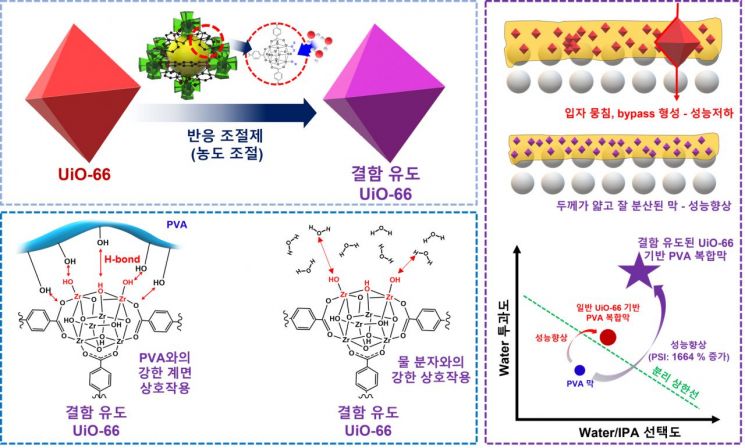 Summary diagram of Defective MOF synthesis and the impact of defects on membranes and membrane performance.
First author of the study, Researcher Choi Kyung-min, stated, “If defects in metal-organic framework materials can be intentionally controlled or regulated, the application of these materials, which are used in various fields, is expected to increase and diversify related industries. We plan to further focus on the development, application, and commercialization of new materials.”
This research was supported by the Korea Research Foundation’s Excellent Young Researcher Program, and the paper titled ‘Thin selective layered mixed matrix membranes (MMMs) with defective UiO-66 induced interface engineering toward highly enhanced pervaporation performance’ was published on the 15th in an international journal in the field of chemical engineering (IF=15.1).
© The Asia Business Daily(www.asiae.co.kr). All rights reserved.
![Clutching a Stolen Dior Bag, Saying "I Hate Being Poor but Real"... The Grotesque Con of a "Human Knockoff" [Slate]](https://cwcontent.asiae.co.kr/asiaresize/183/2026021902243444107_1771435474.jpg)

















