"The cost-sharing ratio for transfer losses on the Busan-Gimhae Light Rail Transit (LRT) should be split evenly between Busan and Gimhae as per the existing agreement."
On the 15th, Hong Taeyong, mayor of Gimhae City, Gyeongnam Province, held a press conference at the Gimhae City Hall Press Center and demanded that Busan adjust the cost-sharing ratio for LRT transfer losses.
Mayor Hong stated, "Our city and Busan have broadly agreed on the full free transfer policy for metropolitan transfers involving Gimhae, Yangsan, Busan buses, Busan-Gimhae LRT, and Busan Metro, and are currently negotiating the cost-sharing ratio for transfer losses," adding, "Busan insists on the cost-sharing ratio of Gimhae 63.19% and Busan 36.81%, which was set during the LRT project restructuring."
"Looking at the transfer ratio between Busan and Gimhae over the past six years, Busan accounts for about 85% of transfers annually, meaning most transfers occur in Busan," he pointed out, "yet Gimhae is bearing about 800 million KRW more than Busan."
He emphasized, "According to the agreement on the metropolitan transfer discount system for Busan, Gimhae, and Yangsan regions signed in 2010, Busan and Gimhae should share the burden equally."
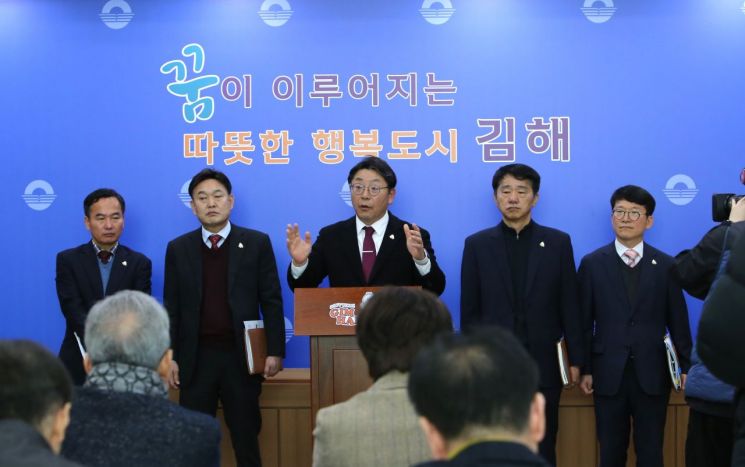 Hong Tae-yong, mayor of Gimhae City, Gyeongnam, is urging an adjustment to the loss-sharing ratio for transfers on the Busan-Gimhae Light Rail Transit.
 [Photo by Lee Se-ryeong]
According to Gimhae City, Article 10 of the metropolitan transfer agreement signed at the end of 2010 specifies that transfer losses within the jurisdiction of the light rail transit are to be borne individually, while losses from transfers between jurisdictions are to be shared 50% each.
The city explained that the cost-sharing ratio changed when the method shifted from the Minimum Revenue Guarantee (MRG) system, which supported fare revenue below a certain percentage of estimated demand in 2002, to the Minimum Cost Compensation (MCC) system in 2017, which supports only the actual shortfall in operating revenue. This change was due to the overestimation of expected ridership when the project plan was made.
The initial agreement anticipated ridership proportions of Gimhae 61.3% and Busan 38.7%, but the city argues that the cost-sharing ratio should be adjusted to reflect the actual ridership proportions of Gimhae 48.5% and Busan 51.5%.
With the complete elimination of public transportation transfer fares among Busan, Gimhae, and Yangsan cities scheduled for May 3, concerns were also expressed that the financial burden on Busan and Gimhae to support fare costs for the Busan-Gimhae LRT private operator until 2041 will increase.
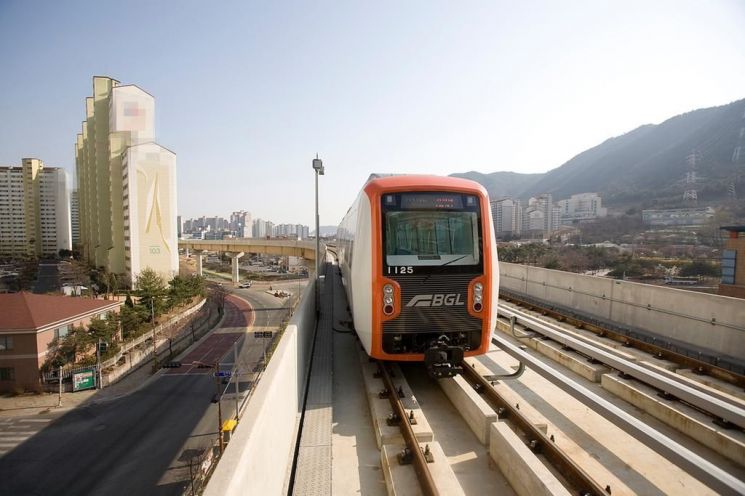
Mayor Hong stated, "So far, Gimhae City has spent about 415.7 billion KRW and Busan about 242.5 billion KRW on the Busan-Gimhae LRT, with Gimhae bearing nearly twice the cost of the metropolitan city Busan," and argued, "It is unfair for the basic local government Gimhae to bear more of the loss-sharing ratio resulting from the metropolitan transfer free policy."
"Due to route reorganizations caused by moving bus route depots, new routes and transfer costs have been incurred, causing inconvenience to citizens," he said. "We have to continue financially supporting the private LRT operator for another 17 years, and it is hard to accept the continuation of this unreasonable situation."
He added, "Since the first half of last year, we have continuously requested Busan to adjust the transfer loss-sharing ratio, but it has not been accepted," and warned, "If Busan continues to insist on the current sharing ratio, it will be difficult to expect cooperative relations in the future."
"Busan and Gimhae have long been neighbors separated by the Nakdong River, coexisting and cooperating, and will remain inseparable with future projects such as attracting the Northeast Asia logistics platform," he said. "We urge a decision befitting the dignity of a major city to ensure the transfer loss-sharing ratio is implemented based on the 2010 agreement."
The Busan-Gimhae LRT, initiated as a government pilot project for light rail transit in 1992, has operated since its opening in 2011, running 21 stations over a 23.764 km section between Busan Sasang Station and Gimhae Gaya University Station.
The project involved a total construction cost of 1.3 trillion KRW, including 189.8 billion KRW in national funds, 832 billion KRW in private capital, and 94.9 billion KRW each from Busan and Gimhae city budgets, but it has consistently operated at a deficit, requiring hundreds of billions of KRW in annual subsidies.
© The Asia Business Daily(www.asiae.co.kr). All rights reserved.
![Clutching a Stolen Dior Bag, Saying "I Hate Being Poor but Real"... The Grotesque Con of a "Human Knockoff" [Slate]](https://cwcontent.asiae.co.kr/asiaresize/183/2026021902243444107_1771435474.jpg)

















