SNE Research Survey Results
Impact of Insufficient New Cars and Charging Infrastructure
Expansion of Market Share Centered on Chinese Commercial Vehicles
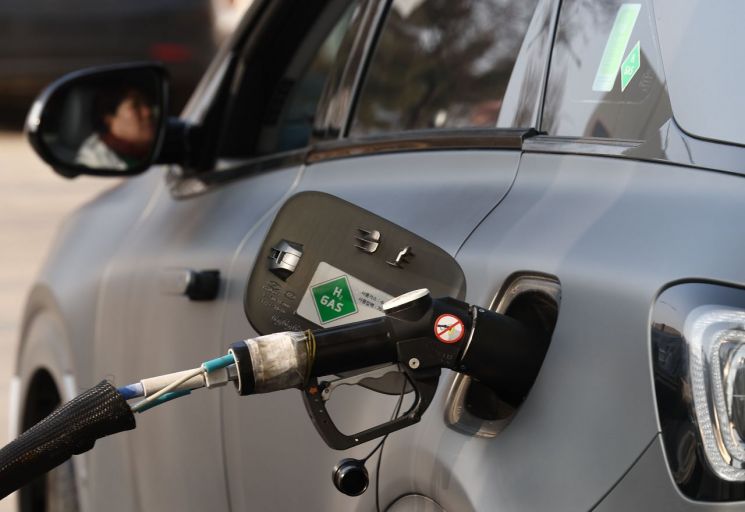 A hydrogen vehicle charging at the National Assembly Hydrogen Charging Station in Yeouido, Yeongdeungpo-gu, Seoul on the 13th. [Image source=Yonhap News]
Last year, the number of hydrogen cars sold domestically was only about half of the previous year. The lack of new car launches and poor charging infrastructure were pointed out as the main causes.
According to market research firm SNE Research on the 15th, the total sales of hydrogen fuel cell vehicles registered worldwide from January to December 2023 amounted to 14,451 units, a 30.2% decrease compared to the same period last year.
By company, Hyundai Motor Company maintained its leading position in the hydrogen car market with a market share of 34.7%, selling 5,012 units of the NEXO and ELEC CITY. However, its market share fell by 20.1 percentage points (p) from 54.8% the previous year. Hyundai's NEXO sold only 4,709 units last year, a 55.9% decrease compared to 11,179 units in the previous year.
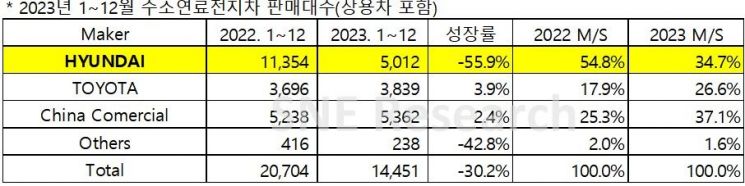
Toyota's Mirai recorded a 3.0% growth rate by selling 3,737 units in 2023. Chinese companies continue to grow mainly in the commercial vehicle market. Chinese companies sold 5,362 commercial hydrogen vehicles in 2023, an increase of 2.4% compared to the previous year.
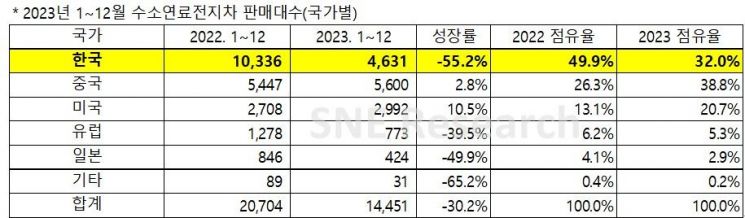
By country, South Korea saw a 55.2% decrease compared to the same period last year due to the sluggish sales of Hyundai's NEXO. China ranked first in the global hydrogen car market with a 38.8% market share.
The primary reason for the hydrogen car market's contraction is the lack of new vehicles. Hyundai has not released any additional models since launching the NEXO in 2018. It only released facelift models of the NEXO twice, in 2021 and 2023.
In addition, rising hydrogen car charging costs, defective hydrogen accidents, and insufficient hydrogen charging infrastructure have reduced the appeal of hydrogen cars in the eco-friendly vehicle market.
In contrast, the Chinese government is actively promoting the expansion of hydrogen car adoption and infrastructure development through the 'Hydrogen Energy Industry Medium- to Long-Term Development Plan (2021?2035)'. China is expanding its hydrogen car market share by leveraging the commercial vehicle market.
In November 2023, Japan's Toyota launched a hydrogen fuel cell vehicle based on the CROWN sedan. The CROWN is equipped with the same hydrogen fuel cell system as the existing Mirai.
Honda plans to launch a hydrogen fuel cell vehicle based on the CR-V sport utility vehicle (SUV) in the Japanese and North American markets within the year. Honda withdrew from the hydrogen car market by discontinuing the Clarity in 2021 but has re-entered the competition based on the popular CR-V model. Hyundai plans to release a new NEXO (The All-New NEXO) in 2025.
© The Asia Business Daily(www.asiae.co.kr). All rights reserved.

![Clutching a Stolen Dior Bag, Saying "I Hate Being Poor but Real"... The Grotesque Con of a "Human Knockoff" [Slate]](https://cwcontent.asiae.co.kr/asiaresize/183/2026021902243444107_1771435474.jpg)

















