Commercial-Residential Villas, Many Unable to Receive Damage Support
Thousands of Won Cheaper Jeonse? Should Be Suspicious
Illegal Renovated Listings Must Be Disclosed, But Reality Is...
There is a surge in victims who cannot receive support for jeonse (long-term lease) fraud after moving into so-called 'Geunsaeng Villas,' which are neighborhood living facilities illegally converted for residential use. Licensed real estate agents have the duty to inform transaction parties of the building's designated use to prevent such damage, but in practice, transactions are sometimes induced without disclosing this fact, requiring special caution.
 A villa-dense area in Seoul. The photo is not related to the article. [Image source=Asia Economy DB]
On the 13th, when searching a villa-dense area around Samseongyo in Seongbuk-gu, Seoul through a real estate brokerage platform, there were listings for jeonse and half-jeonse one-room units priced several tens of millions of won below market value. All these listings stipulated 'no jeonse loan available' as a transaction condition.
However, the reason for the loan unavailability was not separately specified in the postings. The detailed description section indicated that the properties fall under multi-family housing or apartment housing according to the Housing Act. Under the Housing Act, row houses and multi-family houses are classified as apartment housing, while one-room buildings and multi-household houses fall under the category of detached houses.
However, upon checking the building register, the listings specifying no jeonse loan availability were 'Geunsaeng Villas,' which are neighborhood living facilities illegally converted for residential use. Geunsaeng Villas are buildings illegally converted from commercial facilities to residential use and are not legally classified as housing, so jeonse loans cannot be obtained. They are considered illegal buildings, making it impossible to subscribe to jeonse deposit insurance, and even if victims suffer jeonse fraud, they cannot be compensated under the Special Act on Support for Jeonse Fraud Victims.
To prevent tenants from bearing damage due to such illegally converted properties, licensed real estate agents have the obligation to disclose the actual use of the building to customers during transactions. However, in practice, there is a tendency to conceal the fact that the property is a Geunsaeng Villa.
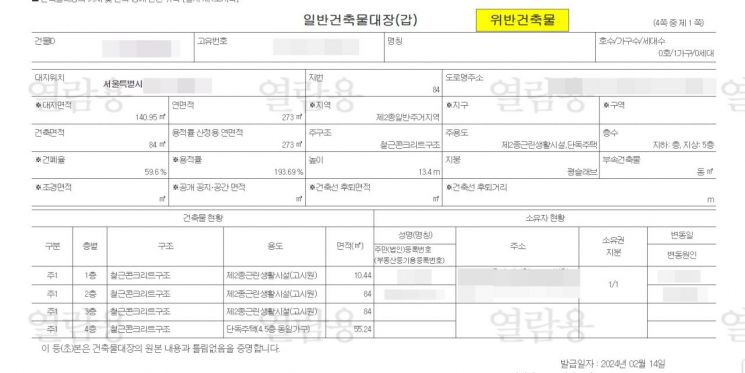 The building register of a commercial villa listed as a property on a real estate brokerage platform. The licensed real estate agent did not disclose that the building corresponds to a neighborhood living facility.
 [Photo by Lee Ji-eun]
In fact, after contacting three real estate agencies in the Samseongyo area and viewing three Geunsaeng Villas, not a single licensed real estate agent properly disclosed whether the property was a neighborhood living facility. When asked why jeonse loans were unavailable, one agent hesitated, saying, "There is a lot of mortgage, so loans cannot be obtained," then added, "Because it is a violation building, loans are difficult."
A landlord who accompanied the agent on site also gave false explanations. When asked which type of building the listing belonged to, he replied, "It corresponds to a multi-family house." However, the building register confirmed that the building was approved for use as a Type 2 neighborhood living facility classified as a goshiwon (small lodging house). Moreover, the balcony had been illegally extended, and a violation building mark was noted. The real estate agent showing the house on site did not explain these facts.
Damage caused by contracts made without proper disclosure from real estate agents is entirely borne by the tenants. In May last year, in Eunpyeong-gu, Seoul, an incident occurred where tenants living in about 100 Geunsaeng Villas, which had been approved for construction as neighborhood living facilities but illegally converted, could not recover their deposits. The estimated damage amount is in the hundreds of billions of won. They are expected to have difficulty recovering deposits because they could not subscribe to jeonse deposit insurance on the grounds that the buildings are not housing.
Furthermore, even if tenants acquire Geunsaeng Villas through auction, they must pay enforcement fines to use them for residential purposes. Under current law, if cooking facilities installed in neighborhood living facilities are not removed, an enforcement fine of up to 10% of the standard market price per year for up to two units must be paid. According to statistics from the Ministry of Land, Infrastructure and Transport, enforcement fines imposed on Geunsaeng Villas over three years from 2020 amounted to about 20 billion won. This averages to about 6.14 million won per unit.
Voices are calling for strengthened crackdowns at the local government level to prevent transaction damage caused by insufficient disclosure. Kwon Il, head of the Real Estate Info Research Team, said, "It is the duty of licensed real estate agents to provide clear explanations about the brokerage object to customers, so if disclosure is insufficient, objections can be raised against them. At the local government level, crackdowns on Geunsaeng Villas and illegal extensions should be strengthened, and enforcement against licensed real estate agents who fail to properly disclose these facts should also be intensified."
© The Asia Business Daily(www.asiae.co.kr). All rights reserved.
![Clutching a Stolen Dior Bag, Saying "I Hate Being Poor but Real"... The Grotesque Con of a "Human Knockoff" [Slate]](https://cwcontent.asiae.co.kr/asiaresize/183/2026021902243444107_1771435474.jpg)
















