Over 300 Trillion Won Decrease Compared to 2022
Due to Geopolitical Conflicts and Increased Administrative Burdens
Number of Listed Companies Increased but Uncertainty Concerns Remain
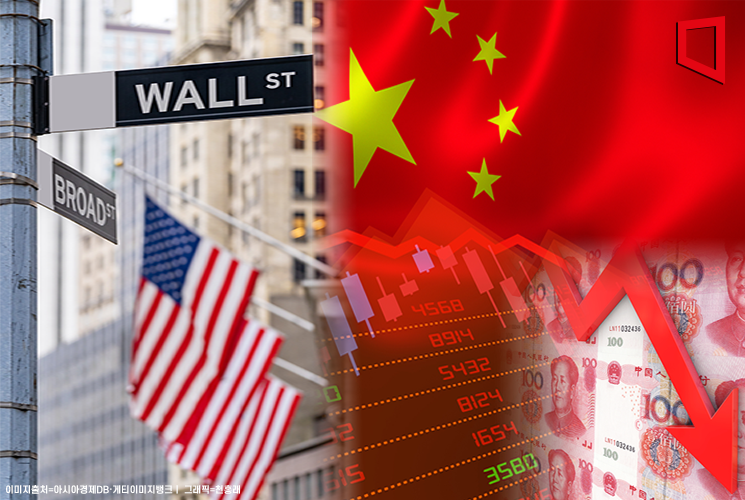
A survey revealed that the value of Chinese companies listed on the U.S. stock market decreased by nearly 18% last year.
On the 14th, Hong Kong's South China Morning Post (SCMP) cited data from the U.S. Congressional advisory body, the U.S.-China Economic and Security Review Commission (UCESRC), reporting that the market capitalization of approximately 256 Chinese companies listed on the three major U.S. stock exchanges?New York Stock Exchange, Nasdaq, and American Stock Exchange?was $804.8 billion (about 1,075 trillion KRW). This represents a decrease of $225.2 billion (17.5%) compared to the $1.03 trillion market capitalization of 252 Chinese companies listed on the U.S. stock market in 2022.

Despite the net increase in the number of listed companies, the market capitalization shrank by more than 300 trillion KRW, which the commission attributed to the slowdown of the Chinese economy, rising geopolitical tensions, and the voluntary delisting of some Chinese state-owned enterprises following the U.S.-China accounting oversight agreement.
Last year, 24 Chinese companies newly listed on the U.S. stock market, raising a total of $656 million. On the other hand, 11 companies, including state-owned enterprises such as China Eastern Airlines and China Southern Airlines, were delisted, with the combined corporate value of these two companies alone reaching $32.3 billion. Many companies decided to voluntarily delist following the U.S.-China accounting oversight agreement.
Chinese state-owned enterprises cited "high administrative burdens and costs" as reasons for withdrawal. However, the commission viewed the delisting decisions as a way to prevent U.S. regulators from obtaining information about these companies. According to SCMP, the information requested by the U.S. included the proportion of government agency shareholdings, a list of Communist Party officials on the board of directors, and whether the company’s articles of incorporation included the Communist Party charter.

The commission's report also questioned the legal status of the so-called 'Variable Interest Entity (VIE)' structure used by companies listed on the U.S. stock market. Many major Chinese big tech companies such as Alibaba, JD.com, and Pinduoduo have used VIEs?offshore entities established in tax havens like the Cayman Islands?to circumvent foreign investment restrictions and other regulations, thereby listing on the U.S. stock market. A total of 166 Chinese companies used this method, accounting for 91% of the market capitalization of Chinese companies listed on the U.S. stock market.
The commission also raised the possibility that China might withdraw from the agreement to allow audits of its state-owned enterprises, worsening transparency. In August 2022, China agreed to provide data from Chinese accounting firms auditing Chinese companies listed on the U.S. stock market to U.S. regulators. The commission stated, "Concerns about continued cooperation from Chinese regulatory authorities remain," adding, "Chinese authorities may violate the agreement and reintroduce restrictive measures, which could lead to forced delisting of companies and harm foreign investors."
Meanwhile, the UCESRC, which issued the report, was established in 2000 with the purpose of advising Congress on the impact of trade and economic relations between the two countries on national security.
© The Asia Business Daily(www.asiae.co.kr). All rights reserved.
![Clutching a Stolen Dior Bag, Saying "I Hate Being Poor but Real"... The Grotesque Con of a "Human Knockoff" [Slate]](https://cwcontent.asiae.co.kr/asiaresize/183/2026021902243444107_1771435474.jpg)


















