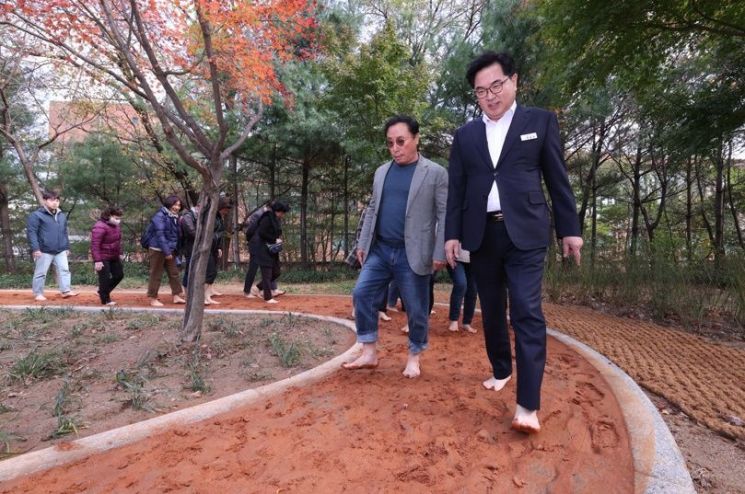
 Park Il-ha, Mayor of Dongjak District (right in the photo), is walking on the Barefoot Loess Trail at Daebang Park in Dongjak District. (Photo by Dongjak District Office)
The barefoot walking craze is heating up. Local governments are competing again this year, following last year, to create ‘barefoot paths’ such as loess trails that are ideal for walking barefoot.
The benefits of barefoot walking, such as improved blood circulation and stress relief, are widely known, and the impact of an aging population is significant. Since these facilities can be used daily by residents for health purposes, their utilization efficiency is high, and from the perspective of local governments, they are well-received by residents.
Seoul and Others Rush to Enact Ordinances
Ordinances related to barefoot walking are being enacted nationwide, including in Seoul, Busan, Yongin, and Jeonju. On the 12th, the Busan Metropolitan Council passed the ‘Busan Metropolitan City Ordinance on the Activation and Support of Barefoot Walking in Urban Parks, etc.’ The passage of this ordinance means that projects such as the installation and maintenance of facilities to promote barefoot walking, as well as administrative and financial support necessary for the activation of barefoot walking, will become more active.
The Seoul Metropolitan Council already passed the ‘Seoul Metropolitan City Ordinance on the Support for the Activation of Barefoot Walking,’ which was introduced by Assemblyman Yumanhee (People Power Party) in July last year. After the passage of the Seoul ordinance, district councils have also rushed to enact ordinances, making the barefoot walking trend a flagship project for local governments.
In the metropolitan area, such as Yongin City in Gyeonggi Province, and in provinces like Jeonju in North Jeolla Province, the enactment of ordinances and the creation of barefoot walking trails and hiking paths are expanding. The barefoot paths defined in the ordinances are unpaved dirt trails in park areas, urban parks, hiking trails, and forest experience courses.
Preferably, Healthy Loess Trails
Dongjak-gu in Seoul is one of the places actively creating barefoot paths. Dongjak-gu is promoting the ‘One Barefoot Loess Trail per Neighborhood’ project. In the second half of last year, barefoot loess trails were opened in three locations: Sangdo, Hyeonchung, and Daebang Parks. In the first half of this year, loess trails are planned for six parks: Nodeulnaru, Gogudongsan, Seodalsan (next to Saimdang Cafe), Kkachisan (behind Jinhung Apartments), Dohwa, and Samil. To install the loess trails, a demand survey was even conducted for residents in November last year.
Guro-gu plans to create three loess trails in the first half of this year alone. A 450-meter loess trail will be built along the cypress tree path in Yeonji Neighborhood Park, and about 700 square meters of loess trail will be created in the Jatjeol district of Onsu Neighborhood Park in Gaebong-dong. The budget is considerable, with 500 million KRW and 300 million KRW allocated respectively. The loess trails will also include foot washing stations and rest areas for users.
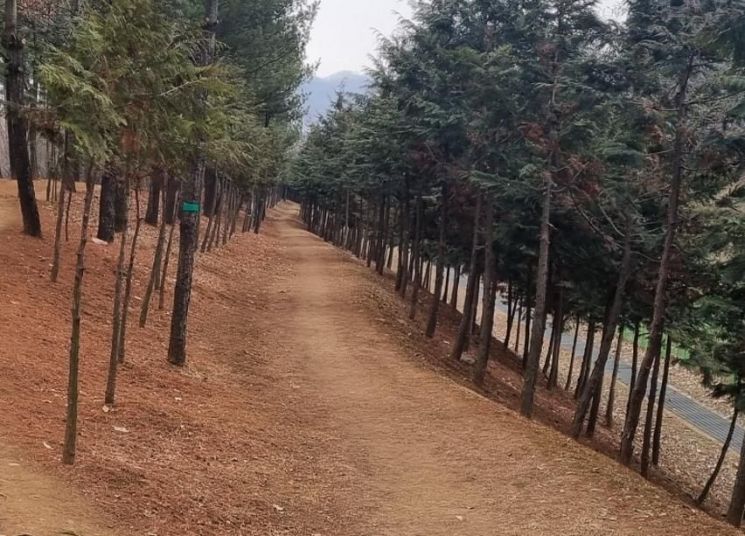 Yeonji Neighborhood Park in Guro-gu, where the creation of a loess road is being promoted. (Photo by Guro-gu Office)
Guro-gu expects that once the loess trail is created along the cypress tree path, people will be able to enjoy barefoot walking while experiencing the phytoncides of the cypress trees, achieving two benefits at once. In October last year, Guro-gu created a loess trail of about 500 square meters along Anyangcheon Stream, and this year plans to add a 110-meter loess trail near Sinjeonggyo Bridge on the small trail along Anyangcheon.
Yeongdeungpo-gu also created three loess trails totaling 600 meters along Anyangcheon Stream and opened them last month. This year, simple loess trails were created in five locations including Singil 9 District and Gochu-mal Children’s Park. Plans are also underway to create loess trails within resident-friendly spaces to be built on public land in Mullae-dong, continuing steady efforts to expand loess trails.
Seocho-gu created barefoot paths in four locations last year, including Banpo Neighborhood Park and Banpocheon Stream, and plans to add more this year in Seoripul Park, Umyeonsan, and the Culture and Arts Park.
© The Asia Business Daily(www.asiae.co.kr). All rights reserved.
![Clutching a Stolen Dior Bag, Saying "I Hate Being Poor but Real"... The Grotesque Con of a "Human Knockoff" [Slate]](https://cwcontent.asiae.co.kr/asiaresize/183/2026021902243444107_1771435474.jpg)

















