Satellite Party Symbol Decided Based on Incumbent Lawmaker Placement
Reform New Party Confident of Up to 20 Members by Next Month
The Reform New Party, which has integrated the third zone, faces the satellite parties of the two major parties as the biggest variable in obtaining candidate number 3 in the general election. The candidate number 3 party is expected to be determined by how many incumbent lawmakers the People Power Party and the Democratic Party place in their satellite parties, which only aim for proportional representation seats.
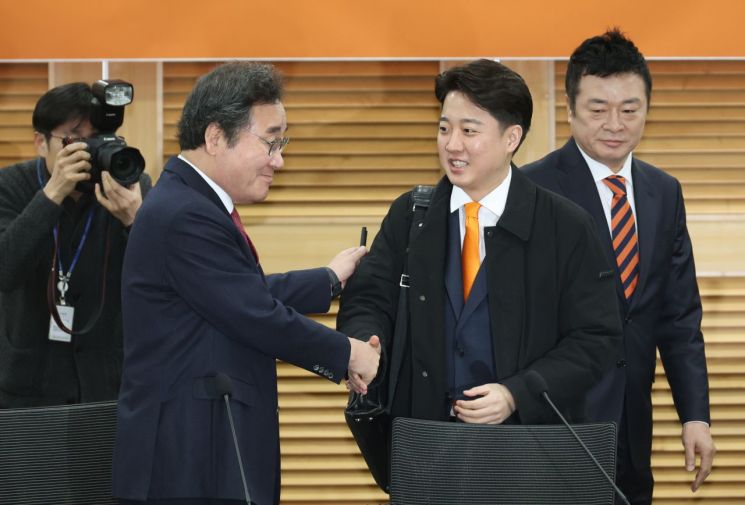
According to political circles on the 14th, based on the current number of seats, the candidate numbers for the April 10 general election will be: the Democratic Party with 164 seats as number 1, the People Power Party with 113 seats as number 2, and the Green Justice Party with 6 seats as number 3. For the Reform New Party, which has secured 4 incumbent lawmakers, to receive candidate number 3, it must secure at least 3 more lawmakers than the Green Justice Party. Lee Jun-seok, co-representative of the Reform New Party, expressed confidence in an interview with the media, saying, "(The number of seats) is planned to increase to 6 or 7," and "When the candidate number is finalized around mid-March, we will be able to become a negotiating group."
Party candidate numbers are determined based on the number of incumbent lawmakers as of the candidate registration deadline on the 22nd of next month, with the order going to parties with more incumbents. The Reform New Party currently expects to secure up to 20 seats by mid-next month depending on the nomination results of the People Power Party and the Democratic Party. There is also a precedent of a third zone new party receiving candidate number 3. In the 21st general election, the Minsheng Party secured 20 incumbent lawmakers and received candidate number 3.
The variable is how many incumbent lawmakers the two major parties place in their satellite parties. If the satellite parties place more incumbents than the Reform New Party, candidate number 3 will go to the satellite parties. In the previous general election, following the Minsheng Party, the satellite parties of the United Future Party (now People Power Party) and the Democratic Party?Mirae Korea Party (17 members) as number 4, and Together Citizens' Party (8 members) as number 5?were assigned proportional representation voting numbers. At that time, the difference in the number of seats between numbers 3 and 4 was only 3 seats.
Depending on the nomination results of the two major parties, the competition for securing incumbent lawmakers between the satellite parties and the Reform New Party is expected to intensify. The 'senior sacrifice theory' is growing within the People Power Party, and within the Democratic Party, conflicts between the pro-Lee Jae-myung faction and the pro-Moon Jae-in faction are intensifying over the 'responsibility theory for the birth of the Yoon Seok-youl administration,' complicating the calculations regarding the future moves of potential defectors.
The Reform New Party also began to check the satellite parties immediately after its founding for the same reason. Jo Eung-cheon, a Reform New Party lawmaker, emphasized at the first supreme council meeting, "The leadership of the two parties is expected to soon demand that lawmakers who have given up running transfer their party affiliation to satellite parties," and appealed, "We strongly ask you to firmly say 'No' to the unscrupulous demands of the two party leaderships that distort the pure intention of not running and extremely hinder the development of Korean politics."
They are also accelerating the securing of incumbent lawmakers, which is key to obtaining candidate number 3. The Reform New Party is discussing the intention to join with independent lawmaker Yang Jeong-suk, formerly of the Democratic Party, and independent lawmaker Hwang Bo-seung-hee, who declared non-candidacy and withdrawal from the party for the 22nd general election. According to election law, if the Reform New Party secures 5 incumbent lawmakers by the 15th, it will receive 600 million won in national subsidies for the first quarter of this year and, as a party with 5 or more but fewer than 20 seats as of the 22nd of next month, will be allocated 5% of the total election subsidy amount (50.197 billion won), which is 2.5985 billion won.
© The Asia Business Daily(www.asiae.co.kr). All rights reserved.
![Clutching a Stolen Dior Bag, Saying "I Hate Being Poor but Real"... The Grotesque Con of a "Human Knockoff" [Slate]](https://cwcontent.asiae.co.kr/asiaresize/183/2026021902243444107_1771435474.jpg)
















