12% of Korean Workers Work Over 50 Hours... OECD Average is 10.2%
Proportion of Workers Over 60 Hours is Even Lower
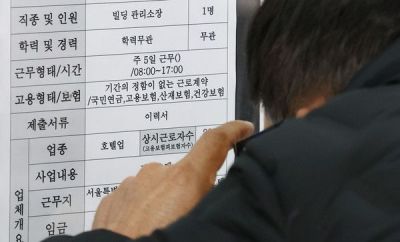
A claim has emerged that the proportion of wage workers in South Korea who actually work more than 50 hours per week is 12%, which is similar to the average level of the Organisation for Economic Co-operation and Development (OECD).
On the 13th, the Korea Employers Federation (KEF) announced the 'Status and Trends of the Proportion of Long-Hour Workers: An International Comparison' containing this information. According to KEF, in 2022, the number of wage workers working more than 50 hours per week was identified as 2.53 million (12.0%) based on actual working hours, and 2.24 million (10.3%) based on usual scheduled working hours. This is higher than the OECD average proportion of long-hour workers, which is 10.2%.
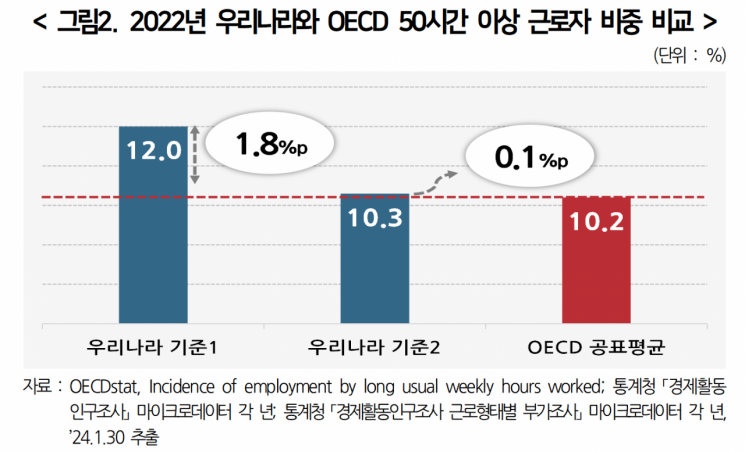
However, the standards are not exactly the same as those of the OECD. KEF explained that it could not obtain statistics on the proportion of long-hour workers that exactly match OECD standards from Statistics Korea, so it compiled the data based on the criteria it judged to be most similar: actual working hours and usual scheduled working hours.
Actual working hours refer to the calculated working hours from all jobs (including full-time and side jobs). This may lead to an overestimation compared to OECD standards. Usual scheduled working hours refer to the calculated working hours from the main job and may be underestimated compared to OECD standards.
According to KEF's survey, the proportion of Korean wage workers working 60 hours or more per week last year was 3.2% based on actual working hours and 2.7% based on average scheduled working hours, which is actually lower than the OECD average of 3.8%.
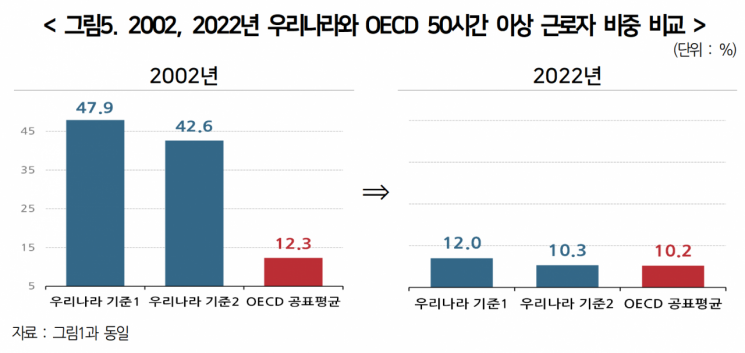
The proportion of long-hour workers has sharply decreased over the past 20 years.
According to KEF's survey, in 2002, the proportion of wage workers working more than 50 hours per week was 47.9% based on actual working hours and 42.6% based on usual scheduled working hours. By 2022, this had decreased by 32.3 to 35.9 percentage points. During the same period, the OECD average decreased by 2.1%.
The proportion of wage workers working more than 60 hours per week showed a similar trend. It decreased by 17.3 to 18.9 percentage points over 20 years, from 22.1% based on actual working hours (20% based on average scheduled working hours) in 2002. During the same period, the OECD average decreased by 2 percentage points.
Ha Sang-woo, head of KEF's Economic Research Department, analyzed, "Both statistics indicate that South Korea is no longer a country of long working hours," adding, "While efforts to further reduce working hours to improve workers' quality of life are still necessary, the time when resolving long working hours itself was a policy goal has already passed." He emphasized, "The paradigm of working hours policy focused on regulation must be changed to a policy paradigm that can enhance flexibility and productivity."
© The Asia Business Daily(www.asiae.co.kr). All rights reserved.
![Clutching a Stolen Dior Bag, Saying "I Hate Being Poor but Real"... The Grotesque Con of a "Human Knockoff" [Slate]](https://cwcontent.asiae.co.kr/asiaresize/183/2026021902243444107_1771435474.jpg)













