Frequent Debates Over 'Sebae Money Age' Recently
Some Suggest Completely Abolishing Sebae Money Culture If So
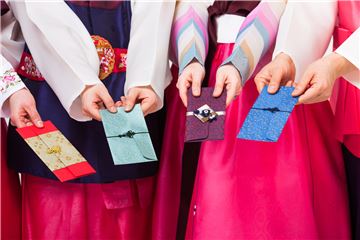 In a similar survey conducted last month by Lotte Members involving 2,000 men and women aged 20 and above, 69.4% responded that "New Year's money should be given until college or high school." "Until before employment" accounted for 16.5%, followed by "until before marriage" at 5.1%.
 [Photo by Getty Images Bank]
This Lunar New Year, netizens' opinions are divided over a sister-in-law's story about giving generous New Year's money to her nephews and nieces but not receiving any from her sister-in-law for her own children. In particular, there is much debate about until what age New Year's money should be given. On the 13th, a story titled "I didn't receive New Year's money" was posted on an online community. The author, A, wrote, "I gave New Year's money to my sister-in-law's children this Lunar New Year, but received nothing in return."
Specifically, A gave 100,000 won and 200,000 won as New Year's money to her sister-in-law's children, who are one middle school student and one high school student, respectively. On the other hand, A's own children, one university student and one young adult just starting their career, did not receive a single won from the sister-in-law, according to A.
A explained, "I think it's okay not to give to the eldest child who is a young adult, but for the second child who is a university student, I believe even a single 10,000 won bill should be given regardless of the amount." She added, "I don't know if it's originally correct not to give anything at all because they are adults, but it feels disappointing." She continued, "According to my husband, our children are all grown up so they don't receive anything, but we have always given New Year's money to my sister-in-law's children since they were newborns," and "Our children didn't receive New Year's money when they were young because they were considered too young." She then asked netizens, "How do other families handle New Year's money for university students?"
Netizens' opinions on the story were divided. Some commented, "Don't think of it as getting it back; just give as much as you don't mind giving to your nephews and nieces," and "Once they graduate high school and become adults, it's okay not to give." On the other hand, some said, "New Year's money is supposed to circulate. Even if not the full amount, at least a minimum gesture should be made," and "The sister-in-law who didn't give any New Year's money is really inconsiderate." One netizen suggested, "If we're going to argue about New Year's money like this, maybe it's better to get rid of this culture altogether."
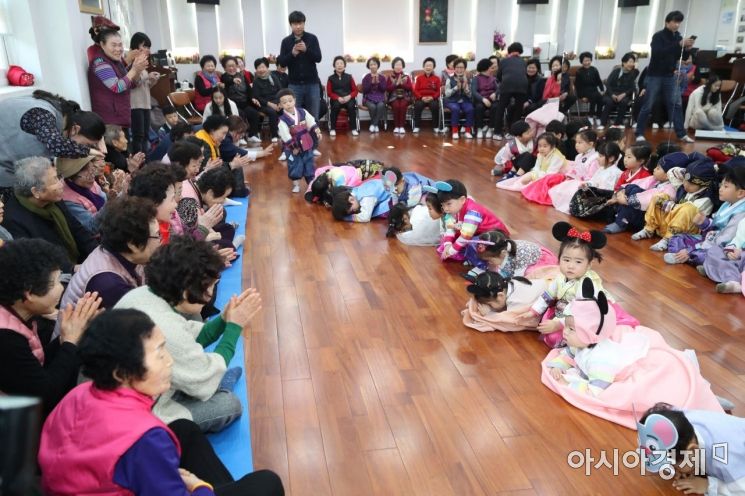 Children dressed in hanbok are performing the traditional New Year's bow to elders at a joint Sebae event held at a cultural center in a district. [Asia Economy DB]
New Year's Money That Forces Everyone Into a Game of Social Cues: Until What Age and How Much Should Be Given?
In this era of high inflation, debates about the "age for New Year's money" have been frequently occurring online. Among them, a survey that gives insight into the opinions of people in their 20s to 40s was released. Convenience store CU announced on the 9th that in a related survey conducted on its commerce app Pocket CU, the most common response, at 34.7%, was "Give New Year's money until before employment." This was followed by "Give to all minors" (30.4%), "Give to everyone who performs the New Year's bow regardless of age" (18.4%), and "Only give to children" (6.7%). Additionally, 2.1% answered, "Those who earn more give to those who earn less." The responses showed clear generational differences.
Among those who said they give until before employment, 48% were in their 20s. This is interpreted as a hopeful response from 20-somethings, many of whom are job seekers. In their 30s, the most common answer (39%) was that those who earn more give to those who earn less, while in their 40s, who tend to have more stable incomes, the majority (44%) said they give to all minors. Earlier, Lotte Members conducted a similar survey last month targeting 2,000 men and women aged 20 and above, in which 69.4% answered that New Year's money should be given up to university or high school students. "Until before employment" was 16.5%, and "Until before marriage" was 5.1%.
© The Asia Business Daily(www.asiae.co.kr). All rights reserved.
![Clutching a Stolen Dior Bag, Saying "I Hate Being Poor but Real"... The Grotesque Con of a "Human Knockoff" [Slate]](https://cwcontent.asiae.co.kr/asiaresize/183/2026021902243444107_1771435474.jpg)











