Says She Felt Hurt Because No Kimchi Was Sent Even During Kimjang
"Shameless" VS "Would Have Sent If She Were a Daughter"
During the Lunar New Year holiday, a story about an "annoying daughter-in-law" rather than an "annoying sister-in-law" was posted online, gaining sympathy from netizens. In the past, stories from daughters-in-law complaining about endless labor such as "making jeon (Korean pancakes)" or "dishwashing hell" at their in-laws' house were common, but nowadays, stories about "daughters-in-law who do nothing" are frequently posted, reflecting the changing holiday atmosphere.
On the 10th, a post titled "Should I pack food for my sister-in-law?" was uploaded on an online community and quickly became a hot topic, surpassing 100,000 views in just one day. The author, A, began by saying, "I’m calming down my excitement to ask this," and explained, "My mother believes that if you don’t work, you shouldn’t eat. For example, when making kimchi, only those who participated get kimchi packed for them."
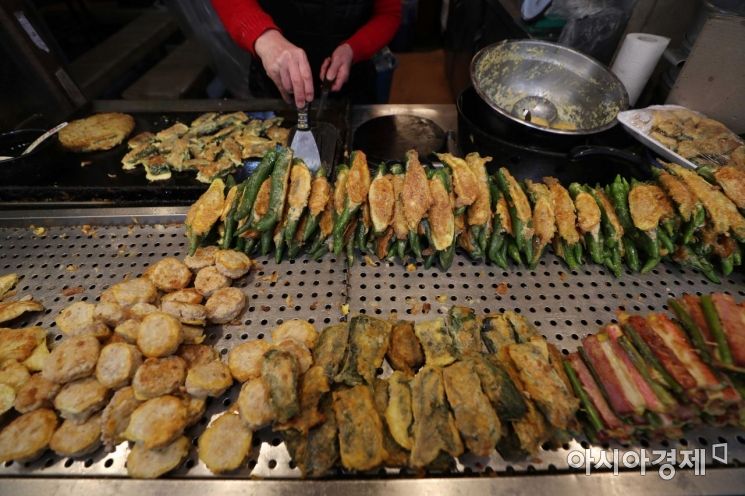 On the 10th, a post titled "Should I pack food and send it to my sister-in-law?" was uploaded to an online community, quickly becoming a hot topic among netizens with over 100,000 views in just one day. The photo is not related to the specific content of the article.
 [Photo by Moon Honam munonam@]
Although they do not perform ancestral rites during the holidays, A said they still make jeon to eat. "It’s a lot of work and tiring, but since it tastes good, I think the effort is worth it," they said. When making jeon, the mother prepares the ingredients, the father and older brother skewer the pieces, and A and their sibling fry them in oil, so the work is well divided. However, the sister-in-law, who married A’s older brother three years ago, often does not come when jeon is being made.
A said, "(The sister-in-law) says she wants to rest and doesn’t come, and we just think ‘okay then.’" "But she doesn’t pack any jeon to send separately either. The older brother makes and eats it at home," they added. The problem reportedly started with a phone call from the sister-in-law. She said that since she is family too, why isn’t anyone packing food for her? She said that at her own family home, even if she doesn’t help, they pack food for her to eat.
When A asked, "Then why don’t you eat the jeon made at your family home?" the sister-in-law replied, "The jeon at my in-laws’ house tastes better, so please pack some for me." She also said she was upset because she had been waiting to eat it but the older brother came home empty-handed. In response, A told the sister-in-law to talk to the older brother, but the sister-in-law said, "He said I have no shame, so we fought," and instead scolded A.
A said, "I don’t know about her family, but in our house, even children who do nothing don’t get special treatment," adding, "She was upset that she didn’t get kimchi when she didn’t participate in making it, and now she’s doing the same thing again." Afterwards, A said, "So I want to ask for opinions," and ended the post by asking, "Is it natural to pack food for her? I think the sister-in-law is shameless, but am I being unreasonable?"
Most netizens sympathized with A’s perspective. Comments on the post included, "If she wanted to rest during the holiday, it’s only natural to give up on the food," "Even though times have changed, are there really daughters-in-law like that?" and "Why does she want to enjoy without doing any work?" However, some comments defended the sister-in-law, saying, "If she really thought of her as family, would she post this and ask for netizens’ opinions?" and "If a daughter said this instead of a daughter-in-law, they would have sent food a hundred times over."
On average, 36% of divorced men and women said "Couple fights happened most often during holidays"
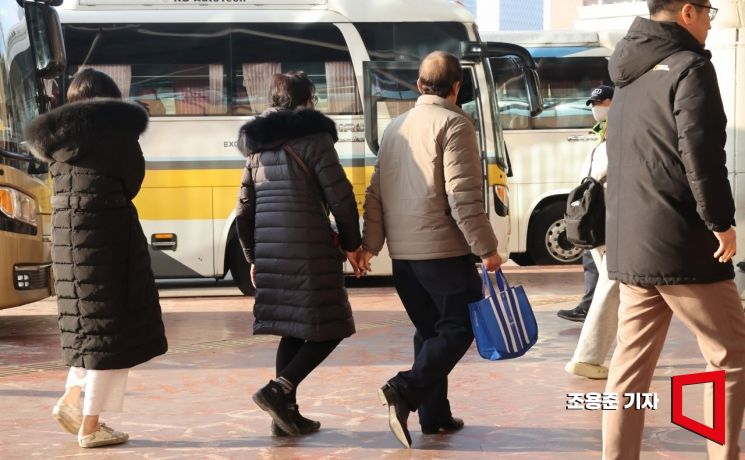 On the 8th, ahead of Seollal, the biggest traditional holiday, returning visitors are getting off the bus and moving at Banpo Express Bus Terminal in Seoul.
 [Photo by Yongjun Cho jun21@]
The holidays are also a time when conflicts between couples frequently occur. According to Naver Data Lab, searches for "divorce" increased around this year’s Lunar New Year holiday (February 9?12). The number of searches rose from 54 on February 7 to 99 on the 8th, 90 on the 9th, and 70 on the 10th. Similar increases in search volume were observed around last year’s Lunar New Year and Chuseok holidays.
According to the Monthly Court Statistics Report, from 2021 to 2023, the number of consensual divorces filed in February?March and September?October, which follow the Lunar New Year and Chuseok holidays, was higher than during non-holiday periods. For example, the Suwon Family Court saw consensual divorce confirmation applications increase from 947 in January last year to 1,122 in February, and from 935 in September to 1,076 in October. Following the Lunar New Year (February 1,061 → March 1,337) and Chuseok (September 1,138 → October 1,070) in 2021, and Lunar New Year (February 1,009 → March 1,002) and Chuseok (September 1,146 → October 1,063) in 2022, divorce applications either increased or showed a slight decrease around the holidays.
In a survey conducted around January last year by remarriage matchmaking company OnlyU and matchmaking agency Bienarae, an average of 36% of divorced men and women said they fought most often with their spouse during holidays. Men cited "time spent at both families’ homes" as the main cause of fights, while women pointed to "division of roles in preparing ancestral rites" as the top reason.
When asked, "During your marriage with your ex-spouse, when did conflicts between you and your spouse occur most frequently?" 36.0% (men 35.8%, women 36.2%) answered "holidays," the highest response rate. When asked about the main issues causing fights during holidays, 32.1% of men said "time spent at both families’ homes." This was followed by "uncomfortable relationships with the wife’s family members" (27.2%), "whether to visit the wife’s family" (21.3%), and "preparing gifts for the wife’s parents" (11.2%).
For women, "division of roles in preparing ancestral rites" (34.3%) was the most selected. The men’s top reason, "time spent at both families’ homes," was second for women at 25.0%. This was followed by "uncomfortable relationships with the husband’s family members" (18.3%) and "whether to visit the husband’s family" (14.6%). Although the rankings differ between men and women, both viewed time spent at both families’ homes as a major source of conflict.
Outside of holidays, men reported conflicts arising most often during "various anniversaries at the wife’s family, such as the wife’s parents’ birthdays" (25.0%), "the couple’s birthdays" (20.5%), and "the couple’s wedding anniversary" (12.0%). Women reported conflicts most often during "ancestral rites at the husband’s family" (26.1%), "various anniversaries at the husband’s family, such as the husband’s parents’ birthdays" (19.0%), and "the couple’s birthdays" (10.5%).
© The Asia Business Daily(www.asiae.co.kr). All rights reserved.
![Clutching a Stolen Dior Bag, Saying "I Hate Being Poor but Real"... The Grotesque Con of a "Human Knockoff" [Slate]](https://cwcontent.asiae.co.kr/asiaresize/183/2026021902243444107_1771435474.jpg)

















