"Estimated to Be More Than Statistics Indicate"
Cultural Heritage Administration Reviews Local Utilization as 'Gongyu Yusan'
It has been revealed that more than 240,000 cultural heritage items scattered abroad due to theft, looting, and trade exist.
On the 12th, the Cultural Heritage Administration and the Overseas Korean Cultural Heritage Foundation announced, “As a result of investigating Korean cultural heritage in 803 museums and art galleries across 29 countries worldwide, it is estimated that there are a total of 246,304 items as of January 1 this year.” This is a slight increase from 229,655 items during the same period last year.
A foundation official explained, “Although the collected information is reviewed and disclosed every January, the exact number is not precise.” This is because the records of overseas export are not accurate, and ownership information has not been fully disclosed, so the actual number is presumed to be higher than the statistical figures.
The reasons for cultural heritage being taken abroad include many known cases of illegal or unjust outflows during historical turmoil such as the invasions by Western powers and the Japanese colonial period. However, there are also numerous cases of legitimate transactions, donations, and diplomatic gifts, as well as instances where foreigners who visited Korea collected ceramics, paintings, and crafts.
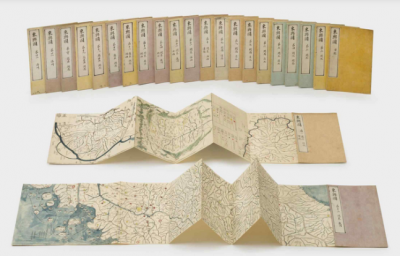 Daedongyeojido Map Repatriated by the Cultural Heritage Administration in March Last Year [Image Source: Provided by the Cultural Heritage Administration]
By country, Japan accounted for the largest share at 44.6%. It was found that 109,801 Korean cultural heritage items are held by 397 institutions and individuals in Japan, including the Tokyo National Museum.
The United States followed with 65,355 items (26.5%), Germany with 15,692 items (6.4%), China with 13,010 items (5.3%), the United Kingdom with 12,805 items (5.2%), and France with 6,511 items (2.6%).
Accordingly, the Cultural Heritage Administration and the foundation have been steadily promoting the repatriation of major cultural heritage based on the collected information.
Last year, the Cultural Heritage Administration announced on the 22nd that it repatriated a total of 1,550 items (1,083 cases), including the folding screen-style atlas “Daedongyeojido” created by late Joseon geographer Kim Jeong-ho (estimated 1804?estimated 1866), in cooperation with the foundation. All of these were repatriated using emergency purchase funds, marking nearly a tenfold increase compared to the 170 cases repatriated in 2022.
The Cultural Heritage Administration is also considering ways to utilize our cultural heritage locally. This involves introducing the concept of “shared heritage,” where two or more countries share historical and cultural values. To this end, they plan to conduct status surveys and build databases (DB) with major countries such as the United States and France.
Additionally, the Cultural Heritage Administration and the foundation are considering establishing a base for repatriating cultural heritage in Europe. Currently, the foundation operates overseas offices only in the United States and Japan.
© The Asia Business Daily(www.asiae.co.kr). All rights reserved.

















