Research by Professor Lee Mina, Department of Sociology, Chung-Ang University
A recent study has found that the increase in suicide rates among young women is linked to the psychological distress experienced by women marginalized in the labor market.
On the 12th, according to academia, Professor Min-A Lee of the Department of Sociology at Chung-Ang University presented this analysis in her paper titled "Intensifying Crisis in the Labor Market and Suicide Rates Among Young Women," published in the latest issue of the Korean Journal of Women Studies by the Korean Association of Women Studies.
According to statistics cited in the paper from Statistics Korea, the suicide rate among women aged 25 to 29 steadily declined from 24.6 per 100,000 population in 2011 to 13.4 in 2017. However, it rebounded to 13.9 in 2018, then increased again to 16.5 in 2019, 19.4 in 2020, and 20.2 in 2021.
The suicide rate among women aged 30 to 34 also continuously decreased from 24.4 in 2011 to 16.4 in 2017, before rising again to 18.6 in 2018, 19.5 in 2019, 19.4 in 2020, and 21.6 in 2021. Professor Lee explained that no consistent relationship was found between unemployment rates and suicide rates among young women.
On the other hand, the proportion of non-regular and part-time workers, which reflects job quality, was found to be related to the increase in suicide rates among young women starting in 2018. The suicide rates of women in these age groups showed a positive correlation with the proportion of non-regular workers among wage earners.
The proportion of non-regular workers aged 25 to 29 remained stagnant from 22.99% in 2011 to 23.34% in 2018, but surged to 29.64% in 2019, dipped slightly to 27.69% in 2020, and rose again to 31.94% in 2021. A similar trend was observed among women aged 30 to 34.
Professor Lee assessed that this indicates many young women experienced unemployment or were absorbed into non-regular and part-time jobs, deepening their marginalization within the labor market. She noted that the COVID-19 pandemic began in 2020, and more women appeared to have faced difficulties both quantitatively and qualitatively in employment.
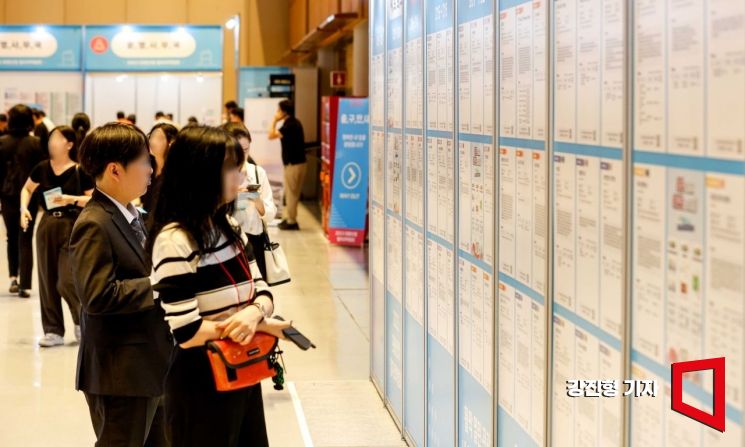 Job seekers participating in the '2023 Tourism Industry Job Fair' held on the 18th at COEX in Gangnam-gu, Seoul, are looking at the recruitment board. Photo by Jinhyung Kang aymsdream@
Professor Lee also analyzed that for women aged 25 and older, including those in their 30s, the NEET (Not in Education, Employment, or Training) rate showed a close correlation with suicide rates.
The proportion of unemployed women aged 30 to 34 and those classified as economically inactive who reported their activity status as "resting" increased significantly from 4.63% in 2017 to 6.79% in 2021. For women aged 25 and older and those in their 30s, reasons for economic inactivity such as preparing for employment or further education may increase psychological distress, and those who have given up job seeking likely faced economic and mental hardships, Professor Lee diagnosed.
He explained that the positive relationship between the NEET rate and suicide rates among young women shows that young women excluded from the labor market may be pushed into a survival crisis. Regarding the research findings, Professor Lee stated, "This implies that the intensified crisis among young women in the labor market since 2018 and the resulting despair are major factors explaining the suicide rates."
Professor Lee added, "Marginalization and exclusion of women in the labor market inevitably darken the future prospects for women who have life plans centered on work rather than marriage and childbirth norms," and elaborated that an anomic situation where difficulties in daily life and future uncertainties overlap can increase the risk of suicide. However, he noted, "The causes of suicide cannot be found solely in jobs or the labor market," pointing out that the despair of young women is a complex issue intertwined with social structural and cultural factors.
Professor Lee emphasized, "Approaching young women's suicide solely as a psychopathological issue will inevitably delay improvement or resolution," and suggested, "Analytical research on the social causes that trigger suicide is necessary, and issues of discrimination and marginalization of female labor in the labor market must be addressed."
© The Asia Business Daily(www.asiae.co.kr). All rights reserved.

















