KB Financial - Woori Financial Net Profit Gap Reaches 1.5 Trillion Won
KB Financial Leads Growth in Banking and Insurance
Hana Financial and Shinhan Financial Face Subsidiary Securities Slump
Woori Financial Experiences Overall Weakness in Banking, Capital, Card, and Woori Jonggeum
Hana Bank Shows the Largest Increase in Banking Performance
As domestic financial companies continue to announce their performance results from last year, it has been revealed that the net income of the four major financial holding companies fell short of 15 trillion won. While KB Financial achieved record-high results, Woori Financial's net income sharply declined by nearly 20% compared to the previous year, showing poor performance.
According to the financial sector on the 9th, KB Financial's net income increased by 11.5% year-on-year to 4.6319 trillion won, marking an all-time high. In contrast, Shinhan Financial, Hana Financial, and Woori Financial all saw their net profits decrease over the year. As a result, the total net income of the four major financial holding companies amounted to 14.9682 trillion won, a 3.6% decrease from the previous year (15.5309 trillion won).
Shinhan Financial recorded 4.368 trillion won, down 6.4% year-on-year; Hana Financial posted 3.4516 trillion won, down 3.3%; and Woori Financial saw a sharp drop of 19.9% to 3.1417 trillion won. The net income gap between KB Financial and Woori Financial reached a staggering 1.5 trillion won. Excluding KB Financial's record-high performance, the results of the other financial holding companies fell short of expectations.
The performance of the banks affiliated with the financial holding companies also varied. Hana Bank recorded net income of 3.4766 trillion won, up 12.3% year-on-year. KB Kookmin Bank achieved 3.2615 trillion won, up 8.9%, and Shinhan Bank posted 3.0677 trillion won, up 0.7%. Woori Bank's net income was only 2.5159 trillion won, down 13% from the previous year.
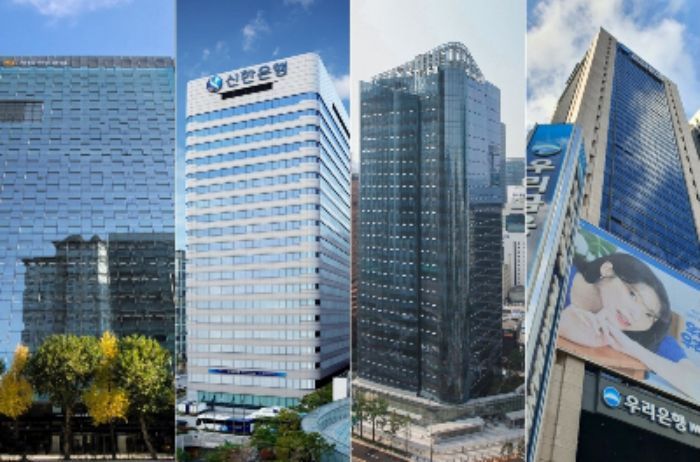
KB Financial Achieves Record-High Performance, Led by Growth in Banking and Insurance... 4Q Net Income Drops to 261.5 Billion Won Due to Consumer Finance and PF Provisions
KB Financial achieved record-high annual results, but its fourth-quarter net income sharply declined to 261.5 billion won compared to the previous quarter. This was mainly due to one-time expenses such as group voluntary retirement, the largest support amount among participating banks for consumer finance support, conservative loss rates on real estate project financing (PF), and seasonal factors reflected in loan loss provisions.
Annual net interest income increased by 5.4% year-on-year to 12.1417 trillion won. The bank's won-denominated loans grew 4.0% from the end of the previous year, mainly driven by corporate loans, securing a stable revenue base. The repricing effect of loan assets due to last year's interest rate hikes improved the net interest margin (NIM), and the contribution of interest income from non-bank affiliates such as securities and cards steadily expanded.
Annual NIM improved by 12 basis points (bp) for the group and 10 bp for the bank, reaching 2.08% and 1.83%, respectively, driving the expansion of interest income. Net fee income rose 4.5% year-on-year to 3.0735 trillion won. Although card usage remained at the previous year's level due to low growth and high inflation dampening consumer sentiment, securities custody fees increased due to a rise in stock contract amounts. Additionally, efforts to improve the portfolio, such as reducing high-cost sales (national tax, local tax, four major insurances, etc.), expanded merchant fee income, and capital's increased operating interest rates boosted lease fees.
The loan loss provision ratio rose to 0.67%. The fourth-quarter credit loss provision amounted to 1.3782 trillion won, an increase of 929.6 billion won from the previous quarter. The group's non-performing loan (NPL) ratio stood at 0.57%, and the NPL coverage ratio was 174.5%. Although the NPL coverage ratio declined compared to the previous year due to more conservative asset classification in key sectors such as real estate PF and overseas commercial real estate, the company explained that it still maintains industry-leading loss absorption capacity.
KB Insurance and KB Life posted net incomes of 752.9 billion won and 256.2 billion won, up 35.1% and 88.7% year-on-year, respectively. In contrast, KB Kookmin Card's net income fell 7.3% year-on-year to 351.1 billion won due to increased provisioning from rising funding costs and delinquency rates amid market interest rate hikes. A KB Financial Group official stated, "As all top lines of the group continued to generate strong and balanced profits, total operating profit in 2023 recorded about 16 trillion won, achieving an all-time high annual growth rate of 17.8%."

Shinhan Financial Sees Increased One-Time Costs and Loss of Securities Building Sale Effect... Weak Performance in Cards, Securities, and Insurance
First, annual interest income rose 2.1% year-on-year to 10.8179 trillion won. This was due to a 1 bp increase in the group's annual net interest margin (NIM) and a 2.6% increase in interest-bearing assets. Non-interest income surged 51.0% year-on-year to 3.4295 trillion won, reflecting improved fee income and the disappearance of losses in the securities segment caused by last year's sharp interest rate hikes.
Annual loan loss provisions increased 70.8% to 2.2512 trillion won. This was due to rising delinquency rates in banks and cards from cumulative interest rate hikes, leading to increased regular provisions and higher economic cycle provisions compared to the previous year. The annual loan loss cost ratio was 0.57%, or 0.38% excluding economic cycle provisions.
Net income by subsidiaries showed mixed results. Shinhan Bank's net income rose 0.7% to 3.0677 trillion won, and Shinhan Capital increased slightly by 0.2% to 304 billion won, showing a flat trend. However, Shinhan Card declined 3.2% to 620.6 billion won, Shinhan Investment Securities dropped 75.5% to 100.9 billion won, and Shinhan Life also fell 61.4% to 44.8 billion won.
Meanwhile, Shinhan Financial held a board meeting to approve a year-end dividend of 525 won per share (2,100 won annually) for the 2023 fiscal year. This will be finalized at the shareholders' meeting in March. Including already paid quarterly dividends and treasury stock acquisition and cancellation, the total annual shareholder return ratio improved by 6.0 percentage points to 36.0% compared to the previous year.
Additionally, Shinhan Financial's board decided to acquire and cancel 150 billion won worth of treasury stock in the first quarter of this year as part of shareholder returns. Shinhan Financial plans to continue efforts to enhance shareholder value consistently and sustainably while maintaining an appropriate capital ratio this year.
A Shinhan Financial official said, "We defended interest income despite margin compression through real-demand-driven corporate loan growth and maintained solid profit generation by increasing non-interest income through securities portfolio management. We are continuously working to mitigate systemic risks from prolonged high interest rates by proactively provisioning for a smooth landing of the real estate PF market and providing win-win financial support to ease interest burdens on self-employed and small business owners."
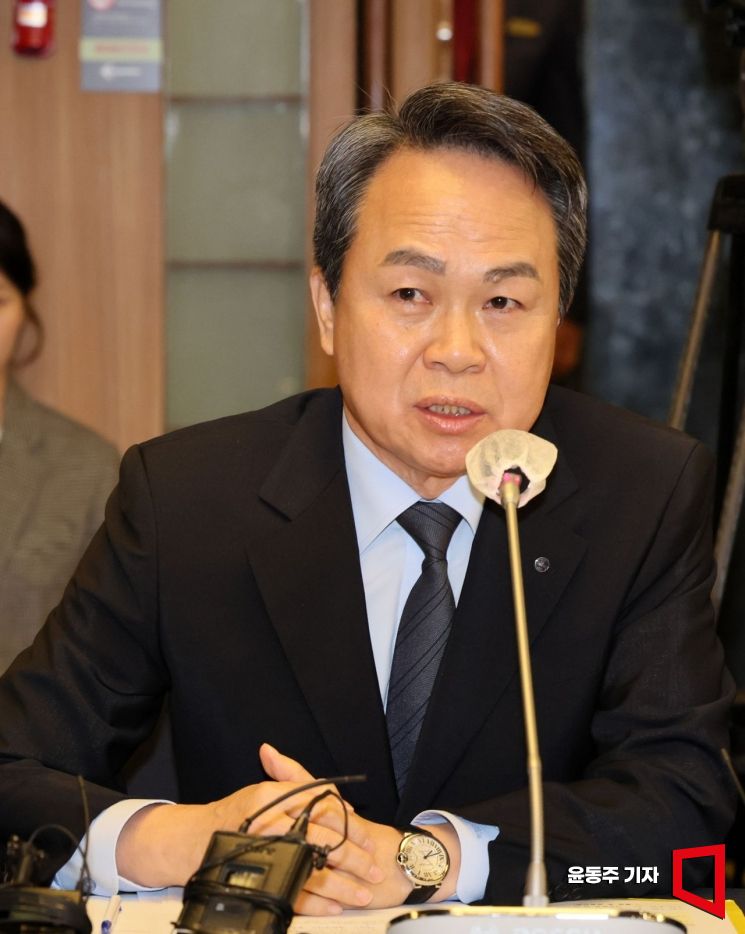 Jin Ok-dong, Chairman of Shinhan Financial Group, is speaking at the Financial Holding Company Chairmen's Meeting held at the Press Center in Jung-gu, Seoul on the 31st. The meeting was attended by Kim Ju-hyun, Chairman of the Financial Services Commission; Lee Bok-hyun, Governor of the Financial Supervisory Service; Jin Ok-dong, Chairman of Shinhan Financial Group; Lim Jong-ryong, Chairman of Woori Financial Group; Ham Young-joo, Chairman of Hana Financial Group; Lee Seok-jun, Chairman of NH Nonghyup Financial Group; Yang Jong-hee, Vice Chairman of KB Financial Group; and Kim Kwang-soo, Chairman of the Korea Federation of Banks. Photo by Yoon Dong-ju doso7@
Hana Financial's Net Income Down 3.3%, Non-Interest Income Up 65%... Securities Posts Net Loss
Hana Financial's core income, combining interest and fee income, increased compared to the previous year. Last year, interest income was 8.9532 trillion won, and fee income was 1.7961 trillion won, totaling 10.7493 trillion won, a 0.36% increase year-on-year. The group's fourth-quarter net interest margin (NIM) was 1.76%, down 0.2 percentage points from the same period last year.
The group's non-interest income rose 65.3% (753.1 billion won) year-on-year to 1.907 trillion won. Fee income and trading gains were 1.7961 trillion won and 863.1 billion won, respectively. Hana Financial Group explained that improvements in accumulated fees such as operating leases and retirement pensions, and increased trading gains related to securities due to financial market volatility, contributed to this growth.
To prepare for domestic and international uncertainties, large-scale provisions were set aside. The cumulative amount for the fourth quarter was 370.9 billion won, and total provisions including this increased 41.1% (499.8 billion won) from the end of the previous year to 1.7148 trillion won.
The group's NPL ratio for the fourth quarter was 0.49%, up 0.15 percentage points from 0.34% at the end of the previous year. The delinquency rate rose 0.15 percentage points to 0.45% from 0.3% at the end of the previous year.
By affiliate, Hana Bank's net income last year was 3.4766 trillion won, up 12.3% year-on-year. Among non-bank affiliates, only Hana Securities recorded a net loss of 270.8 billion won. Hana Capital (216.6 billion won), Hana Card (171 billion won), Hana Asset Trust (80.9 billion won), and Hana Life (6.5 billion won) posted net profits.
Meanwhile, Hana Financial Group's board will pay a year-end cash dividend of 1,600 won per share. Including three quarterly dividends of 1,800 won, the total cash dividend per common share increased by 50 won year-on-year to 3,400 won. The annual dividend payout ratio rose 1.0 percentage point to 28.4%. Considering the 150 billion won treasury stock buyback and cancellation conducted early last year, the total shareholder return ratio for the fiscal year was 32.7%.
The group resolved to purchase and cancel 300 billion won worth of treasury stock within the year to secure appropriate stock value, resolve undervaluation, and continuously increase shareholder value.
Hana Financial Group stated, "We will continue efforts to achieve the industry's highest shareholder return ratio based on excellent capital adequacy and stable asset soundness, and strive to become a trusted partner in society by practicing social responsibility through finance and coexisting with all stakeholders."
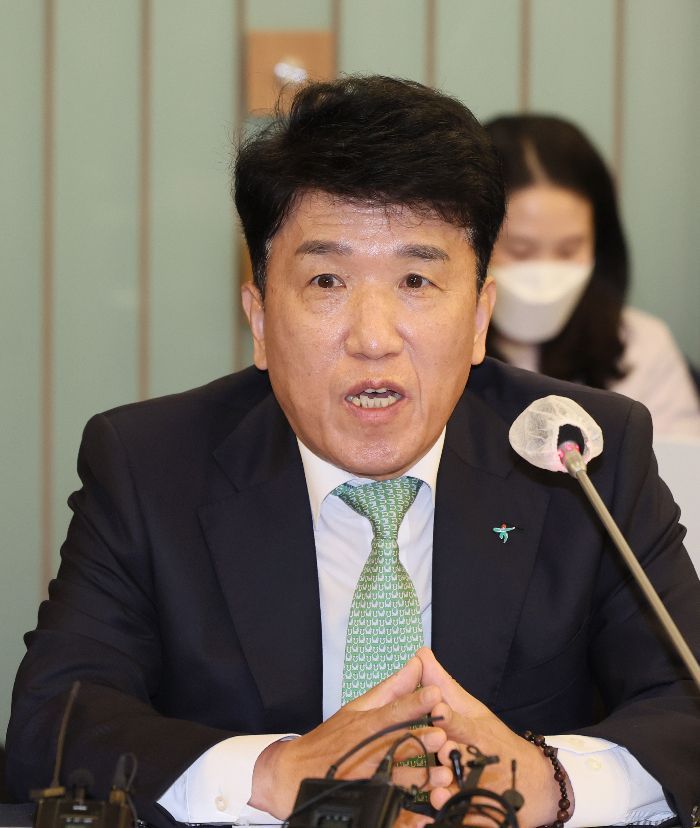 Ham Young-joo, Chairman of Hana Financial Group, is speaking at the Financial Holding Companies Chairmen Meeting held at the Press Center in Jung-gu, Seoul on the 31st. The meeting was attended by Kim Ju-hyun, Chairman of the Financial Services Commission; Lee Bok-hyun, Governor of the Financial Supervisory Service; Jin Ok-dong, Chairman of Shinhan Financial Group; Lim Jong-ryong, Chairman of Woori Financial Group; Ham Young-joo, Chairman of Hana Financial Group; Lee Seok-jun, Chairman of NH Nonghyup Financial Group; Yang Jong-hee, Vice Chairman of KB Financial Group; and Kim Kwang-soo, Chairman of the Korea Federation of Banks. Photo by Yoon Dong-joo doso7@
Woori Financial's Net Income Shrinks 20%, Fails to Join '3 Trillion Club'... Overall Weakness in Cards, Capital, and Woori Finance
According to Woori Financial, last year's net operating income was 9.8374 trillion won, maintaining the previous year's level. Interest income increased 0.5% year-on-year. Although funding cost increases caused the bank's net interest margin (NIM) to fall by 3 basis points (bp), loan growth partially offset the NIM decline.
Non-interest income fell 4.7% year-on-year to 1.0948 trillion won. However, this included one-time expenses related to consumer finance support; excluding these, the company explained that performance increased by about 10% compared to the previous year. A Woori Financial official said, "Despite a challenging business environment, fee income showed stable growth, driven by increased securities-related gains compared to the previous year."
Loan loss costs amounted to 1.8807 trillion won. In the first half of last year, 263 billion won in provisions were proactively set aside reflecting adjustments to future economic outlooks. In the fourth quarter, an additional 525 billion won in provisions were recognized following regulatory guidelines, including changes in loss given default (LGD) and real estate project financing (PF).
The holding company and bank's non-performing loan (NPL) coverage ratios reached record highs of 229.2% and 318.4%, respectively. The NPL ratio increased by 0.04 percentage points year-on-year to 0.35% for the holding company. The bank's NPL ratio was about 0.18%.
By affiliate, Woori Bank's net income fell 13% year-on-year to 2.5159 trillion won; Woori Card dropped 45.3% to 111 billion won; Woori Financial Capital declined 30.1% to 127.8 billion won; and Woori Comprehensive Finance posted a net loss of 53.4 billion won.
A Woori Financial official stated, "Last year, we improved asset quality in vulnerable sectors and strengthened group capital market competitiveness by reorganizing affiliates such as integrating Woori Asset Management and Global Asset Management. This year, we expect to fully turn around performance by focusing on risk management such as risk-weighted asset control, while strengthening group synergies through selective growth strategies and asset management."
© The Asia Business Daily(www.asiae.co.kr). All rights reserved.



















