Mainichi Shimbun Reports "Korea Faces National Extinction Crisis"
"Yoon Government Accepting Immigrants to Increase Birth Rate"
Last year, South Korea's total fertility rate was estimated at 0.72, highlighting the severity of the low birthrate issue, and major foreign media outlets are paying attention to South Korea's demographic challenges. On the 8th, Japan's Mainichi Shimbun focused on South Korea's population issues through the lens of its foreign immigrant acceptance policy.
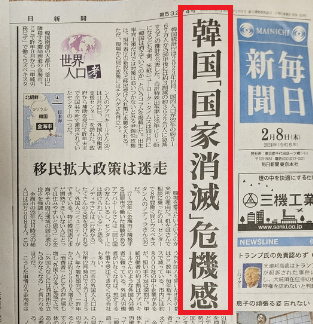 The Japanese Mainichi Shimbun highlighting South Korea's population issue.
 [Photo by Mainichi Shimbun, front page capture]
Under the headline "South Korea's National Extinction Crisis," the newspaper extensively covered South Korea's population situation and government responses across the front page and page 3 of the morning edition. Mainichi Shimbun is the third largest daily newspaper in Japan by circulation and was founded in 1872, making it effectively Japan's oldest newspaper company.
The newspaper cited data released by South Korea's Statistics Korea, reporting that South Korea's population is expected to decline from approximately 51.67 million in 2022 to 36.52 million in 50 years. It added that the Yoon Seok-yeol administration has determined that increasing the birthrate through conventional low birthrate measures alone is difficult, and is therefore actively accepting immigrants.
However, it introduced a case from early last month where the Foreign Workers Support Center in Gimhae City, Gyeongnam Province, was closed due to the government's decision to cut subsidies. The article pointed out that South Korea has a unique anti-immigration sentiment and a lack of awareness regarding the need to support foreign migrants, causing conflicts in government policies. It further analyzed that the current proportion of foreigners residing in South Korea is about 5%, nearly double that of Japan, and although this is expected to increase, there is no national consensus on immigrant acceptance.
"South Korean Conservatives Conservative on Immigrant Acceptance... Only Accept Foreigners Who Are Beneficial"
The article also claimed that conservatives supporting the current administration hold conservative views on immigrant acceptance. It reported that Han Dong-hoon, the Emergency Response Committee Chairman of the People Power Party and former Minister of Justice, pushed for the establishment of an 'Immigration and Immigration Management Agency' but emphasized that this does not mean unconditional acceptance of foreigners. The newspaper evaluated this by saying, "In other words, they only accept foreigners who are helpful to South Korea and willing to integrate into Korean society." It added that, beyond negative public opinion and competition with countries like Japan that accept foreign workers, there are doubts about whether South Korea can transform into a country for immigrants.
The newspaper also pointed out the rising average age of first marriage and the increasing unmarried rate in South Korea. The background factors cited included ▲youth unemployment rate ▲income disparity among youth ▲high housing prices ▲education expenses burden ▲concentration in the Seoul metropolitan area ▲intensified competition. Regarding the issue of securing foreign workers, the article concluded with a response from Lee In-sil, former head of Statistics Korea and director of the Korea Future Population Research Institute, who said, "Southeast Asian countries are also experiencing declining total fertility rates, and the Joseonjok (ethnic Koreans in China) population is aging, so it will not be an easy matter."
© The Asia Business Daily(www.asiae.co.kr). All rights reserved.
![Clutching a Stolen Dior Bag, Saying "I Hate Being Poor but Real"... The Grotesque Con of a "Human Knockoff" [Slate]](https://cwcontent.asiae.co.kr/asiaresize/183/2026021902243444107_1771435474.jpg)

















