Medical Sector: "Government Has No Willingness to Communicate, Discussing Staffing Increase Before Solving Essential Medical Issues Is Nonsense"
Government: "No Submission of Staffing Increase Opinions, Understood as Meaning There Is No Need to Reflect Opinions"
As the government announced the expansion of medical school admissions by 2,000 students, the medical community has warned of a strong resistance, while the government has hinted at a tough response, with both sides differing on who is responsible for the communication breakdown.
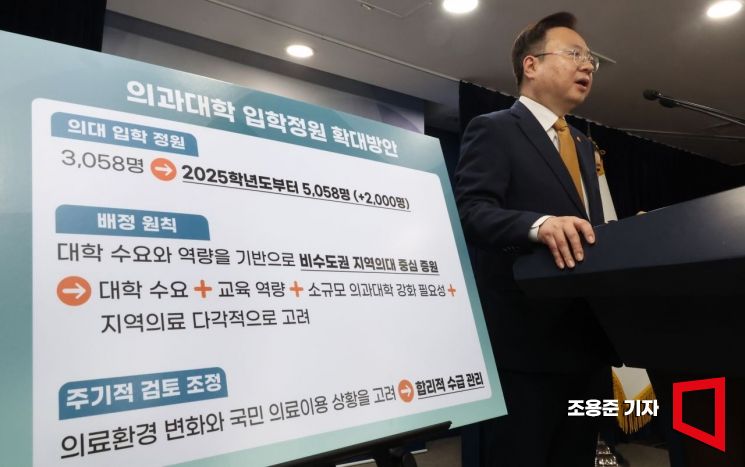 Health and Welfare Minister Cho Kyu-hong is announcing the expansion of medical school admission quotas on the 6th at the Government Seoul Office in Jongno-gu, Seoul. Photo by Jo Yong-jun jun21@
On the 6th, the Ministry of Health and Welfare held the Health and Medical Policy Deliberation Committee meeting at the government Seoul office and announced plans to increase next year’s medical school admissions by 2,000 students. This increase amounts to 65.4% of this year’s quota of 3,058 students.
The Ministry stated that it had sufficiently communicated with the medical community regarding the increase. Minister Cho Kyu-hong of the Ministry of Health and Welfare said, "Since January last year, we have launched the Medical Issues Consultative Body with the Korean Medical Association and held 28 communication sessions. We have also actively communicated with hospital groups such as the Korean Hospital Association, various hospital associations, and the Korean Intern Resident Association."
At the 28th Medical Issues Consultative Body meeting held just hours before the announcement, Jeong Gyeong-sil, Director of Health and Medical Policy at the Ministry, said, "Out of respect for the medical community, we operated a separate Medical Issues Consultative Body and held 28 discussions." She further argued that the responsibility for the communication breakdown lies with the medical community. She stated, "The government requested the Korean Medical Association’s opinion on the scale of medical school admissions increase on January 15, but despite repeated requests and waiting, the association did not submit their views on the appropriate scale." She emphasized, "The failure to submit an official opinion can only be understood as meaning that there is no need to reflect their views."
On the other hand, the medical community unanimously claimed that the government lacked willingness to communicate. Representatives from major organizations such as the Korean Medical Association and the Korean Hospital Association said they only learned about the government’s plan for the increase through media reports. The medical community has long argued that they never had a deep discussion with the government before the announcement. Their failure to submit opinions on the increase is based on the position that discussing the scale of medical school admissions before resolving essential medical care issues is nonsensical. Woo Bong-sik, Director of Medical Policy Research at the Korean Medical Association, pointed out, "The issue of medical school admissions should have been approached delicately and calculated on the premise that essential medical care problems have been resolved."
Yang Dong-ho, Chair of the Gwangju Medical Association Delegates and head of the Korean Medical Association’s negotiation team in the Medical Issues Consultative Body, which has been discussing medical school admissions with the government since last year, said after the government’s announcement, "We suddenly learned about the increase scale through media reports without prior consultation." He added, "Announcing the increase recklessly without reflecting the medical community’s opinions seems like an invitation to a strong confrontation. I have nothing to say."
At the earlier 28th Medical Issues Consultative Body meeting, he criticized, "We have respected the government’s proposals and continuously cooperated to establish desirable medical school policies. We repeatedly proposed TV debates to help the public understand and even suggested all-night, conclusive discussions if necessary. However, the government completely ignored these proposals from the medical community and unilaterally notified us of medical school admission numbers without scientific or objective evidence."
Meanwhile, on the 7th, the Korean Medical Association held an 'Emergency Temporary General Assembly of Delegates for 2024' at its headquarters in Yongsan-gu, Seoul, and resolved to form a 'Countermeasure Committee to Block the Increase of Medical School Admissions.' In their resolution, the association stated, "The Medical Issues Consultative Body was treated like a leash on a pet dog, shaken around to waste time, and just before achieving the goal of increasing medical school admissions, the leash was thrown away like a bored dog owner. We hereby declare the beginning of intense struggle."
As the medical community showed signs of collective action, the government also prepared countermeasures. On the same day, Minister Cho Kyu-hong emphasized to the heads of 221 training hospitals the need for strict responses in case of collective action by residents. The 'Central Accident Response Headquarters for Doctors’ Collective Action' also instructed training hospitals to 'reject acceptance of collective resignation letters.'
© The Asia Business Daily(www.asiae.co.kr). All rights reserved.
![Clutching a Stolen Dior Bag, Saying "I Hate Being Poor but Real"... The Grotesque Con of a "Human Knockoff" [Slate]](https://cwcontent.asiae.co.kr/asiaresize/183/2026021902243444107_1771435474.jpg)
















