77% of 170,000 Marriage Immigrants Are Women
Facing Difficulties Due to Language and Cultural Differences
Sayuri Tahara (42), who lives in Korea after marrying a Korean husband, feels anxious when thinking about the Lunar New Year holiday. Her Korean is still poor, and she has to spend the entire holiday at her in-laws' house. Communication is difficult, and unlike other daughters-in-law, she cannot visit her parental home. Sayuri said, “My sisters-in-law help a lot during the holidays and talk well with relatives, but I can’t even do those basic things, so I end up comparing myself as a daughter-in-law and losing confidence.”
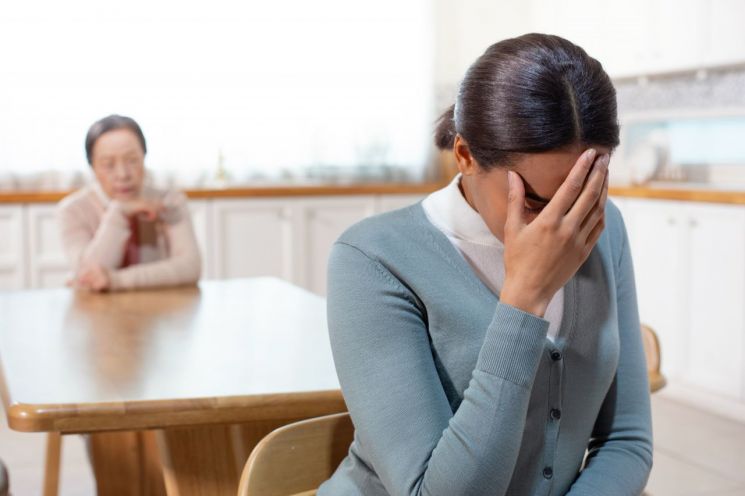
Although Seollal, the biggest ethnic holiday, is just around the corner, not everyone welcomes the holiday with joy. The main subjects are daughters-in-law from multicultural families who married into Korea from abroad.
Marriage immigrant women who do not have a parental home in Korea often stay at their in-laws' house throughout the holiday period. Some visit their hometowns where their parental homes are or meet with other immigrant women, but due to time or financial constraints, that is only the case for a few. Although they have to spend time with many family members, the holiday feels especially long for those who are not fluent in Korean.
According to the status of foreign residents in local governments announced every November by the Ministry of the Interior and Safety, the number of marriage immigrants has steadily remained in the 170,000 range since 2019. As of 2022, about 77% of marriage immigrants are women. Many of them face difficulties due to unfamiliar languages and cultures. Among approximately 210,000 consultations conducted last year through the Danuri Call Center operated by the multicultural family support portal ‘Danuri,’ 55,000 inquiries were related to language.
These concerns become more pronounced during holidays when immediate family and relatives gather in one place. Do Do-tin (35, pseudonym), who married into Korea from Vietnam 10 years ago, struggled at first because everything was unfamiliar. Do-tin said, “At first, I couldn’t eat Korean food and couldn’t speak Korean, so it was difficult to be with my in-laws during Seollal or Chuseok.”
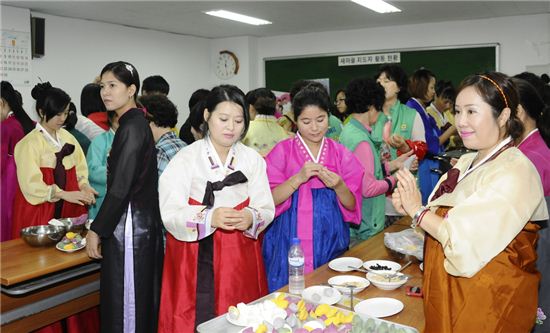 Marriage immigrant women participating in traditional holiday food experiences. The photo is not directly related to the article content. [Photo by Asia Economy DB]
In fact, the ‘2021 National Multicultural Family Survey’ conducted by the Ministry of Gender Equality and Family showed that members of multicultural families most frequently cited ‘not being good at Korean (19.9%)’ as the reason why it is difficult to socialize with others in Korean society. The language barrier directly affects social relationships. Among marriage immigrants’ service usage experiences, the usage rates of ‘Korean language and Korean society adaptation education’ and ‘interpretation and translation service support’ were the highest.
Chiae Tanaka (39, Japanese), who has lived in Korea for 12 years, also recalls when she first married into Korea. Chiae said, “At first, I didn’t know Korean food recipes and couldn’t communicate well, so I only felt sorry for not being helpful,” adding, “I used to worry about making mistakes by speaking Korean poorly at gatherings where many in-laws were present.”
There are also difficulties arising from cultural differences. Vicky Hwang (39, Chinese) confessed that the holidays became harder after having a child. Vicky said, “There are cultural and generational differences in how to raise a baby, and I had to follow those methods while living at my in-laws’, which was uncomfortable,” adding, “Differences in lifestyle habits, from how to feed the children to how to do laundry, caused conflicts.”
As international marriages and marriage immigration increase, forming a so-called ‘global village,’ voices are calling for various support in areas such as language and culture. Myungok Kwon, head of the multicultural project team at the Seongbuk-gu Family Center in Seoul, said, “Since COVID-19, not only marriage immigrants but also new arrivals have been increasing,” emphasizing, “Interpretation and translation support need to be more active so that they can settle well initially.”
Sangwoo Jung, a professor at the Multicultural Convergence Research Institute, also advised, “There is no shortage of Korean language education programs,” but added, “We need to create an environment where they can receive education and continuously monitor so that smooth family relationships can be maintained, not just provide material support.”
© The Asia Business Daily(www.asiae.co.kr). All rights reserved.

















