Silver, Bronze, and Encouragement Awards Swept Up
Students of DGIST (President Geonwoo Lee) swept six awards, including the grand prize, at the ‘30th Samsung Human Tech Thesis Awards,’ the largest of its kind in Korea, the institute announced on the 8th.
Marking its 20th anniversary this year, DGIST recently highlighted its excellence by ranking 7th worldwide in the QS World University Rankings research indicator for citations per faculty member. This award further proved its world-class research capabilities.
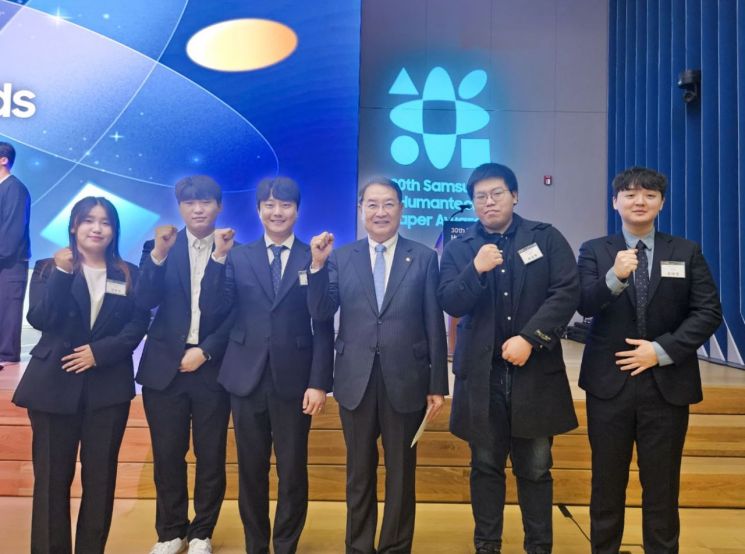 (Photo from left) Kang Yumin (Silver Prize), Park Jihoon (Encouragement Prize), Kim Jinwoo (Grand Prize), President Lee Geonwoo, Choi Wonhyuk (Bronze Prize), Seol Taeryeong (Silver Prize) students.
Jinwoo Kim, a student in the Department of Electrical Engineering and Computer Science at DGIST, received the grand prize, awarded to only one individual across all categories, along with a total prize of 40 million KRW. Kim was highly praised for his research on increasing laser penetration depth by utilizing low-intensity ultrasound energy to overcome the depth limitation caused by light scattering in laser therapy.
By increasing the depth of phototherapy, it is expected to expand clinical applications and enhance phototherapy effects in beauty and medical fields. Notably, the grand prize is sometimes not awarded if no suitable candidate is found, but Kim received it in recognition of the excellence of his research.
Yumin Kang from the Department of Chemistry and Physics and Taeryeong Seol from the Department of Electrical Engineering and Computer Science won silver awards in the ‘Material Science & Engineering’ and ‘Circuit Design’ categories, respectively. Kang developed a simplified system for multi-cell separation using local magnetic energy changes caused by micro magnetic element structure deformation. Seol developed a hybrid measurement system capable of simultaneously and precisely recording potential and bioelectric current signals, applicable to ultra-small high-performance medical devices. Additionally, Wonhyuk Choi from the Department of Electrical Engineering and Computer Science received a bronze award in the ‘Signal Processing’ category for his research improving 3D object estimation performance using metric learning techniques.
Encouragement awards went to Jihoon Park from the Department of Electrical Engineering and Computer Science and Junmo Yang from the Department of Robotics and Mechanical Engineering in the ‘Signal Processing’ and ‘Mechanical Engineering’ categories, respectively. Park developed a model capable of transforming only the style of text-related objects in proposed images, while Yang conducted research to improve existing robots’ ability to perform tasks with one hand more smoothly, supported by P-COE funding.
Grand prize winner Jinwoo Kim said, “I would like to thank Professor Jinho Jang for his guidance,” adding, “I will continue research that contributes to society through many challenges and developments.”
DGIST President Geonwoo Lee said, “This year marks the meaningful 20th anniversary of DGIST’s founding. Despite our short history, it is a great honor to prove DGIST’s excellence both domestically and internationally through this award,” and added, “We pledge to strive further so that, centered on world-class faculty and students, we can stand shoulder to shoulder with prestigious global universities.”
The ‘Samsung Human Tech Thesis Awards,’ established by Samsung Electronics in 1994, celebrated its 30th anniversary this year. It is held to discover creative and challenging scientists among domestic and international university, graduate, and high school students who will lead the future of science in Korea.
© The Asia Business Daily(www.asiae.co.kr). All rights reserved.
![Clutching a Stolen Dior Bag, Saying "I Hate Being Poor but Real"... The Grotesque Con of a "Human Knockoff" [Slate]](https://cwcontent.asiae.co.kr/asiaresize/183/2026021902243444107_1771435474.jpg)
















