KMA Approves Formation of 'Emergency Committee' for Government Struggle
Big 5 Hospitals Conduct Vote on Participation in General Strike
Government Emphasizes 'Strict Response' and Takes Immediate Preparations
The medical community's strike over the government's plan to increase medical school admissions by 2,000 is becoming visible. The Korean Medical Association (KMA) has begun forming an emergency response committee for government opposition, and residents at major hospitals are conducting votes on whether to proceed with a full strike.
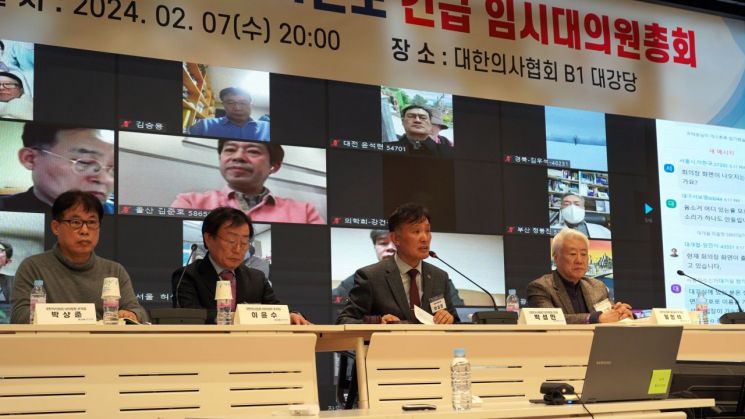 The Korean Medical Association held the "2024 Emergency Extraordinary General Assembly" at 8 p.m. on the 7th at the KMA Hall in Yongsan-gu, Seoul, and resolved to form a "Task Force to Prevent the Increase of Medical School Quotas" for immediate and effective action. [Image source=Korean Medical Association]
On the 7th at 8 p.m., the KMA held an 'Emergency Extraordinary General Assembly of Delegates for 2024' at the KMA headquarters in Yongsan-gu, Seoul, where it resolved to form an 'Emergency Committee to Stop the Increase in Medical School Admissions' for immediate and effective action. Additionally, it urged to 'launch a full-scale and strong struggle against the government' and announced that it would delegate decision-making authority regarding all means of protest.
In a resolution issued that day, the KMA sharply criticized, stating, "The government has committed the atrocity of tossing aside the leash it held like a pet dog, after wasting time shaking the medical issue consultation body back and forth like a leash, just as a dog owner grows tired before achieving the goal of increasing medical school admissions," and declared, "The prelude to a fierce struggle has begun."
Residents at the 'Big 5' hospitals (Seoul National University, Seoul Asan, Samsung Seoul, Severance, and Seoul St. Mary's) are also preparing for a full strike. According to the residents' councils of each hospital, the Big 5 hospitals are conducting votes on participation in the strike at the request of the Korean Intern Resident Association (KIRA). Seoul Asan Hospital has already passed the vote with a high approval rate among residents.
Earlier, KIRA announced that in a survey conducted from December 30 last year to January 3 this year among about 10,000 residents affiliated with training hospitals nationwide, 88.2% of respondents said, "If the government increases medical school admissions, I will participate in collective actions such as strikes."
The timing for entering a hardline struggle is expected to be after the Lunar New Year holiday. A KMA official said, "Since the Lunar New Year holiday is approaching, it seems that full-scale protest activities will begin only after the emergency committee is formed following the holiday." A representative from one of the Big 5 hospitals also said, "Although we have not received specific information about the strike start date, it is expected that the strike will begin after the Lunar New Year holiday, coordinated with other hospitals."
In response to the growing strike atmosphere in the medical community, the government has begun preparations. On the same day in the morning, Minister of Health and Welfare Cho Kyu-hong held a non-face-to-face meeting with the directors of 221 training hospitals (institutions) at the National Organ, Tissue, and Blood Management Agency conference room. Minister Cho emphasized that collective actions by residents disrupt the operation of training hospitals and pose a serious threat to the lives and health of the public, and stressed the need for strict response according to laws and principles.
The 'Central Accident Response Headquarters for Doctors' Collective Actions' also held a meeting that afternoon at Seoul City Hall in Jung-gu, Seoul, to discuss 'Response Measures to Doctors' Collective Actions.' The meeting included four related ministries?Ministry of the Interior and Safety, Ministry of Justice, Ministry of National Defense, and National Police Agency?and 17 metropolitan and provincial governments. They stated their intention to proactively establish a rapid inter-ministerial response system to illegal collective actions and to respond jointly. For example, as some residents considered submitting collective resignation letters to preemptively nullify work commencement orders, the Ministry of Health and Welfare instructed training hospitals to 'prohibit acceptance of collective resignation letters' based on Article 59 of the Medical Service Act and Article 15 of the Specialist Training Regulations.
© The Asia Business Daily(www.asiae.co.kr). All rights reserved.

















