Wholesale Prices Down 14.3% Compared to Average Year
Sirloin Retail Prices Drop 0.9%
Due to Structural Issues Including Distribution Costs
It has been found that the retail price decline of beef still does not match the drop in wholesale prices. Since last year, the government has viewed increasing consumption as crucial to alleviating the difficulties faced by Hanwoo farmers due to falling wholesale prices, and has promoted large-scale discount support. As a result, retail prices have slightly decreased compared to a year ago, but when compared to average levels, the decline in wholesale prices has not been fully reflected. This is due to unresolved structural issues such as distribution costs.
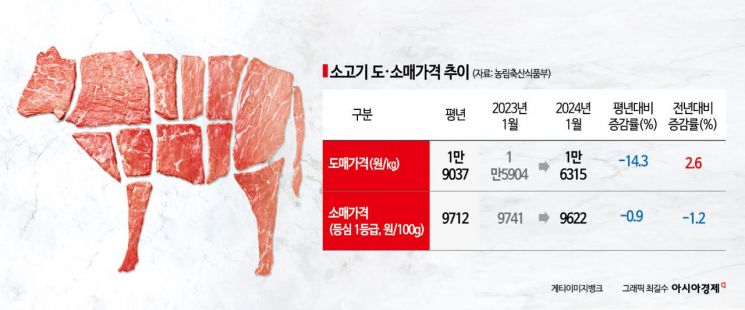
According to the Ministry of Agriculture, Food and Rural Affairs on the 8th, the average wholesale price of beef in January this year was 16,315 KRW per kilogram, a 2.6% increase compared to the same period last year (15,904 KRW). During the same period, the retail price of sirloin (grade 1) per 100g was 9,622 KRW, a 1.2% decrease.
Looking at the price trends over the past year, wholesale prices have risen while retail prices have fallen, but when the scope is broadened, wholesale and retail prices have shown different movements. Compared to the average of the past five years, the wholesale price of beef dropped by 14.3%, from 19,037 KRW to 16,315 KRW, but the retail price of sirloin only decreased by 0.9%, from 9,712 KRW to 9,622 KRW. The decline in wholesale prices has intensified difficulties for Hanwoo farmers, while consumers find it hard to feel the price drop. On the 5th, Han Hoon, Vice Minister of the Ministry of Agriculture, Food and Rural Affairs, expressed concern while reviewing the livestock supply situation, stating, "Despite the recent Lunar New Year peak season, Hanwoo wholesale prices have sharply declined since mid-January, increasing the difficulties faced by Hanwoo farmers."
This situation was similar last year. In January last year, the wholesale price was 15,904 KRW, down 16.5% compared to the average and 20.4% compared to the previous year. On the other hand, the retail price (sirloin) fell by only 12.9% compared to the previous year and actually rose by 4.5% compared to the average.
The Ministry of Agriculture, Food and Rural Affairs believes that due to the retail price structure, which includes direct and indirect distribution costs, the decline in wholesale prices is not fully reflected in consumer prices. Accordingly, in February last year, the ministry promoted the introduction of a "Livestock Product Delivery Price Reporting System" as part of the "Hanwoo Supply Stabilization Measures." This system requires wholesalers and processors (meat packaging handlers) to report the prices at which they receive livestock or cuts and the prices at which they deliver packaged meat.
Subsequently, during the Regulatory Reform Committee review process, concerns were raised that "disclosing delivery prices is an excessive regulation," leading the Ministry of Agriculture, Food and Rural Affairs to propose the "Act on the Management and Support of Livestock Product Distribution and Livestock Transactions (draft)" in September last year. This draft limits reporting to the purchase price at which processors buy Hanwoo from farms, narrowing the scope of price disclosure from delivery prices to farm purchase prices. However, this bill has been stalled without discussion in the relevant standing committee. The bill will be automatically discarded when the 21st National Assembly's term ends on May 29.
An official from the Ministry of Agriculture, Food and Rural Affairs stated, "The government plans to focus its policy efforts to ensure the bill is enacted during the 21st National Assembly," adding, "If the purchase prices at which processors buy Hanwoo from farms are disclosed, it is expected that a more efficient and competitive livestock product distribution and livestock transaction system will be established."
© The Asia Business Daily(www.asiae.co.kr). All rights reserved.

















