Decline in TV Viewership, Transmission Fee Burden
Major 4 Broadcasters Target 'Mobile Live Streaming' Market
The home shopping industry, facing dual challenges of declining TV viewership and the burden of transmission fees, posted sluggish results. Among the four major home shopping companies (GS, CJ, Lotte, Hyundai), only GS Home Shopping surpassed the 100 billion KRW mark in operating profit. Lotte Home Shopping saw its operating profit plummet by nearly 90%. It is urgent to find a breakthrough for survival beyond TV channels.
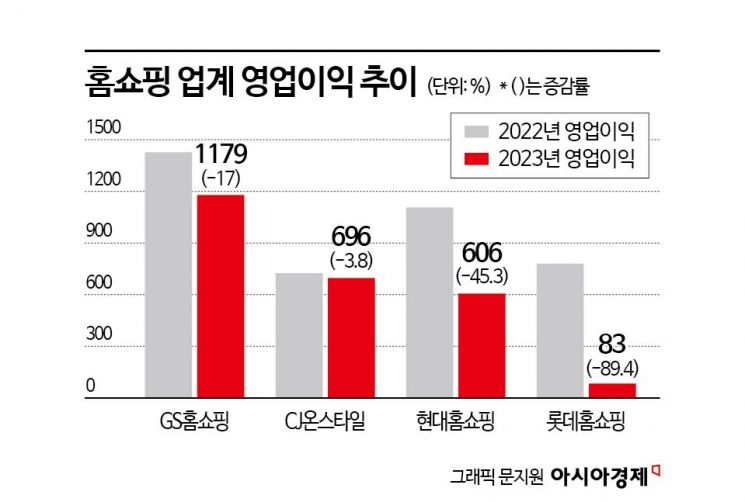
According to the distribution industry on the 8th, Lotte Home Shopping recorded an operating profit of 8.3 billion KRW, a sharp decline of 89% compared to the previous year. Although it posted an operating loss of 2 billion KRW up to the third quarter, it barely turned a profit with 10 billion KRW in the fourth quarter. Sales also shrank by 12.6%, from 1.0778 trillion KRW in 2022 to 941.6 billion KRW. The deterioration in Lotte Home Shopping’s performance was predicted early. Kim Jaegyeom, CEO of Lotte Home Shopping, mentioned in an internal notice, “Although we have maintained a steady operating profit of around 100 billion KRW annually over the past few years, in 2023, due to various adverse factors such as business suspension and economic recession, profits decreased by 90%, making it difficult to pay performance bonuses.”
Other home shopping companies that announced their results earlier also did not show good performance. GS Home Shopping posted a profit of 117.9 billion KRW, but this was a 17% drop compared to the previous year (142.6 billion KRW). According to CJ OnStyle, last year’s operating profit was 69.3 billion KRW, showing a decline of about 4.1% compared to the previous year (72.3 billion KRW). Although the decrease in profit was in the single digits, it failed to achieve an operating profit of 100 billion KRW for two consecutive years. Hyundai Home Shopping suffered a bigger hit, recording an operating profit of 60.6 billion KRW, a 45% decline compared to the previous year.
The poor performance of home shopping companies is due to a decrease in consumers purchasing clothing, electronics, and food through TV amid an economic downturn and weakened consumer sentiment. As sales declined, the financial situation of home shopping companies became more difficult. Additionally, the burden of transmission fees continued, further expanding the decline in operating profit.
Transmission fees are costs that TV home shopping companies pay to pay-TV operators. It is the largest single expense for home shopping companies. As of 2022, the proportion of transmission fees relative to sales was 66%. The home shopping industry strongly requested a reduction in fees, even resorting to the “blackout” card of stopping broadcasts, citing the burden of last year’s performance and the decline in TV viewership. However, pay-TV operators, for whom transmission fees account for 35% of total sales, did not easily accept the fee reduction demands. A tense tug-of-war is expected again this year.
To overcome the fee burden, home shopping companies have turned to a clever solution: ‘mobile live.’ The plan is to expand contact points with more consumers through mobile channels, not limited to TV. Among major companies, CJ OnStyle is showing aggressive moves in the mobile live market. CJ OnStyle has long promoted a ‘one platform strategy,’ allowing brands to use TV, mobile live, and CJ ENM’s media platforms for advertising. This year, the goal is to refine the one platform strategy to generate profits, with a particular focus on expanding mobile live. The company’s mobile live commerce sales grew by 34.5% year-on-year in the fourth quarter of last year, proving its growth potential. A CJ OnStyle official explained, “We conduct about 200 mobile live broadcasts per month, and this year we plan to expand the organization and increase the number of broadcasts. We will concentrate the advantages of video into mobile live and the YouTube channel launched last October.”

GS Home Shopping launched the ‘ShortPick’ service at the end of last year to target the mobile live market. It is short-form content that edits product sales videos broadcast on live commerce channels into about one minute. This tailored content was created for consumers who prefer short and concise content. While TV might feature 1 to 2 products per hour, ShortPick allows viewers to see more than 60 products per hour. Hyundai Home Shopping also plans to strengthen its presence in the mobile live market as part of platform diversification. On YouTube, it operates ‘Apgu Advertising Studio,’ and in the mobile live market, ‘Shora’ is the representative channel. Shora currently sells luxury goods and baby products, and plans to introduce various content concepts such as influencer group purchases.
Lotte Home Shopping is introducing an One Source Multi Channel (OSMC) strategy. The strategy is to source good products and present them according to the characteristics of each channel (TV, mobile live, etc.). The overall system and processes are currently being established. The new business ‘Belligom’ is actively entering overseas markets, aiming to become a global character. The virtual human ‘Lucy,’ which underwent a review period, conducts TV home shopping fashion broadcasts as an AI avatar. A Lotte Home Shopping official said, “As interest in virtual humans has declined, we have been considering new concepts to make Lucy a hot topic. We will continue various activities beyond just influencers.”
© The Asia Business Daily(www.asiae.co.kr). All rights reserved.
![Clutching a Stolen Dior Bag, Saying "I Hate Being Poor but Real"... The Grotesque Con of a "Human Knockoff" [Slate]](https://cwcontent.asiae.co.kr/asiaresize/183/2026021902243444107_1771435474.jpg)

















