The Social Meaning of Orange Color is 'Revolution'
Orange Chosen to Highlight Political Identity
Lee Jae-myung, Ahn Cheol-soo, and Lee Jun-seok share the common trait of being politicians associated with the color orange. When these figures began to seriously expand or solidify their political bases, they prominently adopted a bright orange color to highlight their political identities.
The orange hue psychologically conveys warmth, comfort, and a calming effect on conflicts, but conversely, it can also evoke anxiety or signify caution. Politically and socially, it is often used to symbolize 'revolution' or 'overthrowing entrenched powers.' A representative revolution associated with orange is the 'Orange Revolution' that spread in the former Soviet Union. This revolution is regarded as a democratization movement that toppled authoritarian regimes.
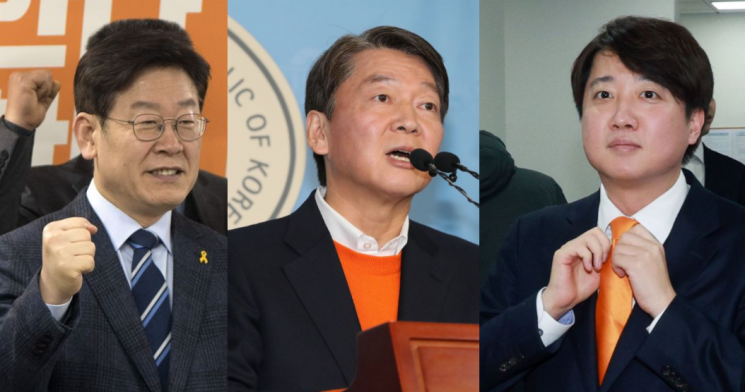 Lee Jae-myung, leader of the Democratic Party of Korea (from the left), Ahn Cheol-soo, member of the People Power Party, Lee Jun-seok, leader of the Reform New Party.
Among the three politicians, the first to choose orange was Lee Jae-myung, leader of the Democratic Party of Korea. In 2017, he adopted orange as his signature color when running in the party's presidential primary. During the primary, candidates Moon Jae-in, Ahn Hee-jung, and Choi Sung all wore blue sashes symbolizing the Democratic Party, but Lee was the only one to wear an orange shoulder sash, which attracted attention. The orange sash bore the phrases 'Reform President Lee Jae-myung' and 'Eradicate Deep-rooted Evils.'
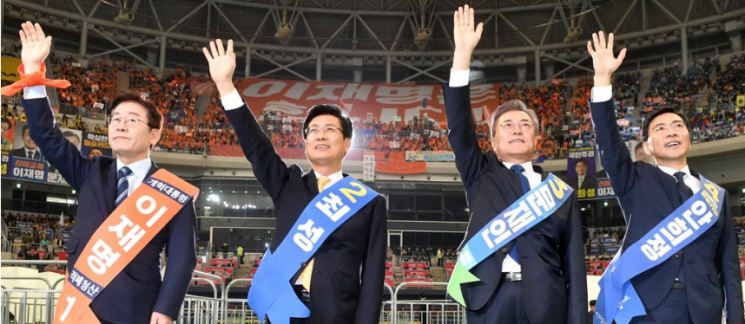 In 2017, the Democratic Party presidential candidates raised their hands and greeted during the Democratic Party's 19th presidential candidate regional voting tour for the Seoul metropolitan area, Gangwon, and Jeju, held on the 3rd at Gocheok Sky Dome in Seoul. From left to right: Lee Jae-myung, Mayor of Seongnam; Choi Sung, Mayor of Goyang; Moon Jae-in, former party leader; Ahn Hee-jung, Governor of Chungnam Province. Photo by Yonhap News Agency
Lee’s political fandom, known as the 'Finger Revolution Army' (Songahyeok), also adopted orange as their representative color. Songahyeok is a group of fervent supporters of Lee who actively engage in online activities aimed at political reform. In the past, Lee encouraged political participation through social networking services (SNS) during his confrontations with the Park Geun-hye administration, calling it the 'Finger Revolution.' His supporters joined Songahyeok to back him.
When Lee first promoted the orange color, he was serving as mayor of Seongnam, drawing attention with his unconventional governance and 'cider-like' rhetoric, establishing himself as a 'named politician.' However, he was not closely connected to the central political circles. Lee himself described himself as a 'general on the periphery.'
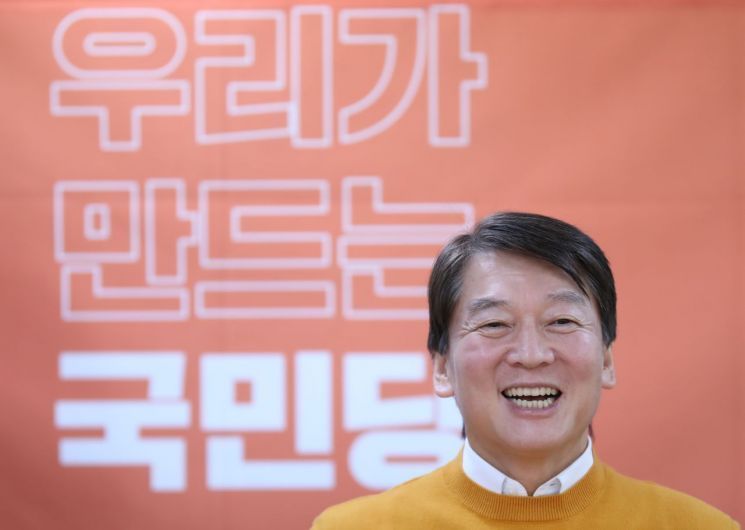
In the case of Ahn Cheol-soo, a member of the People Power Party, he used orange as the party color when founding the People Party in 2020. At that time, the Minjung Party was already using a shade of orange as their party color, and they protested that the People Party had 'stolen' their color, but Ahn insisted on orange.
The People Party chose orange to emphasize its identity as a 'centrist political party.' In his acceptance speech as party leader, Ahn said, "The newly reborn People Party will show the true face of practical centrism," and added, "With firm and resolute determination, let us together ignite an 'Orange Revolution' to change politics and transform the Republic of Korea."
However, the People Party disappeared into history when it merged into the People Power Party in April 2022. During the 20th presidential election, Yoon Seok-youl, the People Power Party candidate, and Ahn Cheol-soo, the People Party candidate, after prolonged negotiations, jointly declared a unified government and party merger. Ahn had campaigned on overcoming the two-party system with slogans like "Changing the era," but ultimately, it remained an attempt.
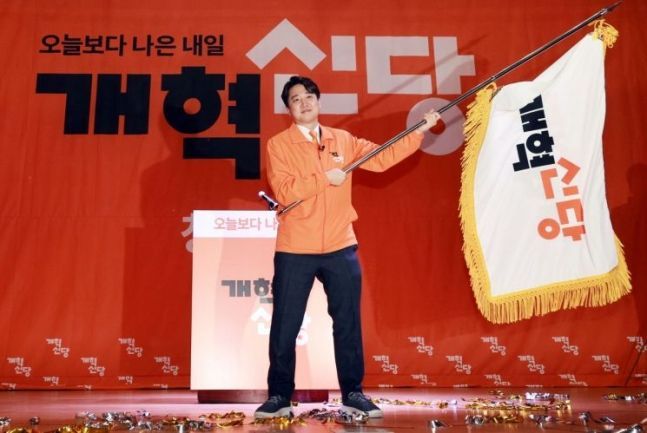 Lee Jun-seok, leader of the Reform New Party, is waving the party flag at the Reform New Party Central Party founding convention held on the afternoon of the 20th at the National Assembly Members' Office Building in Seoul. Photo by Yonhap News
Recently, Lee Jun-seok, leader of the Reform New Party, adopted orange as the party color. The Reform New Party explained their choice of orange as follows: "The party color 'Reform Orange' combines orange, symbolizing youth and boldness, with the party image of reform. It expresses the dynamic and future-oriented pursuit of a new party opening a new era." The decision on the party color was led by Yoon Hyung-geon, director of public relations and a board member of the Korean Society of Design Science.
Lee’s selection of orange appears to be a strategic move to highlight his political asset of a 'young and reformist conservative image.' There is speculation that the choice was made with a view toward merging with Yang Hyang-ja’s 'Hope of Korea.' Prior to merging with the Reform New Party, Hope of Korea also used orange as its party color. The two parties successfully merged on the 24th of last month, becoming the first third-force group to unite ahead of next year’s general election.
The 'political rivals' Lee Jun-seok and Ahn Cheol-soo even engaged in a color-related turf war. Ahn disparaged Lee’s new party by saying, "The party’s color, future, reform?these core concepts were all things I did first." In a recent BBS radio interview, Ahn explained, "By the way, the reason we (People Party) chose orange is that it symbolizes the rising sun," adding, "Another meaning is that it represents a centrist, practical party."
© The Asia Business Daily(www.asiae.co.kr). All rights reserved.
![Clutching a Stolen Dior Bag, Saying "I Hate Being Poor but Real"... The Grotesque Con of a "Human Knockoff" [Slate]](https://cwcontent.asiae.co.kr/asiaresize/183/2026021902243444107_1771435474.jpg)


















