The Statistics Korea will proceed with future projections of the foreign population in the country. Workers with irregular employment forms, such as platform workers, will also be included in future statistics.
On the 12th, Statistics Korea finalized the 'Statistics Korea Major Work Promotion Plan' containing these details.
First, to support responses to the population crisis, it will announce domestic and foreign population forecasts for policy support, including multicultural families, foreigners, and single-person households, by April, and will publish future household projections in September.
Additionally, it will establish and disclose a statistical indicator system related to the current low birthrate situation and its determinants, as well as family policies, by December. In December, it will also conduct a pilot survey targeting parents of infants and young children on private education subjects and types, usage time and costs of institutions operating half-day or longer.
Statistics on income mobility by gender and age will also be disclosed. By combining the Statistics Korea census and National Tax Service income data, it will create probabilities of income quintile mobility by gender, age, and region, and release this as panel data in December. For example, it will show cases such as Mr. A, who belonged to the 5th income quintile in his 20s, moving to the 4th quintile in his 30s.
Considering the aging labor market, this month it will separate elderly workers into 'ages 70-74' and '75 and older' instead of just '70 and older' and publish the data. To measure various employment types in employment statistics, a new category for 'dependent contractors' such as platform workers will be added, wage workers will be subdivided, and unpaid family workers will be expanded. Reflecting the aging and nuclear family trends in rural populations, it will compile farm household income including single-person households. It will also develop a housing cost index using administrative data.
The quality of life measurement indicator system for youth and the elderly will be supplemented and announced in November, and in December, it will analyze results from regional quality of life compilations using community surveys. For the time use survey, spring will be added to the existing summer, winter, and autumn surveys, with publication planned for the second half of next year.
Statistics will also be used to support businesses. From June, it will provide multifaceted analyses of 131 items such as corporate trade characteristics, industry classification, and size by linking corporate export-import trade amounts with data on financial, personnel, and other SME support information through the corporate statistics registry. To support new growth industries, it will continuously accept demands for special industrial classifications related to industrial complex residency and tax benefits, and develop new special classifications throughout the year for ▲Carbon Capture, Utilization, and Storage (CCUS) ▲Pyrolysis oil industry ▲Meetings, Incentives, Conferences, and Exhibitions (MICE) industries.
To quickly capture economic fluctuations, it will study the creation of monthly rapid composite indicators using various data such as trade statistics, electricity usage, vehicle sales, and construction project information. Reflecting the increasing share of services in private consumption, it will research expanding the current 'Retail Sales Index' to include service consumption as well as goods consumption.
To enable all citizens to easily utilize diverse statistics, it will establish an 'Economic Statistics Dashboard (tentative name)' within the National Statistical Portal (KOSIS) and build 'Citizen Life Magnifier,' a content composed of statistical data related to citizens' lives and awareness, by December. A customized chatbot service using artificial intelligence (AI) technology will also be introduced in December.
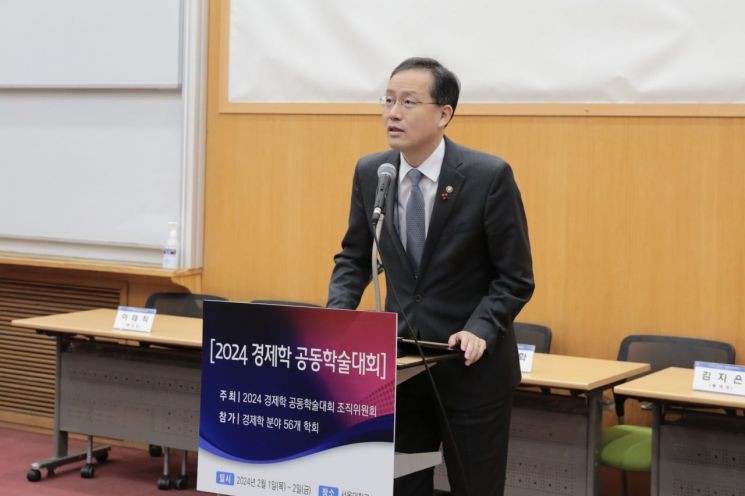
Lee Hyung-il, Commissioner of Statistics Korea, stated, "In 2024, Statistics Korea will support national policies with statistics that users can feel, assist citizens and businesses in future planning, and do its best to restore trust in national statistics. In the first half of the year, we will expand trade statistics and data to support corporate management activities, and in the second half, we will develop income mobility statistics to enhance corporate vitality and support the dynamism of our economy."
© The Asia Business Daily(www.asiae.co.kr). All rights reserved.
![Clutching a Stolen Dior Bag, Saying "I Hate Being Poor but Real"... The Grotesque Con of a "Human Knockoff" [Slate]](https://cwcontent.asiae.co.kr/asiaresize/183/2026021902243444107_1771435474.jpg)
















