Trump Side "Appeal to Protect Presidency and Constitution"
The U.S. Federal Circuit Court of Appeals has rejected former President Donald Trump's claim of immunity in the case accusing him of attempting to overturn the presidential election results. Trump immediately announced his intention to appeal. The key to the U.S. presidential election landscape this November now shifts to the Supreme Court.
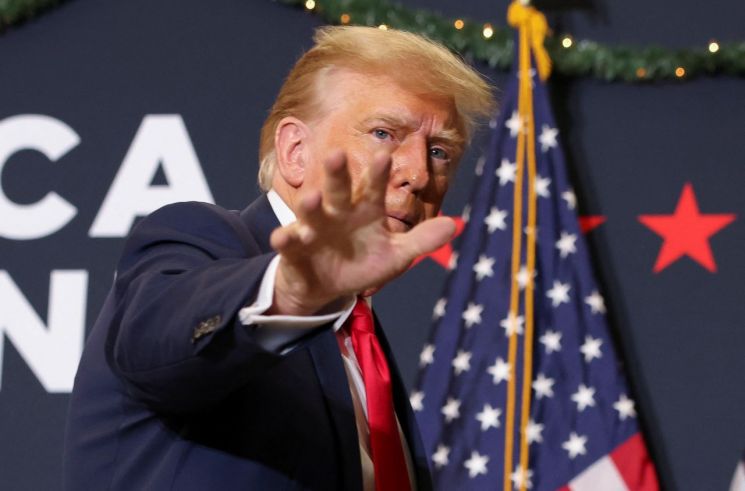
The Washington D.C. Federal Circuit Court of Appeals panel unanimously ruled on the 6th (local time) that former President Trump does not have immunity from prosecution related to criminal charges brought against him for crimes committed during his presidency aimed at overturning the 2020 election results.
The court stated, "In this criminal case, former President Trump has become 'citizen Trump' (not the incumbent president)," and "the executive immunity that might have protected him while he was president no longer shields him from prosecution."
Currently, former President Trump is accused of inciting supporters to riot at the Capitol on January 6, 2021, in an attempt to overturn his election defeat. Special Counsel Jack Smith of the U.S. Department of Justice indicted Trump on charges of attempting to overturn the election results. Trump claimed immunity, but the trial court, the Washington D.C. Federal District Court, previously rejected his claim. Trump then appealed to the Washington D.C. Federal Circuit Court of Appeals, but the higher court also did not accept his claim.
Former President Trump plans to immediately appeal the ruling in protest. He is expected to continue his previous argument that actions taken during his presidency should be protected by immunity even after leaving office and should not be subject to judicial review.
Trump campaign spokesperson Steven Cheung said, "Former President Trump respectfully rejects the court's decision and will appeal to protect the presidency and the Constitution." He added, "If immunity does not apply, future presidents will be prosecuted immediately by opposing parties upon leaving office," and argued, "Without full immunity, the U.S. president cannot properly perform his role."
If former President Trump appeals, the Supreme Court will decide on the issue of immunity.
Separately, on the 8th, the Supreme Court will review whether former President Trump is eligible to run for president. The key issue is whether the 14th Amendment, Section 3?which prohibits anyone who engaged in insurrection from holding public office?applies to Trump in relation to the January 6 Capitol riot. This follows a ruling by the Colorado Supreme Court that Trump is ineligible to run in the primary election, which Trump appealed to the Supreme Court. The Supreme Court will hold oral arguments the following day.
Bloomberg News reported, "Trump, the leading Republican presidential candidate, could become the first major party nominee to be tried for criminal conduct during a presidential campaign."
Trump, who is expected to secure the Republican presidential nomination, currently leads President Joe Biden in the polls, but his 'judicial risk' remains a significant variable. He is currently facing four criminal indictments with a total of 91 charges, including attempts to overturn the election results.
A recent survey conducted at the end of last month by Bloomberg News and Morning Consult of voters in seven battleground states (Arizona, Georgia, Michigan, Nevada, North Carolina, Pennsylvania, Wisconsin) found that 53% of respondents said they would not vote for Trump if he were convicted. Among Republican supporters, 23% also said they would not vote for Trump.
Meanwhile, President Biden strongly criticized former President Trump regarding the deadlock in Congress over border control measures and funding for Israel and Ukraine.
In an emergency speech that day, President Biden said, "After efforts in the Senate, a security budget agreement was reached, but it is difficult to pass," adding, "This is because of former President Trump. He sees that this does not politically benefit him." He continued, "I heard that former President Trump contacted Republican senators and representatives over the past 24 hours to threaten them to oppose the agreement."
© The Asia Business Daily(www.asiae.co.kr). All rights reserved.

















