Strengthening Competitiveness through Transition to Low-Carbon Production System
Annual Capacity of 2.5 Million Tons at Gwangyang Steelworks
600 Billion Won Investment, Over 160,000 Workers Participated in Construction
POSCO has broken ground on an electric arc furnace plant in Gwangyang with an annual production capacity of 2.5 million tons.
At the groundbreaking ceremony for the new electric arc furnace project held on the 6th at the Gwangyang Steelworks, a total of about 130 people attended, including Kim Hak-dong, Vice Chairman and CEO of POSCO, Park Chang-hwan, Political Deputy Governor of Jeollanam-do, Jung In-hwa, Mayor of Gwangyang, Kim Tae-gyun, Vice Chairman of the Jeollanam-do Provincial Council, Yeom Dong-il, Head of the Jeonnam Regional Headquarters of the Korea Industrial Complex Corporation, and executives and employees of the construction company.
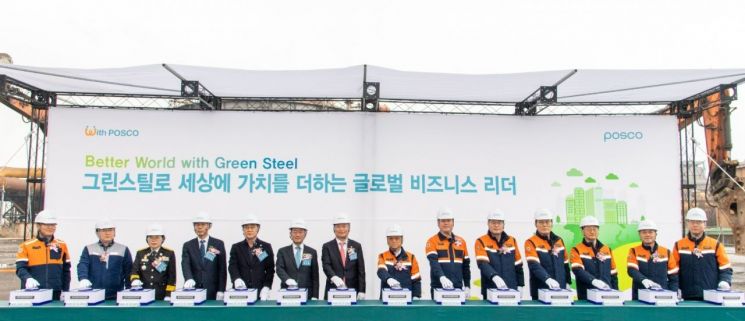 POSCO held a groundbreaking ceremony for the new electric furnace project at the Gwangyang Steelworks on the 6th.
 Photo by Gwangyang Steelworks
Amid accelerating establishment of decarbonization policies by the international community and expanding demand for low-carbon products, POSCO has decided to invest about 600 billion KRW to build a large electric arc furnace with an annual capacity of 2.5 million tons to transition to a low-carbon production system. The plant is scheduled to be completed by the end of 2025 and to begin full-scale operation from 2026.
At the event, Vice Chairman Kim Hak-dong stated, “As the global climate crisis and new trade regulations rapidly change the business environment, POSCO will swiftly establish a competitive low-carbon production system starting with this new electric arc furnace.”
POSCO plans to produce products by applying a blending technology that either directly uses molten steel produced in the electric arc furnace or mixes it with molten steel produced in the blast furnace. Additionally, it plans to improve energy efficiency by using the exhaust gas generated during electric arc furnace operation to preheat scrap metal.
By producing 2.5 million tons of molten steel annually through the electric arc furnace, POSCO expects to reduce carbon dioxide emissions by up to approximately 3.5 million tons per year compared to its blast furnace method.
In particular, while reducing carbon dioxide emissions compared to the existing blast furnace method, the application of blending technology will enable the production of high-grade steel, which was previously limited in the electric arc furnace method, allowing flexible responses to various customer requirements.
Furthermore, the construction of this new electric arc furnace will involve about 160,000 person-days of construction labor, which is expected to contribute to job creation and economic revitalization in the Gwangyang region.
Meanwhile, steel companies worldwide are focusing on developing hydrogen reduction steelmaking technology, introducing electric arc furnaces, and developing carbon reduction technologies to achieve carbon neutrality.
This process requires massive investment costs, and recently, major countries such as the EU and Japan have been implementing various policy supports for the successful decarbonization transition of the steel industry.
In particular, Japan has established the GX (Green Transformation) policy for decarbonization across industries and is actively supporting the acceleration of carbon neutrality by investing in the development and demonstration facilities of hydrogen reduction steelmaking technology and expanding tax benefits for green steel production.
POSCO is closely communicating with the government and related organizations, requesting policy protection measures such as expanding R&D and facility investment support for low-carbon technologies including hydrogen reduction steelmaking technology, and stable and economical hydrogen and power infrastructure support, to accelerate the implementation of carbon neutrality while maintaining the competitiveness of the domestic steel industry and achieving carbon neutrality goals.
Through achieving the 2050 carbon neutrality goal, POSCO plans to fulfill its social responsibility, actively respond to the low-carbon demands of the international community and stakeholders, and secure future competitiveness in the global market by continuing its best efforts.
Asia Economy Honam Reporting Headquarters, Reporter Heo Seon-sik hss79@asiae.co.kr
© The Asia Business Daily(www.asiae.co.kr). All rights reserved.

















