Last Year Sauce Export Surpassed 500 Billion KRW
Increased Demand for Sauces as Interest in Korean Cuisine Grows Due to K-Content Popularity
Samyang, Daesang Target Localization and B2B Markets
Thanks to the global impact of the 'K-Food' effect, the export value of sauces from domestic food companies, including Buldak sauce and gochujang, surpassed 500 billion KRW last year. Companies such as Samyang Foods, CJ CheilJedang, and Daesang plan to strengthen their dominance in the sauce market through product localization and targeting the B2B (business-to-business) market.
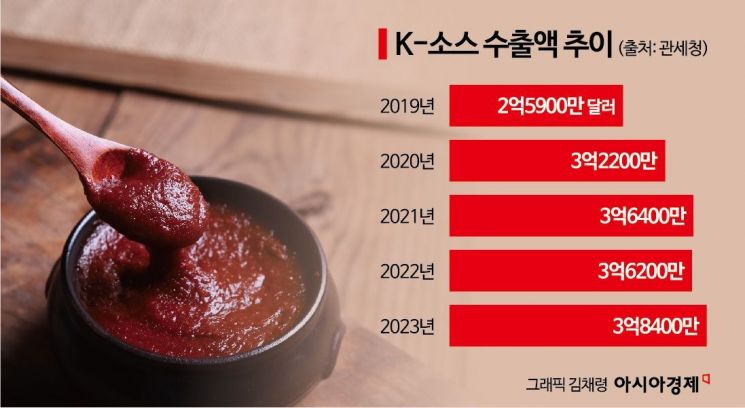
According to the Korea Customs Service on the 7th, the export value of seasoning sauces and traditional pastes reached $384 million USD (approximately 512 billion KRW) last year. This is the highest annual amount ever recorded, marking a 6.2% increase from $362 million USD the previous year. The export volume was 131,800 tons, the second highest following 132,000 tons in 2021. Compared to 66,000 tons in 2013, a decade ago, the volume has roughly doubled.
By product category, seasoning sauces such as Buldak and Bulgogi sauces accounted for the largest share at $241 million USD. Pastes like gochujang and doenjang totaled $111 million USD, while ketchup and mayonnaise reached $32 million USD.
By country, the United States led with $84 million USD, accounting for 21.8% of the total. This was followed by China ($51 million USD), Japan ($35 million USD), Russia ($31 million USD), and Vietnam ($18 million USD). Last year, exports reached a record high with 139 countries receiving shipments.
The record-high sauce export value is largely due to increased interest in Korean sauces driven by the popularity of K-content and K-Food. While most food exports in the past were consumed mainly by overseas Koreans and some Asian communities, recent growth in Korean food popularity has led to increased consumption by local consumers.
In fact, YouTube is flooded with recipes from global consumers using K-sauces such as Buldak, gochujang, and jjajang. A representative dish is 'Buldak Paengi Beoseot' (Buldak enoki mushrooms). This dish involves simmering thinly sliced enoki mushrooms in a sauce containing Buldak sauce. The seasoning sauce sometimes includes gochujang or jjajang powder. A mukbang video of jjajang Buldak Paengi Beoseot posted by YouTuber Joy, who has 4.55 million subscribers, has been viewed over 140 million times, gaining immense popularity.
As a result, domestic food companies' sauce exports have taken off. Samyang Foods exported sauces worth 11.7 billion KRW cumulatively by the third quarter last year, nearly matching the total export value of 11.9 billion KRW for the entire year of 2022. Samyang Foods exports Buldak sauce, Carbo Buldak sauce, and Nuclear Buldak sauce among their domestic products, which also include Buldak Sriracha, Buldak sauce sticks, Buldak mayo, Buldak chipotle mayo, and Giant Buldak sauce. They also sell Buldak Sriracha exclusively for the U.S. market.
Daesang's sauce export value last year was 58 billion KRW, showing a sharp growth of 77% compared to 32 billion KRW five years ago in 2018. Daesang's global food brand O'Food is targeting the global market with K-sauces based on traditional Korean pastes such as gochujang, doenjang, and soy sauce. CJ CheilJedang also reported a 10% year-on-year growth in overseas sales of K-sauces as of October last year.
A representative from Samyang Foods stated, "We plan to further strengthen our lineup by launching new products reflecting consumer needs and actively target not only the B2C (business-to-consumer) market but also the B2B market. We aim to develop Buldak sauce into a flagship product in the global hot sauce market, similar to Tabasco."
© The Asia Business Daily(www.asiae.co.kr). All rights reserved.
![Clutching a Stolen Dior Bag, Saying "I Hate Being Poor but Real"... The Grotesque Con of a "Human Knockoff" [Slate]](https://cwcontent.asiae.co.kr/asiaresize/183/2026021902243444107_1771435474.jpg)
















