Opposition: "Kukhim insists only on 'parallel system'... Negotiations were difficult"
Ruling party: "It's for Lee Jae-myung," belittling the issue
Third camp: "Both major parties abused the electoral system... They will be judged"
The Democratic Party of Korea has proposed maintaining the current semi-proportional representation electoral system and introduced the concept of a 'quasi-satellite party' for proportional representation. Within the party, this move is being evaluated as an inevitable choice to prevent the worst-case scenario of a 'parallel proportional representation system.' On the other hand, the ruling party has downplayed the decision, claiming it was made to check Lee Nak-yeon, co-chair of the New Future, a potential rival.
On the 6th, Kim Young-bae, a member of the Democratic Party of Korea, explained on MBC Radio's 'Kim Jong-bae's Focus' that the ruling party's insistence on the parallel proportional representation system had stalled negotiations on the electoral system between the ruling and opposition parties, which led the Democratic Party to propose the 'quasi-satellite party' concept, effectively no different from a satellite party. Kim, the opposition floor leader of the Political Reform Special Committee, said, "The People Power Party has effectively threatened to create satellite parties," and questioned, "Isn't it true that Han Dong-hoon, the emergency committee chairman, who claimed to pursue reform politics, has started the process of founding a satellite party called People’s Future?"
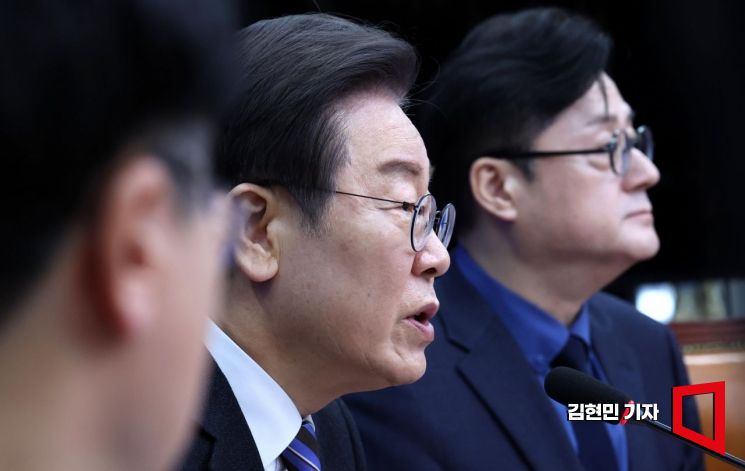 Lee Jae-myung, leader of the Democratic Party of Korea, is speaking at the Supreme Council meeting held at the National Assembly on the 2nd. Photo by Kim Hyun-min kimhyun81@
He continued, "In this situation, there was a lot of internal debate within our party about what to do," adding, "Due to the unreasonable claims of the People Power Party, the Democratic Party could not make changes, and in the end, Representative Lee Jae-myung also apologized to the public."
Jeong Seong-ho, a Democratic Party lawmaker, also evaluated the maintenance of the semi-proportional system as "an inevitable choice." On KBS Radio's 'Jeonggyeok Sisa,' he said, "When the mixed-member proportional representation system was adopted four years ago, the original intent presented by the Democratic Party has largely faded," but added, "However, the purpose of protecting minority parties and securing the representativeness and proportionality of the people's votes must be preserved. Overcoming the extreme confrontational relationship of the current two-party system is necessary for political development."
Lee Tan-hee, a Democratic Party lawmaker who advocated for maintaining the proportional representation system and even declared he would not run in the general election, expressed relief that "regression in the electoral system has been prevented." Through his Facebook the day before, he stated, "The task is to find institutional supplements to the issues raised during the social discussion process over the past two years and to enhance the completeness of political reform," emphasizing, "I will keep my promise not to run and dedicate myself to judging the Yoon Seok-yeol administration and securing our party's victory as a united front."
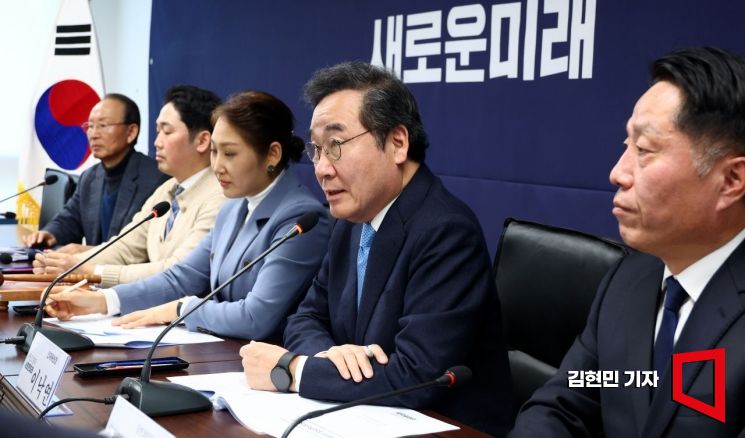 Lee Nak-yeon, Chair of the New Future Talent Recruitment Committee, is speaking at the Party Establishment Preparation Committee meeting held at the party headquarters in Yeouido, Seoul, on the 26th. Photo by Hyunmin Kim kimhyun81@
On the other hand, the People Power Party raised their voices, claiming that Democratic Party leader Lee Jae-myung pulled out the 'maintain semi-proportional representation' card to check Lee Nak-yeon, co-chair of the New Future and a potential competitor.
Cho Jung-hoon, a member of the People Power Party, pointed out on SBS Radio's 'Kim Tae-hyun's Political Show,' "If you gather all the so-called third zone progressive camps, it completely overlaps with Lee Nak-yeon’s space," adding, "Those who want to check President Yoon Seok-yeol now have no reason to vote for Lee Nak-yeon’s party." He further criticized, "(Lee Jae-myung) took the justification. It’s very cunning," and said, "It was clearly a decision made only for himself (Lee Jae-myung)."
Cho also argued that to open opportunities for political newcomers, it is right not to create satellite parties, criticizing, "It is contradictory to say you will take care of minority parties while creating satellite parties under the proportional system." Cho entered the National Assembly by receiving the 6th spot on the proportional list of the Democratic Party’s satellite party, the Democratic Citizens' Party, in the 21st general election, which introduced the 'semi-proportional representation system.'
He lamented, "When founding the Transition Korea party, we believed that if we got just 3% of the vote, we could get one seat. But both major parties created satellite and proportional parties," adding, "I don’t want to give juniors starting politics in 2024 the experience of starting with a proportional party. It’s really tough and an experience I never want to repeat."
In the third zone, there are criticisms that the two major parties are repeating the tricks from four years ago. Yang Hyang-ja, floor leader of the Reform New Party, said on SBS Radio's 'Kim Tae-hyun's Political Show,' "It’s not the People Power Party but the Trick Power Party, and the Democratic Party of Korea is the Democratic Trick Party," adding, "Watching the abuse of the electoral system, I wonder if the two major parties are really looking at the people. They will face not only the judgment of the people but also the judgment of history."
© The Asia Business Daily(www.asiae.co.kr). All rights reserved.


















