Law: "Decline in Public Trust in Judicial Fairness and Neutrality"
Over 500 Days Detention, Long-Term Criticism Considered as 'Social Punishment'
Im Jong-heon, former Deputy Director of the Court Administration Office, who was identified as the so-called ‘practical person responsible’ for the ‘judicial farm scandal’ allegations and brought to trial, was sentenced to two years in prison with a three-year probation in the first trial.
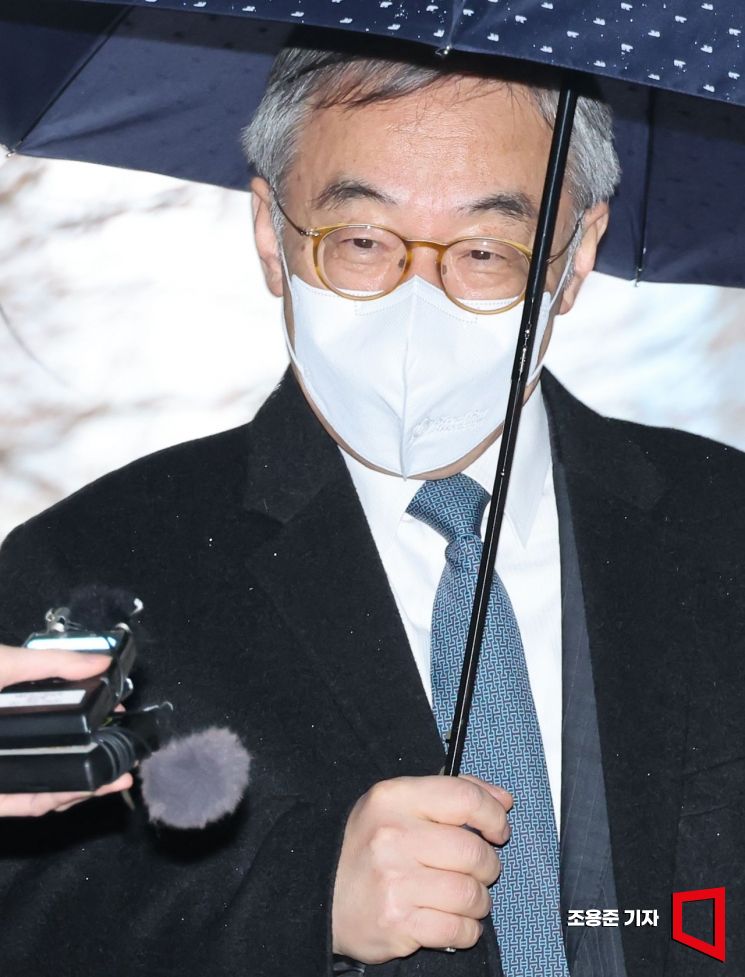 Im Jong-heon, former Deputy Chief of the Judicial Administration Office, who has been identified as a key figure in the so-called 'judicial farming' allegations, is heading to the courtroom to attend the first trial sentencing hearing held on the 5th at the Seoul Central District Court in Seocho-gu, Seoul. Photo by Jo Yong-jun jun21@
The Criminal Division 36-1 of the Seoul Central District Court (Presiding Judges Kim Hyun-soon, Jo Seung-woo, Bang Yoon-seop) on the 5th sentenced Im, who was indicted on charges including abuse of authority and obstruction of the exercise of rights, to two years in prison with a three-year probation.
The court found him guilty of ▲effectively drafting litigation documents for the Ministry of Employment and Labor in the lawsuit regarding the non-recognition of the Korean Teachers and Education Workers Union (Jeon-gyo-jo) as a legal labor union ▲formulating criminal trial strategies on behalf of former Liberty Korea Party lawmaker Hong Il-pyo ▲ordering the review of filing measures against local councilors from the Unified Progressive Party’s constituencies.
However, the court acquitted him of most charges, including those related to reviewing trial directions from the perspective of Japanese companies and receiving and approving the Ministry of Foreign Affairs’ opinion letters in advance concerning the damages claims lawsuits filed by forced labor victims.
The court pointed out, “The defendant privatized judicial administrative power and used it to support specific members of the National Assembly and the Blue House. The ideal of judicial independence from other state powers has become meaningless, and public trust in the judiciary’s fairness and political neutrality has been undermined.” Furthermore, it stated, “To prevent judges exercising judicial administrative power from following the defendant’s footsteps again, it is necessary to hold the defendant, who seriously neglected his significant duties, strictly accountable.”
The court explained the sentencing by saying, “However, the defendant was identified as a core figure in the judicial farm scandal from the early stages of the investigation and was subject to criticism for a long time. He suffered a kind of social punishment, having to spend countless time and costs to clear his name rather than being proven guilty quickly. He was detained for over 500 days in relation to this case and has paid part of the price for his mistakes.”
Im was arrested and indicted in November 2018 on four categories of charges: ▲promoting the establishment of a Supreme Court and enhancing the court’s status and interests ▲suppressing internal and external critics ▲unjust organizational protection ▲creating slush funds. Over 30 charges were applied, including abuse of authority, dereliction of duty, disclosure of official secrets, obstruction of official duties by deception, loss of state funds under the Act on the Aggravated Punishment of Specific Crimes, and fabrication and use of false official documents.
At the sentencing hearing held in November last year, the prosecution demanded seven years in prison, arguing that Im abused judicial administrative power and destroyed trust in the judicial system. In his final statement, Im denied the charges, calling them a “mirage-like illusion.”
Immediately after the sentencing, when reporters asked Im, “Please say a word about the sentencing result” and “Do you have anything to say to the court members?” he left the courthouse without responding.
© The Asia Business Daily(www.asiae.co.kr). All rights reserved.

















