National Police Agency Operates 'Integrated Reporting and Response Center'
Aiming to Simplify Reporting Procedures and Victim Relief
Over the past five years, voice phishing crimes have caused more than 600 billion KRW in annual average damages, prompting the police to activate a rapid response system. The reporting procedure has been unified under '112', and relief for damages caused by new and variant voice phishing schemes is expected to accelerate.
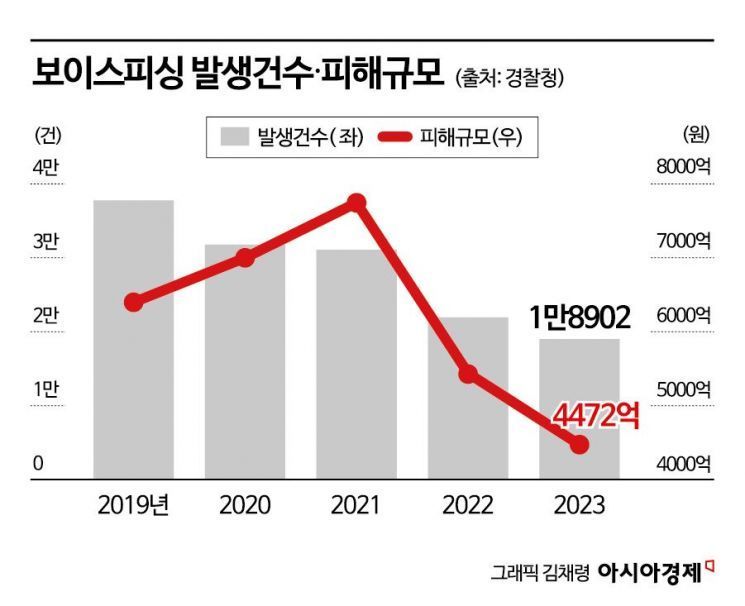
According to the National Police Agency on the 6th, the number of voice phishing incidents and the scale of damages over the past five years were recorded as follows: 37,667 cases and 639.8 billion KRW in 2019, 31,681 cases and 700 billion KRW in 2020, 30,982 cases and 774.4 billion KRW in 2021, 21,832 cases and 543.8 billion KRW in 2022, and 18,902 cases and 447.2 billion KRW in 2023. On average annually, 28,212 cases occurred, resulting in damages amounting to 621 billion KRW.
The recently prevalent voice phishing method involves sending texts pretending to be from delivery services, obituary notices, or the National Health Insurance Service, prompting victims to install malicious applications (apps). Once the app is installed, all files such as messages, contacts, and photos are extracted. Using the obtained information, voice phishing criminals impersonate employees of the police, prosecution, Financial Supervisory Service, and others, sending messages even to acquaintances of the victim.
Another representative method is investment reading room scams. They lure people by claiming principal guarantees and high returns, then entice them to invest. They deceive by creating fake Home Trading Systems (HTS), blogs, and YouTube channels. Additionally, similar deposit-taking and multi-level marketing scams promote guaranteed principal and high returns without any means of generating profits. These take the form of Ponzi schemes, where criminals pay existing investors with funds from new investors and disappear once their target amount is reached.
To respond to such voice phishing crimes, the National Police Agency has been operating an Integrated Reporting and Response Center for Telecommunication Financial Fraud since September last year. The center employs a total of 28 people, including 22 from the National Police Agency, Financial Supervisory Service, and Korea Internet & Security Agency (KISA), and 6 from the three major mobile carriers (SK Telecom, KT, LG Uplus).
Previously, crime reports were divided among the National Police Agency (112), payment suspension by the Financial Supervisory Service (1332), and malicious app blocking by KISA (118), making swift action difficult. In cases where no financial damage occurred, reports were often abandoned, resulting in a lack of accumulated information such as phone numbers used in scams, limiting systematic responses.
To improve this, on the 1st, the National Assembly passed an amendment to the 'Special Act on Prevention of Telecommunication Financial Fraud and Refund of Damages.' The amendment provides a legal basis for the Integrated Reporting and Response Center, enabling rapid payment suspension and damage relief procedures for voice phishing involving account threats and simple remittance services.
A National Police Agency official stated, “The goal of the Integrated Reporting and Response Center is to handle voice phishing crimes all at once through 112.” They added, “Starting this year, we plan to create an integrated platform for information sharing and analysis. The system will be advanced over four years, and we plan to utilize artificial intelligence (AI) and big data.”
© The Asia Business Daily(www.asiae.co.kr). All rights reserved.


















