Internet Enterprise Association Issues 'Issue Paper'
Concerns Over Market Failure Due to Government Intervention
"Premature Regulation Causes Side Effects" Claims
Domestic internet companies have expressed concerns over the government's excessive pre-regulation of the digital industry. They pointed out that the recently proposed 'Platform Fair Competition Promotion Act (tentative name)' by the Fair Trade Commission could have irreversible negative effects on the market.
The Korea Internet Corporations Association (KICA), a domestic ICT industry group with members including Naver and Kakao, stated in an issue paper on the 26th of last month that "recent laws strongly regulating the platform industry in South Korea will have a negative impact on the national economy." KICA argued that while regulations are introduced to correct market failures, premature government intervention in the market can lead to even greater failures.
The Fair Trade Commission pushed for the enactment of a platform law last December that would pre-designate 'dominant platform operators.' The purpose is to designate platform companies above a certain scale as 'dominant platforms' and scrutinize their monopolistic behaviors.
The industry has voiced strong criticism. The core argument is that it weakens the competitiveness of domestic companies and fails to consider consumer harm in an unfair environment caused by such regulations. In particular, the domestic platform industry is a new growth engine actively competing with overseas global companies, and despite the situation not allowing for premature conclusions, the regulatory authorities are proposing regulatory bills targeting domestic companies.
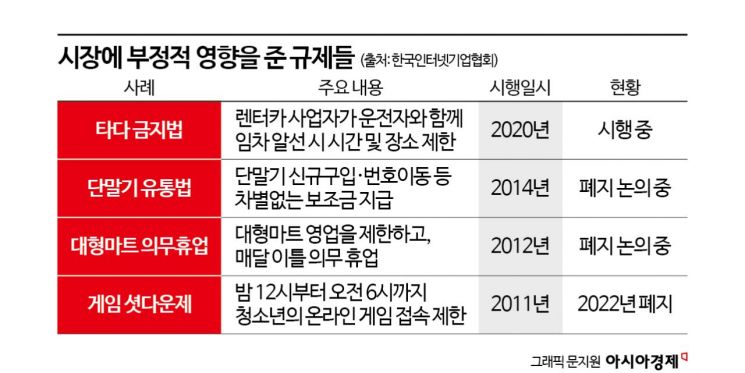
According to KICA, in the past, Korean regulatory authorities have shown a tendency to respond immediately to issues naturally arising as new industries grow. However, in this process, they have repeatedly failed to consider the realities of the domestic industrial economy or the external effects that regulations may cause, resulting in negative impacts on the market. A representative example is the Tada ban law.
The emergence of the ride-sharing service Tada in 2019 seemed to bring a significant wave of change to the mobility industry. However, the traditional taxi industry strongly opposed it, and as the conflict deepened, the National Assembly enacted the Tada ban law, which suppressed the growth of the new industry. As a result, while ride-sharing services rapidly grew worldwide, it became difficult to expect further growth in the mobility industry domestically.
The Act on the Improvement of Distribution Structure of Mobile Communication Terminals (Terminal Distribution Act) is also considered a failed regulatory policy. Originally enacted in 2014 to resolve information asymmetry between suppliers and consumers and to promote competition, the act aimed to reduce consumer confusion caused by differences between the release price and sales price by making subsidy payments by terminal sellers transparent and to curb subsidy competition among mobile carriers.
However, ten years after the implementation of the Terminal Distribution Act, KICA explained that manufacturers such as LG Electronics and Pantech have disappeared, leaving Samsung and Apple to dominate the smartphone market. As competition among carriers weakened, oligopolistic behavior has become more entrenched.
Economic growth and regulation have long shown a deep correlation. KICA emphasized, "Many studies since the mid-1990s have proven that deregulation promotes economic growth," adding, "Premature and incorrect regulations hinder market competition and desirable market competition." They cited side effects of regulation such as △loss of consumer benefits △threats to the survival of small and medium-sized businesses △loss of new growth engines △weakening of national competitiveness.

They also pointed out that premature regulatory initiatives could leave irreversible scars on the market. KICA stated, "The responsibility for wrong decisions falls not on the regulatory authorities but on the people and companies," and stressed the need for a lesson learned from past mistakes to avoid repeating the same errors.
© The Asia Business Daily(www.asiae.co.kr). All rights reserved.



















