The railway network construction project in Incheon is gaining momentum. Various railway projects are underway to connect the entire country within a half-day living zone, enable commuting within 30 minutes in the metropolitan area, and enhance the competitiveness of Incheon International Airport.
According to Incheon City on the 5th, the Incheon-origin KTX, which was the first pledge project of the 6th local government administration, is scheduled to open next year, nine years after the plan was announced (the 3rd National Railway Network Construction Plan in 2016). The Incheon-origin KTX project started construction in December 2020 and utilizes the existing Suin Line, departing from Songdo Station, passing through Chojeok Station in Ansan, Gyeonggi Province, and Eocheon Station in Hwaseong, connecting to the Gyeongbu High-Speed Railway.
Once the Incheon-origin KTX, which will establish a half-day living zone for 6.5 million residents in Incheon and southwestern Gyeonggi Province, opens, travel from Incheon to Busan will take 2 hours and 30 minutes, and the target time is 2 hours and 10 minutes.
The double-track electrified railway from Wolgot to Pangyo on the Gyeonggang Line connecting Incheon and Gangneung, and the Metropolitan Area Express Railway (GTX) Line B are also being promoted with the goal of opening in 2028 and 2030, respectively. Currently, the only public transportation directly connecting Incheon to Pangyo is an intercity bus from Incheon Terminal via Yatap to Moran Station. Once the Wolgot-Pangyo double-track railway opens, travel distance and time from Incheon to Pangyo are expected to be drastically reduced. Additionally, travel from Incheon to Gangneung will be possible within 110 minutes.
The GTX-B line, scheduled to begin construction this year, will be built over an 82.7 km section from Songdo International City in Incheon, passing through Bucheon and Seoul, to Maseok in Namyangju. It will be possible to reach Seoul Station from Songdo International City within 30 minutes, significantly improving Songdo’s accessibility to Seoul.
The GTX-D Y-shaped line and GTX-E line departing from Incheon were also finalized last month. The GTX-D line is a Y-shaped route where the 'Incheon Airport?Cheongna?Gajeong' and 'Gimpo?Geomdan?Gyeyang' lines meet at Daejang?Samsung and operate in two branches toward Hanam City and Yeoju City. The GTX-E line, like the GTX-D line, connects 'Incheon Airport?Cheongna?Gajeong?Daejang' to Namyangju.
Once the GTX-D line opens, commuting from Geomdan and Cheongna to Samsung will take about 30 minutes, and from Yeongjong to Samsung about 40 minutes, reducing travel time by approximately 1 hour and 30 minutes compared to now. Incheon City plans to work closely with the Ministry of Land, Infrastructure and Transport to ensure the inclusion of these projects in the 5th National Railway Network Construction Plan scheduled for the second half of next year and to pass the preliminary feasibility study within the current government’s term.
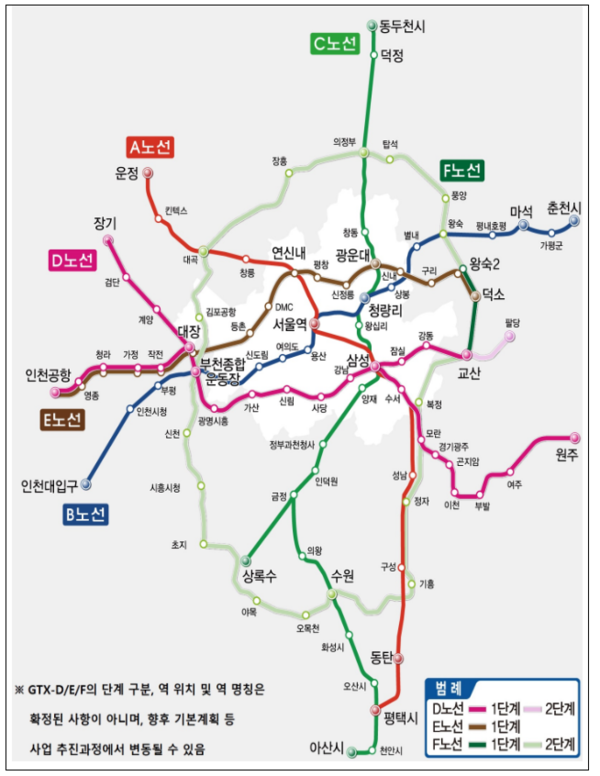 Metropolitan Area Express Railway (GTX) Line Plan [Provided by Ministry of Land, Infrastructure and Transport]
Expansion projects for the metropolitan railway network, which will reduce travel times between major metropolitan hubs to within 30 minutes, are also underway.
The extension of Incheon Line 2 to Goyang will reduce travel time between Geomdan and Goyang KINTEX to the 10-minute range (from 97 minutes to 13 minutes), and the extension of Seoul Line 2 to Cheongna will shorten travel times to Hongdae (from 60 minutes to 32 minutes) and Sindorim (from 70 minutes to 31 minutes) to within 30 minutes. Additionally, the Second Gyeongin Line, which will dramatically improve Seoul accessibility by establishing a metropolitan railway network in southwestern Incheon, is expected to be promoted through private investment projects and other methods.
Furthermore, Incheon City plans to ensure that the construction of the Second Airport Railroad is included in the 5th National Railway Network Construction Plan in the first half of this year. Once the Second Airport Railroad, connecting Sungui Station and the Airport Railroad, opens, the high-speed rail service area will expand to Incheon International Airport, enabling rapid connections between the airport and major cities nationwide.
An official from Incheon City stated, "Incheon, where Korea’s first railway, the Gyeongin Line, passed 124 years ago, is once again seeing various railway projects connecting different parts of the country. In particular, the expansion of GTX lines connecting the east-west axis of the metropolitan area is not only essential for Incheon citizens but also crucial for Incheon International Airport to become one of the world’s top three airports and to strengthen its competitiveness."
© The Asia Business Daily(www.asiae.co.kr). All rights reserved.

















