280,000 Units Sold in Just Five Days
Commuters in Gyeonggi and Incheon Unable to Use
Citizens Confused by Out-of-Sync Administration
The Climate Companion Card, an unlimited public transportation pass within Seoul city, is gaining popularity, but users are expressing frustration due to administrative mismatches with other metropolitan local governments such as Gyeonggi and Incheon.
Since its launch on the 27th of last month, the Climate Companion Card, an unlimited public transportation pass priced in the 60,000 KRW range per month, has sold a cumulative total of 288,000 cards as of the 31st. Daily users reached 175,000 as of the 31st of last month. However, many users have complained about inconvenience because the card cannot be used in most areas of the Seoul metropolitan area adjacent to Seoul, such as Gyeonggi Province and Incheon.
Currently, the Climate Companion Card can only be used in Gimpo and Gunpo cities in Gyeonggi Province and some areas of Incheon, excluding Seoul. Considering that more than half of Seoul citizens commute or attend school in other regions, the usage range is quite limited. According to Statistics Korea, about 5.37 million people aged 12 and over commute or attend school from Seoul to Incheon or Gyeonggi Province.
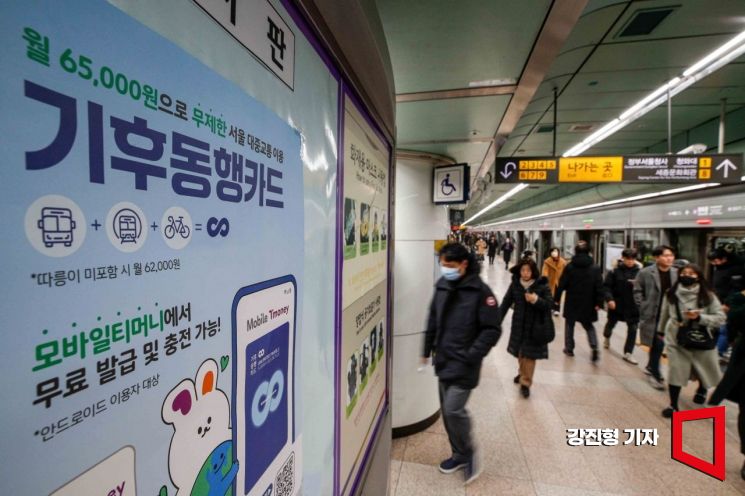 On the 26th, one day before the pilot operation of the 'Climate Companion Card,' the unlimited public transportation pass introduced nationwide for the first time by Seoul City, promotional flyers for the Climate Companion Card were posted at Gwanghwamun Station on Subway Line 5 in Jongno-gu, Seoul. Photo by Jinhyung Kang aymsdream@
Citizens Awaiting 'Companion' Transportation in the Metropolitan Area
This issue was anticipated from the moment Seoul announced the implementation of the Climate Companion Card. On September 11 last year, Seoul announced, “The Climate Companion Card will be piloted from January 27 to the end of June 2024, and officially introduced from July.” Immediately after Seoul’s announcement, Gyeonggi Province strongly opposed it.
At that time, Gyeonggi Province issued a press release expressing regret, stating, “Transportation issues in the metropolitan area, which shares a single living zone, require joint efforts among the three local governments rather than unilateral announcements by a specific local government.” Subsequently, Gyeonggi Province announced the introduction of ‘The Gyeonggi Pass,’ a program that partially refunds transportation costs, declaring an alternative path.
An official from Incheon City also stated, “Expanding the usage area of the Climate Companion Card in the future is a matter that the three local governments need to derive through research,” adding, “There are many issues to be resolved immediately, such as financial problems and transfer losses, so sudden expansion seems difficult.”
In response, Seoul City stated that it intends to find solutions through consultations with other local governments. A Seoul transportation policy official explained, “Before announcing the Climate Companion Card, we held meetings with Gyeonggi Province, Incheon, Korail, Airport Railroad, and metropolitan transportation operators,” adding, “During the pilot operation period, transportation research institutes from Seoul, Incheon, and Gyeonggi Province are jointly conducting research projects.”
Administrative Mismatches Cause Inconvenience and Confusion for Citizens
While local governments are out of sync, the inconvenience and confusion have been passed on to citizens. The card’s usage is limited not only on subways but also on buses, restricted to Seoul-licensed city buses and village buses, making it unusable on Gyeonggi and Incheon metropolitan buses and late-night buses.
Park Eun-kyung (54), who commutes from Seonbawi Station on Line 4 to City Hall Station, said, “I purchased the Climate Companion Card as soon as it was released, but it was not usable at Seonbawi Station, so I had to use the transportation card I had been using,” expressing regret over the 65,000 KRW already paid.
Jo Ye-rin (29), who commutes from Bucheon in Gyeonggi Province to Mok-dong in Seoul, said, “The card was created to promote public transportation in response to serious environmental issues, but the fact that it can only be used in Seoul is a major limitation,” adding, “Applying it to as many areas as possible is the only way to truly practice ‘Climate Companion.’”
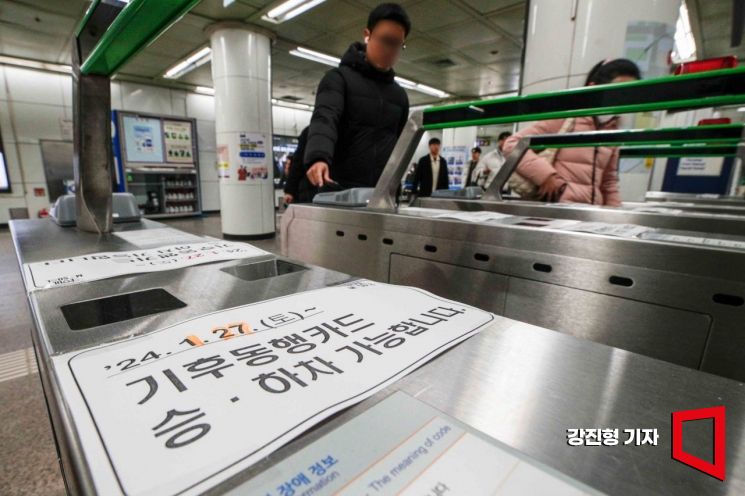 On the 26th, one day before the pilot operation of the 'Climate Companion Card,' the unlimited public transportation pass introduced nationwide for the first time by Seoul City, an information notice about the Climate Companion Card was posted at Gwanghwamun Station on Subway Line 5 in Jongno-gu, Seoul. Photo by Jinhyung Kang aymsdream@
Bus drivers have also been confused by citizens’ complaints. Kim (58), a driver of a metropolitan bus operating between Gyeonggi Province and Seoul, expressed bewilderment at the increased inquiries since the Climate Companion Card was introduced. Kim said, “Passengers boarding in Seoul often think it is a Seoul-licensed bus and ask why the Climate Companion Card cannot be used,” adding, “It is often difficult to identify which card is being used at a glance when using mobile payments.”
Confusion has also arisen on the Shinbundang Line, where the Climate Companion Card is not accepted. At Gangnam Station, which serves about 70,000 passengers daily, the station office has seen a sharp increase in inquiries from passengers since the card was first implemented on weekends.
"The Intent is Good, but Cooperation Among the Three Local Governments is Essential"
Experts agree with the purpose of the Climate Companion Card but point out clear limitations. Yoon Tae-beom, a professor in the Department of Public Administration at Korea National Open University, said, “The intent of the service is definitely positive, but close cooperation with other local governments is necessary for the service to be properly utilized.”
There are also predictions that cooperation among the three local governments will not be easy. Lee Seung-jae, a professor in the Department of Transportation Engineering at the University of Seoul’s College of Urban Science, said, “It will help activate public transportation,” but added, “From the perspective of public transportation operators, if financial burdens continue, they may need to receive government financial support again, and there are many complex issues, so the negotiations themselves will not be easy.”
© The Asia Business Daily(www.asiae.co.kr). All rights reserved.


















