Yangcheon-type Home Repair, Income Criteria Relaxed and Study Room Added for High Satisfaction Existing Home Repairs, Expanded by 57% Compared to Last Year
Applications Accepted from February 1 to 29, Final Selection of Recipients in March, Construction Scheduled from April
Housing Environment Improvement Project Unified under Housing Division, One-Stop Customized Services Based on User Needs Provided
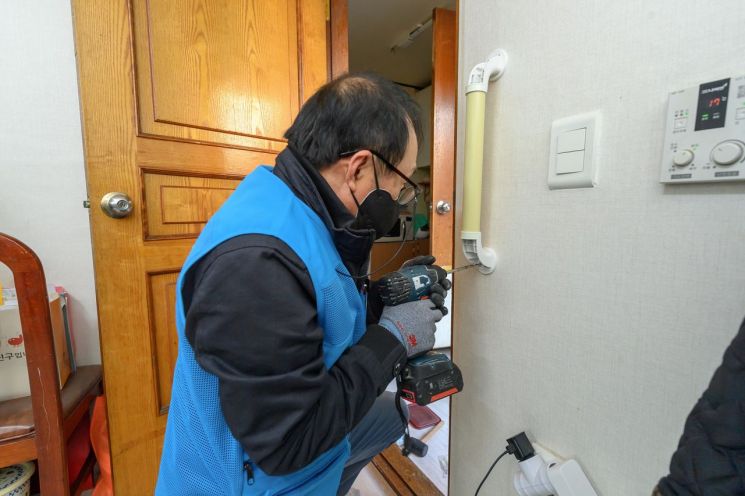
Yangcheon-gu (Mayor Lee Gi-jae) announced that it has significantly expanded the number of beneficiaries from 70 to 110 by newly implementing the Yangcheon-type Hope Home Repair, which relaxes income criteria compared to the existing Seoul Hope Home Repair and creates study rooms for children and adolescents to support stable housing for low-income vulnerable groups.
Yangcheon-type Hope Home Repair, Relaxed Income Criteria Compared to Existing Seoul Home Repair Project
First, by newly introducing the ‘Hope Home Repair Project’ to create a pleasant living environment for low-income vulnerable households living in poor housing conditions, the project will be promoted in two types: Seoul-type and Yangcheon-type. In particular, the ‘Yangcheon-type Home Repair,’ which corresponds to the housing (住) part of the district’s representative welfare project for warm clothing, food, and shelter, is a specialized project unique to Yangcheon-gu that expands the already verified Seoul-type home repair, reflecting the residents’ desire to live in clean homes.
Applicants must all reside in ‘housing’ as defined by the Housing Act, and the support amount is the same within a limit of 2.5 million KRW for a total of 18 types of work including wallpapering, flooring, sinks, and flood alarms. However, there is some difference in income criteria.
A district official explained, “We relaxed the income criteria (households owning or renting with 70% or less of the median income) compared to Seoul’s criteria (households owning or renting with 60% or less of the median income) to broadly support those who had difficulty receiving services due to income limits in the existing Seoul home repair project. This year, we secured our own budget to support 24 more households.”
Expansion of Study Room Creation Project for Low-Income Children and Adolescents, True to Yangcheon’s Reputation as an Educational District
Second, the project to create study rooms to guarantee the learning rights of children and adolescents who lack study spaces or desks at home due to economic difficulties will be expanded. The support target is 35 households with school-age children (born between 2006 and 2017) with incomes at or below 100% of the median income. Priority is given to multi-child, single-parent, and multicultural families, and repair costs for seven types of work such as LED lighting, blackout curtains, desks, and chairs will be supported up to 2 million KRW per household.
This reflects Yangcheon-gu’s commitment as an educational city to build hope together so that children do not give up their dreams for economic reasons, going beyond simple home repair improvements.
Among the households creating study rooms, 25 are jointly promoted with Korea Airports Corporation and were selected last year for the Dreaming Study Room contest aimed at improving welfare for residents in noise control areas.
Establishment of a Control Tower for Housing Welfare Projects to Provide Customized Services According to User Characteristics
The housing environment improvement project is part of housing welfare projects that help stabilize housing for low-income vulnerable groups. Depending on the target, it is divided into six categories: Hope Home Repair, Safe Home Repair, Senior Safe Housing Environment Improvement, Housing Convenience Support for Low-Income Disabled, Green Building Creation Support, and LED Lighting Replacement Support for Vulnerable Groups. These have been dispersed and promoted by five departments, but from now on, they will be integrated and managed by the Housing Division to provide one-stop customized services to residents. Additionally, a database consolidating various scattered data will be established to enable accurate demand identification and be utilized for practical housing welfare policies.
Furthermore, to improve the efficiency of staff work and provide better services to residents, the district produced the ‘2024 Customized Housing Welfare Project Guidebook’ for the first time this year, covering all 24 housing welfare projects implemented by the district, and distributed it to each department, community centers, and welfare institutions.
In the future, to allow residents to easily check various and complex housing welfare services at a glance, a ‘Yangcheon-gu Housing Welfare Portal’ menu will be newly established on the district office website to enhance accessibility and convenience.
The application period for the Hope Home Repair project is until the 29th of this month. Households wishing to participate can visit their local community service center to submit application documents. The district plans to select the final households in March and begin full-scale repairs as early as April.
Lee Gi-jae, Mayor of Yangcheon-gu, stated, “Through the integrated management of this housing environment improvement project, we will resolve residents’ inconveniences and accurately identify personalized housing welfare needs to ensure they lead to practical benefits. We hope that through the Yangcheon-type Hope Home Repair project, introduced for the first time this year, more vulnerable residents can enjoy a pleasant and safe living environment.”
© The Asia Business Daily(www.asiae.co.kr). All rights reserved.

















