"Inflation in February to March could rise again to around 3%." (Choi Sang-mok, Deputy Prime Minister for Economy and Minister of Strategy and Finance)
Despite inflation falling to the 2% range last month, concerns about high inflation persist. This is because oil prices are fluctuating amid signs that the Middle East conflict may prolong following the first U.S. military casualty. Gasoline prices, which had been declining, have turned upward for the first time in 17 weeks.
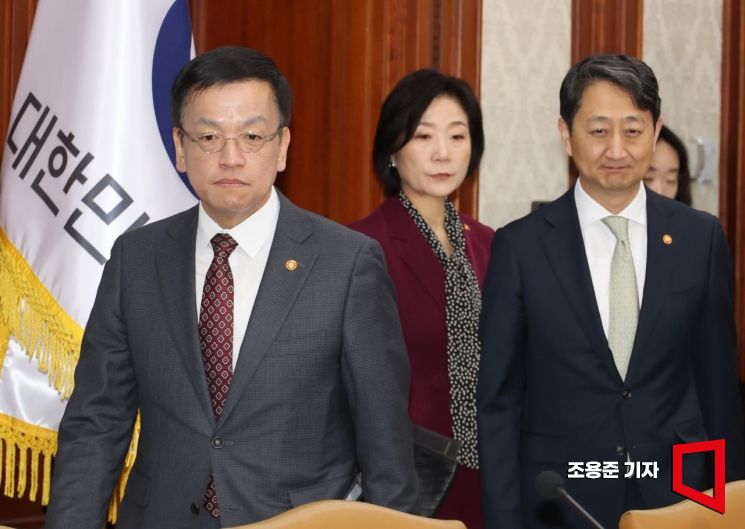 Choi Sang-mok, Deputy Prime Minister for Economic Affairs and Minister of Economy and Finance, is attending the Emergency Economic Ministers' Meeting and Price-Related Ministers' Meeting held at the Government Seoul Office in Jongno-gu, Seoul on the 2nd. Photo by Jo Yong-jun jun21@
According to Opinet, the oil price information service of the Korea National Oil Corporation, the average gasoline retail price in the fifth week of January rose by 15.3 KRW from the previous week to 1,579 KRW per liter. The average diesel retail price also increased by 12.9 KRW from the previous week to 1,485.9 KRW per liter, rising alongside gasoline.
Domestic diesel and gasoline prices had been declining for 16 consecutive weeks since the second week of October last year but turned upward for the first time in 17 weeks. This is due to rising international oil prices amid concerns over the prolonged Middle East conflict and upward revisions of global economic growth forecasts. The Dubai crude oil price, a benchmark for imported crude, rose by 2.1 USD to 82 USD per barrel compared to the previous week.
The Middle East conflict reached a critical point with the first U.S. military casualty. On the 27th of last month, three U.S. soldiers were killed in a drone attack by Iranian militias, and the U.S. government announced retaliatory strikes. On the 2nd, attacks were carried out against the Iranian Revolutionary Guard Corps (IRGC) Quds Force and related militias, and on the 3rd, against Yemen's Houthi rebels.
Experts believe that while the likelihood of the Middle East conflict escalating into a full-scale war is low, the possibility of a prolonged conflict is high. On the 2nd, the Korea Institute for International Economic Policy (KIEP) stated in its report "Spread of the Middle East Conflict and Its Impact on Our Economy" that "considering the U.S. presidential election and Iran's economic recession, the possibility of a full-scale war expansion is low," and "the most likely scenario is prolonged regional tension."
In this case, KIEP advised that South Korea should secure as much shipping capacity as possible, especially for products requiring special vessel types such as automobiles, to prepare for worsening logistics disruptions, and consider support to reduce logistics costs for exporters. It also recommended securing strategic oil reserves and preparing to release them timely to cope with energy supply disruptions and inflation driven by raw materials.
Ahead of the Lunar New Year, the government invested 59 billion KRW to support prices of fruits such as apples and pears to firmly maintain price stability, and decided to inject an additional 10 billion KRW one week before the holiday. Deputy Prime Minister Choi and Minister of Agriculture, Food and Rural Affairs Song Mi-ryeong personally visited sites to inspect prices and took measures to control inflation.
© The Asia Business Daily(www.asiae.co.kr). All rights reserved.
![Clutching a Stolen Dior Bag, Saying "I Hate Being Poor but Real"... The Grotesque Con of a "Human Knockoff" [Slate]](https://cwcontent.asiae.co.kr/asiaresize/183/2026021902243444107_1771435474.jpg)
















